
Hunting, No Arrows Needed
HistoryWe were watching one little critter chase another through the woods. And it made us laugh because, you know how you go for a run “for your health”? Turns out that, in its oldest version, that was basically a hunting strategy.
It’s a thing we now call persistence hunting. It’s not “run like lightning”. It’s running for ages and doing it smart, until the animal that was flexing on you at first starts to fade and just can’t keep it up.
What is persistence hunting?
It’s a method documented in some hunter-gatherer groups (it’s been described in southern Africa, for example) where the key is keep going, and keep going. You track the animal, you make it stay at a steady trot, you don’t let it properly rest… and in the end its body overheats or it simply runs out of fuel and can’t sustain the effort. It’s not a movie-style chase. It’s more like, “I’ll beat you with patience.”
How could humans beat an antelope by running?
Because humans are kind of weird: we’ve got loads of sweat glands and not much hair (well, some of us more than others, hey), so we cool the engine by sweating, like a little portable radiator. A lot of four-legged animals, on the other hand, rely heavily on panting to cool down, and that gets tricky when they have to keep running nonstop. Plus our bodies come with some seriously endurance-friendly parts (springy tendons, a steady stride, a balanced head) that fit what’s called endurance running. And yep, this wasn’t the only way to hunt: there were traps, spears, teamwork, and a thousand other tricks. Still, this idea explains why running “for no prize” can make us feel so… human.
Magikito moral: today there’s no need to tire out any animal, obviously. But you can totally keep the vibe. If something scares you because it’s huge, maybe you don’t beat it with a wild sprint. Maybe you beat it with a steady rhythm, honest sweat, and a “I’ll go a little longer, quitting can wait.”

Swoon Sofa
HistoryThere was a time when fainting was almost trendy, and it even came with its own official piece of furniture.
In the 19th century (especially in bourgeois circles across Europe and North America), the “delicate” type became a whole vibe. Between the heat and the stress of keeping up perfect manners, people would just keel over, and someone would whisk them onto a fainting couch (basically a proper sofa made for collapsing in style).

The wild part is that what we’d now treat as a warning sign, in some drawing-room stories turned into a full-on “dramatic moment” with a routine: fan, smelling salts, a pretty couch, and back to the social theatre.
Magikito moral: history reminds us that sometimes people romanticise what is actually your body waving a little red flag. Today, if something steals your breath or makes the floor disappear, don’t turn it into a scene. Turn it into care.
The lifesaver little line
HistoryThere was a time when some ships “floated” by being stuffed to the gills with cargo, like: if it doesn’t sink today, we’ll deal with tomorrow tomorrow.
In the 19th century, sea trade was booming and nobody fancied losing money. So yeah, overloading ships was pretty common. They sat so low in the water that any cheeky wave could slip onboard and turn a routine trip into a tragedy.
What’s the Plimsoll line?
It’s that mark on the ship’s side that looks like a little line with a circle, like a “level tattoo”. It tells you how deep the hull can safely sit in the water depending on the load. If the water hits that mark, take out the last box you squeezed in, unless you want the whole thing to go full Titanic before you can say “iceberg”.
Who was Samuel Plimsoll, and why did he get into this mess?
Samuel Plimsoll was a British politician who got obsessed with sailors’ conditions and with the so called “coffin ships”, vessels that went to sea basically half-doomed. After a lot of public pressure, the UK passed laws in the 1870s that made maritime safety a real thing. That load mark, known as the Plimsoll line, became a standard to stop the worst abuses.
The beautiful part is it’s almost a poem. A tiny painted line saving lives. No drama, no fancy stuff. Just a clear mark and done.
Magikito moral: sometimes self-care is your own Plimsoll line. Today, where’s your “Plimsoll stripe” so you don’t overload yourself just to look good?
From powder to tube
HistoryWalking through the forest, we spotted a little toothpaste tube snagged on a bramble, like the woods were saying: “hey, humans, your civilization is falling out of your pocket”.
And that got us pulling the thread. Since when did humans decide to scrub their teeth with weird creams?
What is toothpaste really?
It’s any mix made to clean your teeth. Before today’s classic creamy paste existed, people used powder. In Ancient Egypt they were already using powders with abrasive ingredients, think crushed minerals, that scraped the grime off. Sometimes they added fragrant stuff too, so yeah, this “mystery” is not new at all.
In the 19th century, some brands sold dentifrice in jars, kind of a cream you’d scoop with your finger or your brush. But that was anything but hygienic. You shared the jar and without even noticing, you threw a microbe party with free entry for everyone.
Who came up with the toothpaste tube idea?
The idea of putting it in a tube shows up at the end of the 19th century, when people started copying the format of paint tubes. The dentist Washington Sheffield (from the US) is often named as the big popularizer of toothpaste in a tube. And honestly, the tube was a practical hygiene upgrade: cap it, store it, no fingers in there, and no inviting half the town into your jar.
Magikito moral: when something goes from a shared jar to a capped tube, it’s not just design. It’s learning to take better care of yourself. Today, what part of your life needs a more hygienic format, with clear boundaries and a cap firmly in place?
The Mold That Came in Peace
HistoryHere’s a quiet little conquest that actually went well: a mold that, by accident, served a legendary clapback to a whole bunch of bacteria.
In 1928, Alexander Fleming was grinding away with bacteria, proper serious lab vibes, and when he came back after a few days he found one of his petri dishes had been hijacked by mold. The normal move would be, “ew, nope,” and toss it instantly. But Uncle Fleming gave it that curious owl stare and spotted something weird: around the mold there was a zone where the bacteria just would not grow. Like the mold had drawn a border.
What is penicillin and why was it such a big deal?
Penicillin is an antibiotic, a substance that can slow down or kill bacteria. And that changed everything, because back then infections that seem silly today could turn deadly. Penicillin kicked open a massive door to modern medicine: safer surgeries, treatments for infections, and a huge drop in deaths caused by bacteria.
Why would a mold make something that kills bacteria?
Because life is pure competition, my friend. Picture a countertop full of crumbs: if you want that snack for yourself, you’re not exactly thrilled when the ants show up. So the mold, in its microscopic turf war, releases substances so bacteria don’t steal its territory. It’s not altruism, it’s survival. And for us, it was a total win.
Magikito moral: sometimes what looks like a mess-up is actually a clue. Today, if something comes out “imperfect,” take a second look. Maybe it’s not trash, maybe it’s a good mold showing you a shortcut.
The origin of the name Tardigrada
HistoryWe Magikitos have this old magnifying glass that looks like it came straight out of a scientist grandpa’s drawer. Today we pulled it out and curiosity hit us: who was the first person to see a tardigrade and give it such a seriously cool name?

Back in the 18th century, when there was no internet and folks still lost their minds staring at little puddles through microscopes, the German zoologist Johann August Ephraim Goeze described one of these micro-critters and called it something like “little water bear” (in German, kleiner Wasserbär). And honestly, if you look at it with enough zoom and a bit of affection, it really does have that chubby tiny teddy-bear vibe.
Why are they called tardigrades?
A few years after Uncle August spotted them, in 1777, the Italian Lazzaro Spallanzani gave them the name that stuck: Tardigrada. It comes from Latin and means something like “slow step”. Basically, “check out how this little buddy walks”. It’s not a show-off name, but it nails the description.
The sweet part is that, since those first microscope peeks, the tardigrade went from being a random puddle oddity to a full-on resilience icon. Not because it’s out there blasting things and conquering the world, but because of pure practical biology. Living in moss means living through stretches of “yep” and “nope”, so they evolved to handle the climate’s vibe checks.
Magikito moral: history moves forward thanks to people who crouch down, look at the tiny stuff, and name it. Today, if something in your life is moving at a “slow step”, maybe it’s not a delay. Maybe it’s something powerful simmering low and slow.
The wardrobe disk
HistoryIn Taramundi we’ve got a super-ancient oak that thinks it’s the father of “cloud storage”. Well, today we told it there was once a hard drive that was, quite literally, a wardrobe.
In 1956, IBM presented the IBM 350part of the RAMAC system. It was one of the first commercial hard drives. And when we say “hard drive”, we don’t mean a tiny little chip the size of a fingernail, we mean a massive contraption with a bunch of platters spinning inside, like an industrial washing machine with a library complex.
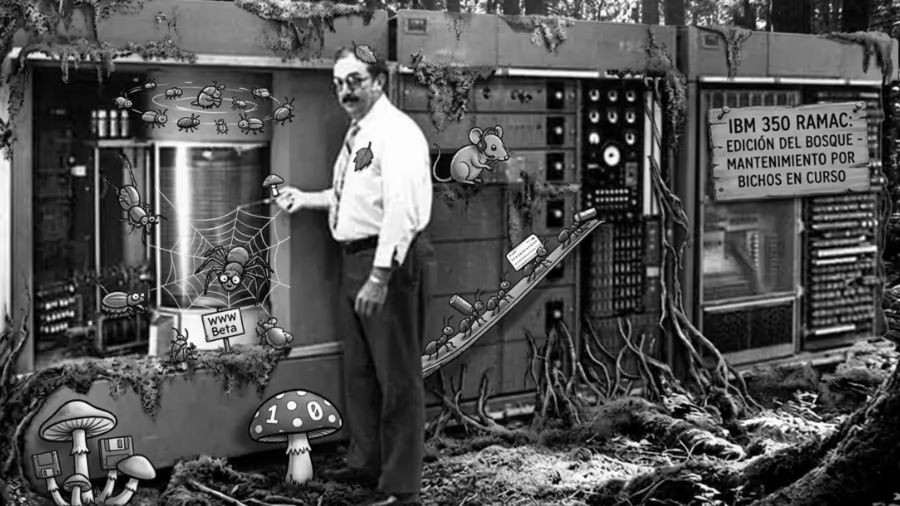
What was the first hard drive in history like?
Picture a metal tower on wheels (loud, heavy)storing data the way you’d store index cards in a gigantic office. Its capacity was around 5 megabytes. Yes. Five.
What are 5 megabytes, in plain language?
It’s like having a little tupper that only holds five olives… and you trying to squeeze a paella in there. With 5 MB today you can’t even fit a handful of decent phone photos, let alone a video. But back then it was a wildly useful leap: being able to access data “randomly” on disk without rewinding tapes was the kind of jump that changes how work gets organized.
The funny part is that we come from there: from having to choose what you kept because not everything would fit. Now almost everything fits… and precisely because of that, choosing is harder.
Magikito moral: before, the machine set the limit. Now you do. It’s dizzying, yes, but it’s also freedom: you get to decide what deserves to stay on your “drive” and what can go off to graze in the fields of forgetfulness.
Galileo’s Puff
HistoryToday, while taking a little stroll past the rubbish heap, we found an old glass tube, the kind that practically whispers “I’ve seen real winters, kid.” And of course we had to follow the thread: who was the first person to say, “Okay, you can’t see cold… but I’m going to measure it with a gizmo”?
Before today’s fancy thermometers, there was an invention that was more of a heat tattletale: the thermoscope. People often mention Galileo as part of that early spark, with devices that reacted to temperature changes… just without any serious numbers yet.
What was a thermoscope, and why wasn’t it a real thermometer?
Imagine a straw in a glass: if the air inside warms up, it pushes, and the level shifts. The thermoscope did something like that, it only told you “up or down,” and that’s it. There wasn’t a fixed scale, and on top of that air and atmospheric pressure barged into the conversation like that know-it-all uncle, so it wasn’t always easy to compare readings from one day or place to another.
When did the thermometer arrive with actual numbers?
The real glow-up came when people started using a liquid inside a sealed tube with a scale. In 1714, Daniel Gabriel Fahrenheit built mercury thermometers (very consistent for their time) and proposed his scale. A bit later, in 1742, Anders Celsius introduced the centigrade scale.
The lovely part is that the thermometer didn’t just measure weather, it changed medicine, cooking, and even the eternal “Am I sick, or am I being dramatic?” Suddenly the body stopped being “I feel kinda weird” and became a little number you could argue with.
Magikito moral: when you give numbers to something invisible, you gain clarity.
The pioneering feather duster
HistorySo, guess what, we found a proper old-school feather duster behind a wardrobe, looking like it’s seen more dust than the lightbulb in a barn.
And of course, we started tugging on the little historical thread. Who was the first person to say, “Okay, I’m not going to defeat dust… but I am going to comb it off the shelf with the elegance of a samurai”?

In the United States, Susan Hibbard, from Syracuse (New York), is often mentioned as one of the first people to patent a feather duster in the late 19th century.
The story goes that she made do with feathers (turkey, goose, whatever she could get) to clean without sending as much dust flying as the usual cloths, and that she ended up registering the invention so half the neighborhood wouldn’t copy it.
Why is a feather duster cooler than a dust cloth?
Because feathers are like a super soft brush with thousands of fine little filaments. On delicate surfaces (figurines, books, tiny corners), a duster slips in without dragging so much, and without scratching. Now, if you go in swinging like a barbarian, the dust will rebel and clap back with extra attitude. You’ve got to use it gently, like, “Come here, little dust bunny, I’m bringing you some kindness.”
Magikita moral: humanity didn’t invent the feather duster to win the war on dust, it invented it to negotiate living together. At home, like in life, sometimes victory is simply moving more softly than the problem.

The man who had hiccups for decades
HistoryThere’s a story that, when we read it in the library, had us raising an eyebrow: a man in the United States had hiccups for years and years without a break.
His name was Charles Osborne and he lived in Iowa. According to the most cited records (and the “record” people repeated for decades), it started in 1922 after an accident at work, and it didn’t stop until 1990. They talk about over 60 years of hiccups. Absolutely wild.
Imagine trying to sleep, talk, or eat a stew with a “hic!” crashing into every sentence.
How does a hiccup become history?
Because we’re not talking about the usual hiccups from gulping down a soda too fast. Here we’re in persistent hiccups territory (more than 48 hours) and intractable hiccups (more than a month). At that point it’s not a joke. There’s usually something behind it that’s worth checking out, calmly and properly.
What can cause persistent hiccups?
Think of hiccups like a sensitive alarm that goes off when part of the circuit gets irritated: the diaphragm, the stomach, the larynx, or the nerves that control them. It can show up with reflux, irritation, neurological issues, side effects from certain meds, or things that inflame or bother the chest area. Sometimes there isn’t one clear cause, but when it lasts that long, doctors dig in.
The most Magikito thing about this story is how it turns something “silly” into a daily endurance test.
Magikito moral: when a symptom gets heavy, it’s not a sign to tough it out like a hero. It’s a sign to listen to yourself and ask for help without feeling weird about it. When your body talks, it’s got something to say.
The cloned banana and the grumpy fungus: why the banana lives on edge
HistoryMost of the bananas you eat (the usual supermarket ones) are the Cavendish variety. And here’s the wild part: they’re almost clones. Meaning instead of a nice mixed-up genetic cocktail, they’re basically living photocopies of each other.
So if a disease learns the trick with one, it can pull the same move on almost all of them.
What does it mean for a crop to be a clone?
Picture a neighborhood where every key is identical. If someone gets a copy, they can open every door. With clones it’s similar: they share super similar defenses, so once a pathogen learns how to get in, it barges in hard.
And here comes the real villain of the story: a soil fungus called Fusarium, responsible for the famous Panama disease (Fusarium wilt). In the 20th century, one strain wiped out the Gros Michel variety, the queen of export bananas back then. The industry switched to Cavendish because it held up better, and everyone clapped.
But nature doesn’t sit still: new strains have shown up, like TR4, able to infect Cavendish too in lots of places. And the worst part is this fungus can hang out in the soil for years, waiting like someone who left a revenge tupper in the fridge.
Magikito moral: when everything in your life is “the same cloned routine” it feels comfy, but it also makes you fragile. Add a little variety to your days, even if it’s just a different fruit or one tiny decision. That’s where your resilience likes to hide.
Concheros: when clam scraps turned into a history archive
HistoryThere are piles of shells that have nothing to do with a romantic beach stroll. They’re the after-dinner leftovers of whole centuries. Along many coastlines, especially in the north of the Iberian Peninsula, you can find concheros. These are huge accumulations of shells and shellfish remains left behind by human communities for generations. Basically, it’s like the sea has been keeping a historic shell bin that spills all the tea about how our ancestors lived together.
So what exactly is a conchero?
Picture an ancient dump, but packed with seriously good info. A conchero is not just a heap of empty shells. It is a deposit where clams, mussels, fish bones, fireplace ash, and stone tools all get mixed together. It is the real record of what people ate in prehistory, how they cooked it, and whether they threw big feasts or went through lean times. It is like reading a family diary through whatever they tossed out after dinner.
Why are archaeologists so obsessed with shells?
The cool thing about shells is that they are tough as rocks and they preserve beautifully for thousands of years. Thanks to them, scientists can figure out which species people collected, whether the sea was colder or warmer than it is now, and even if they were overharvesting small ones. On top of that, these heaps often hide traces of everyday life: fire spots for warmth and tools that show the sea was not only food. It was their calendar and their whole way of living.
In places like Cantabria, Asturias, or the Tagus Valley in Portugal, these concheros are proper libraries made of mud and mother-of-pearl. They show us those humans were absolute pros at making the most of whatever the sea gifted them with each moon. In the end, those mountains of leftovers prove that history was not only written by kings. It was also written by regular people sitting by the waves, shucking oysters and peeling limpets.
Magikito moral: what you call “leftovers” today is sometimes what tells the truest story of who you really are. Take care of the small and everyday stuff, because in the end life gets remembered for the same little shells day after day, not for one-off fireworks.
When toes started crying inside pointy little prisons
HistoryOn our little expeditions around the world map we’ve noticed something hilarious: roe deer walk around with their toes fanned out, zero fear of nature… and you humans go around with your foot shoved into a plastic funnel. Like, who decided the toe had to get narrow exactly where your feet are the widest?
This mess started ages ago. In the beginning, shoes were more “protection” than “sculpture”. But in Europe, fashion soon started doing its thing: “posh feet, even if it hurts”.
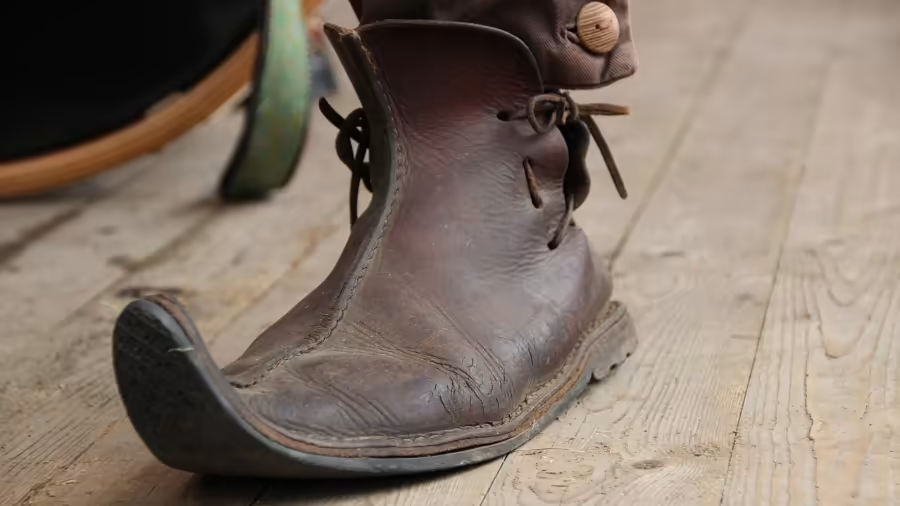
In the Middle Ages they wore shoes with a suuuper long point (the poulaines), so over the top that sometimes people tied them to their leg so they wouldn’t trip. Later it evolved into less extreme points, but the idea stuck, supposedly to elongate the foot.
What’s the deal with a narrow toe box?
The toe box is the front part of the shoe, where your toes live like roommates in a shared flat. If the toe box is narrow, your toes can’t spread out like a fan, so they bunch up, overlap, and the poor big toe ends up climbing over the others however it can.
Why did squishing toes become fashionable?
Because fashion sometimes works like an instagram filter: it doesn’t care if you can breathe, it only cares if it looks chachi piruli. From the 19th century on, with industrialization, sizes got standardized and lots of lasts (the shoe mold) were designed with that sharp shape that looks so elegant in a photo.
Result: aesthetics win, but toes lose all their living space.
These days there’s way more conversation about wide lasts, “barefoot” shoes, and the whole vibe of letting your feet do their thing. But the cultural hangover is still here: loads of people buy shoes the way you buy someone else’s opinion.
Magikita moral: not everything “traditional” is a good idea. If something in your life keeps the tips of your soul all squished up, maybe you don’t need to endure it anymore… maybe you need a new last: more space, less posing… more doing you.
When honey was medicine, money, and a map: the hive in the ancient world
HistoryThis morning we found a little jar of honey abandoned behind a can of chickpeas and it got us thinking, since when has humanity been like “this stuff works for everything” while licking its fingers?
The answer is, for thousands of years we’ve treated honey like liquid gold. In Ancient Egypt it was so valuable that jars found in pharaohs’ tombs were still edible after three thousand years. It was not a fancy whim, it was basically the only food that didn’t know what an expiration date was.
Why is honey a time-proof bunker?
Picture honey as a private party where sugar is a super strict club bouncer that won’t let bacteria in. Microbes need free water to live, but in honey the sugar is so concentrated it “kidnaps” every tiny bit of moisture. It’s so dry at a microscopic level that the little nasties dehydrate before they can move in. On top of that, bees add a magical enzyme that produces tiny doses of hydrogen peroxide, building a chemical shield that keeps the jar free of unwanted guests for centuries.
How was this treasure used through history?
Before pharmacies were a thing, honey was the queen of the medicine kit. Roman warriors carried it on campaign to cover their wounds after battles, because they knew it helped keep flesh from going bad. But there’s more, in ancient Greece it was the star ingredient of mead, considered the first alcoholic drink in history, and they called it the nectar of immortality. It sweetened life, sealed deals, and kept wounds from turning nasty, all in the same little pot you could hang from your belt.
And while we see it as a posh ingredient or a grandma remedy, bees are out there working on something way more epic. To make that one kilo of honey, hopping flower to flower, they’ve had to visit millions of blossoms and fly a distance equal to going around the world three times. Without that endless trip, forests would go quiet and fruit trees would stand empty. They’re the engineers holding up the market of life, and they don’t even ask for a medal.
Magikito moral: sometimes what’s most valuable isn’t what shines the hardest on social media, it’s what lasts and holds you up when life turns bitter. Today, think about what “honey” you’ve got tucked away, that steady habit, that person who always shows up, or that little detail that never expires. Take care of it like the Egyptians did, because that’s what truly feeds the soul.
Back when Wi‑Fi was called ALOHAnet
HistoryBefore you ever said “my Wi‑Fi is sooo slow” with full-on drama, there were people in Hawaii in the 70s trying something pretty wild. They wanted to send data by radio between islands, sharing the same air without it turning into a noisy mess of interference. That idea was called ALOHAnet and it was the rebellious great-great-great-grandparent of your internet connection.
How did ALOHAnet work?
The concept was super simple and also ridiculously groundbreaking. Instead of keeping perfect order, each station sent its data packets as soon as they were ready. No asking permission, no checking if someone else was talking. It was pure survival mode: “I’ll send it, and if it lands, cool.” If two stations talked at the same time, the data crashed into each other and nobody understood a thing. Out in the air-forest, that’s called a collision.
What happened when the data crashed?
Picture a town square where everyone has a megaphone. If two people shout at once, the listener gets blasted with unbearable noise. In ALOHAnet, when a crash happened, the stations simply waited a bit and tried their luck again. The genius part was they invented some basic “manners”: listen before you talk, and if you collide, don’t retry instantly. Wait a moment so you don’t smash into the other one again.
This trial-and-error vibe is what inspired the Ethernet in your computer and the Wi‑Fi in your phone. It wasn’t perfect from day one, it’s the result of learning how to handle chaos. Today your router does thousands of these little negotiations per second so you can watch cat videos without your neighbor’s waves killing the vibe. It’s not magic, it’s traffic school for radio waves.
Magikito moral: the internet wasn’t born perfect, it was born from constantly trying to connect even when things fail. So if today you bump into a problem, or even your own head, don’t think it’s the end. Life is like ALOHA: throw your attempt out there. If there’s a collision, breathe deep, wait a tiny bit, and try again with extra heart.
When coffee started an “ideas club”
HistoryPicture London in the 17th century: cold that bites your ears off, streets full of mud, and you tucked into a cozy little spot where, for a penny, you got a cup of coffee and conversation for days. That’s when the coffeehouses were born, and people nicknamed them “penny universities”.
Merchants, writers, sailors, wig-wearing scientists, and anyone itching to debate absolutely everything would all end up in the same room without throwing punches (well, sometimes, but politely). Coffee got famous as the “sober” option, a break from the morning beer lots of people used to drink. And with clearer heads and brains switched on, ideas started flowing like spring honey.
So what exactly was a coffeehouse?
Honestly, it was a mash-up of a bar, a make-do library, and a “let’s fix the world” office. You paid a little, sat down, read pamphlets and newspapers, and started chatting with strangers like you’d been mates forever. Think of it as a group chat, but with wooden chairs, fireplace smoke, and a tiny coffee keeping your eyes wide open.
Did important stuff really come out of them?
Yep, some coffeehouses became hubs for business and science. People say Lloyd’s, which would later turn into the famous marine insurance market, started in a café (Lloyd’s Coffee House) where merchants insured ships and swapped info. In others, folks dissected experiments, world news, and theories with the same passion you use to argue whether coffee is best black or with milk.
Magikito moral: one cup won’t fix the planet, but it can start a conversation that changes your day. Today, find your own little “coffeehouse”, a moment with someone who makes you think and laugh, even if it’s in the kitchen with the coffee maker huffing away.
When cheese was a “bank”: Parmigiano and the power of aging your patience
HistoryIn Italy there was a time when an aged cheese was worth so much you could use it as collateral for a loan. Yep, like a gold bar, only smellier and way tastier.
We’re talking about Parmigiano Reggiano, that hard cheese you grate and it falls like edible snow. The cool part is it’s not “pricey just because”. Its value comes from the fact it takes a loooong time to make, and for months (or years) it just sits there, still as a statue, getting deeper and deeper in flavor like someone quietly saving up.
So what does it mean when a cheese is “aged”?
Aged basically means “matured over time”. Picture a fresh cheese as a soft little sponge full of water. As it ages, that sponge slowly loses moisture, and inside it starts transforming: proteins and fats break down into smaller bits that smell stronger and taste more intense. It’s like a person who learns a little every day, they get tougher, sharper, and more themselves.
In Emilia-Romagna, where Parmigiano is born, some banks have accepted super-aged wheels as guarantees because they’re stable goods: if they’re well made and stored properly, they don’t spoil quickly. Actually, they get better. And since a big wheel can weigh thirty-something kilos, the idea of “storing wealth” in cheese is literally storing a very serious cheese in a vault.
Magikito moral: some things in life become valuable thanks to craft plus waiting. Today, if you’re planting something (a habit, a job, a relationship), maybe you don’t need more rush, you need more aging.
The day the modern lighter sparked to life
HistoryPicture living in a world where starting a fire was a whole workout of “stone, tinder, and patience”… and then, out of nowhere, a pocket little gadget shows up that goes click and boom… “let there be a tiny flame”.
That’s basically what went down in the 20th century with the “modern” spark lighter, closely tied to the discovery and everyday use of ferrocerium (also called “artificial flint”), an alloy that throws off crazy sparks when you scrape it.
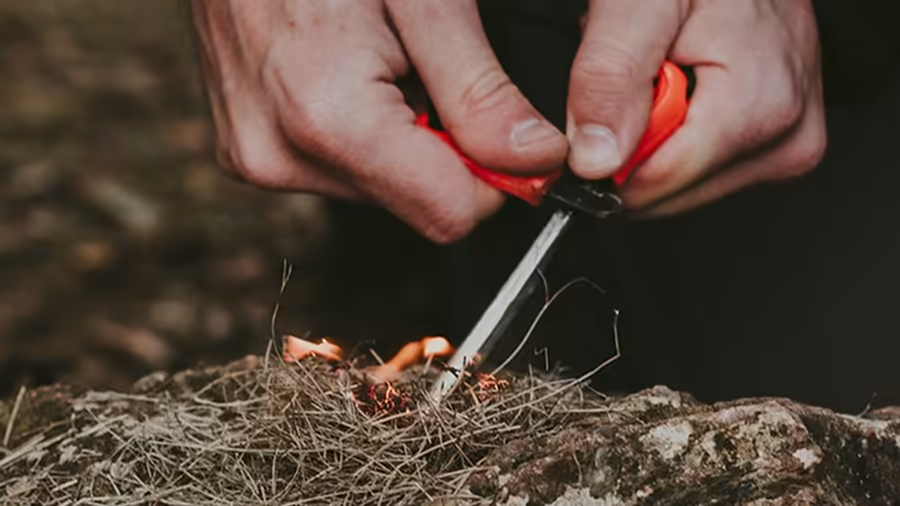
Sure, there were wick-and-gasoline lighters before, but ferrocerium made fire feel instant. More like “I’m cold and I’m in a hurry”.
What is ferrocerium and why does it spark so easily?
Think of ferrocerium like a little bar stuffed with tiny “party-hungry shavings”. When you scrape it with a steel wheel, you rip off microscopic particles. Those bits hit the air, oxidize super fast, and glow red-hot. It’s like grating cheese and getting a little snowfall, except this “snow” comes out on fire, which is a whole different vibe.
Why did this change everyday life?
Because fire stopped being this mysterious thing and became a tool. Cooking, warming up, lighting a candle, firing up a gas stove… everything became more “right at your fingertips”. And yeah, it also taught us something: if something that powerful fits in your pocket, responsibility fits in there too, you just have to remember to bring it along.
Magikito moral: some inventions hand you pocket-sized power. Today, when you feel that “click” of impulse (a snappy reply, a silly purchase, a burst of anger), ask yourself if you’re using your spark to light something useful… or to start a fire you can’t undo.
When the forest made it into the dictionary
HistoryThere was a moment when people went, “this thing we feel out in nature… we need a name for it”.
The idea of shinrin-yoku wasn’t born in some mystical cabin, but in Japan in the 80s, when forest institutions started encouraging going to the woods as a wellbeing practice.
The lovely part is that making it official cracked a door open. Once you name it, you can study it, recommend it, and chat about it without people looking at you like you’re having a deep conversation with an oak tree.
Over time the research kept growing, and now the term is cruising around half the planet. And it makes us chuckle because it’s like watching a little brownie signing paperwork: nature, which has always been out there handing out good vibes, suddenly has an official stamp.
Taramundian moral: sometimes you don’t need to invent anything new. You just need to recognise what was already doing you good, and give yourself permission to repeat it, guilt-free.
The day love turned into a card
HistorySo where did the whole idea of “celebrating love” with messages and hearts everywhere even come from?
The story of this date is like a patchwork blanket made from reused scraps: it’s a bit of everything stitched together. Back in Ancient Rome, they weren’t doing the same heart-eyes routine we do today. They were way more over-the-top and celebrated Lupercalia in mid-February. A pretty wild party about fertility and purification. Think drums and rituals, nothing to do with the calm, mandatory “surprise rose” waiting for you when you get home.
So what’s the origin of Valentine’s Day?
As centuries went by, the Roman Lupercalia got toned down. Christianity slipped Saint Valentine into the mix to cover up the old rites, but the full glow-up happened in the Middle Ages. That’s when poets like Geoffrey Chaucer started saying that around mid-February, the birds got together to find a little sweetheart. Suddenly, it became fashionable for nobles to write each other letters and promises with maximum drama.
Then in the 18th and 19th centuries, with printing presses sparking like crazy, paper cards became the thing and everyone started saying sweet stuff with melodramatic rhymes. In the end, what began as a Roman rite of pure survival turned into a “I’ll tell you in pretty handwriting and extra honey” tradition.
Magikito moral: love has spent centuries wearing different costumes. You stick with what actually works in the forest: say it every day, prove it now, and don’t wait for the calendar to give you permission to hand out affection.
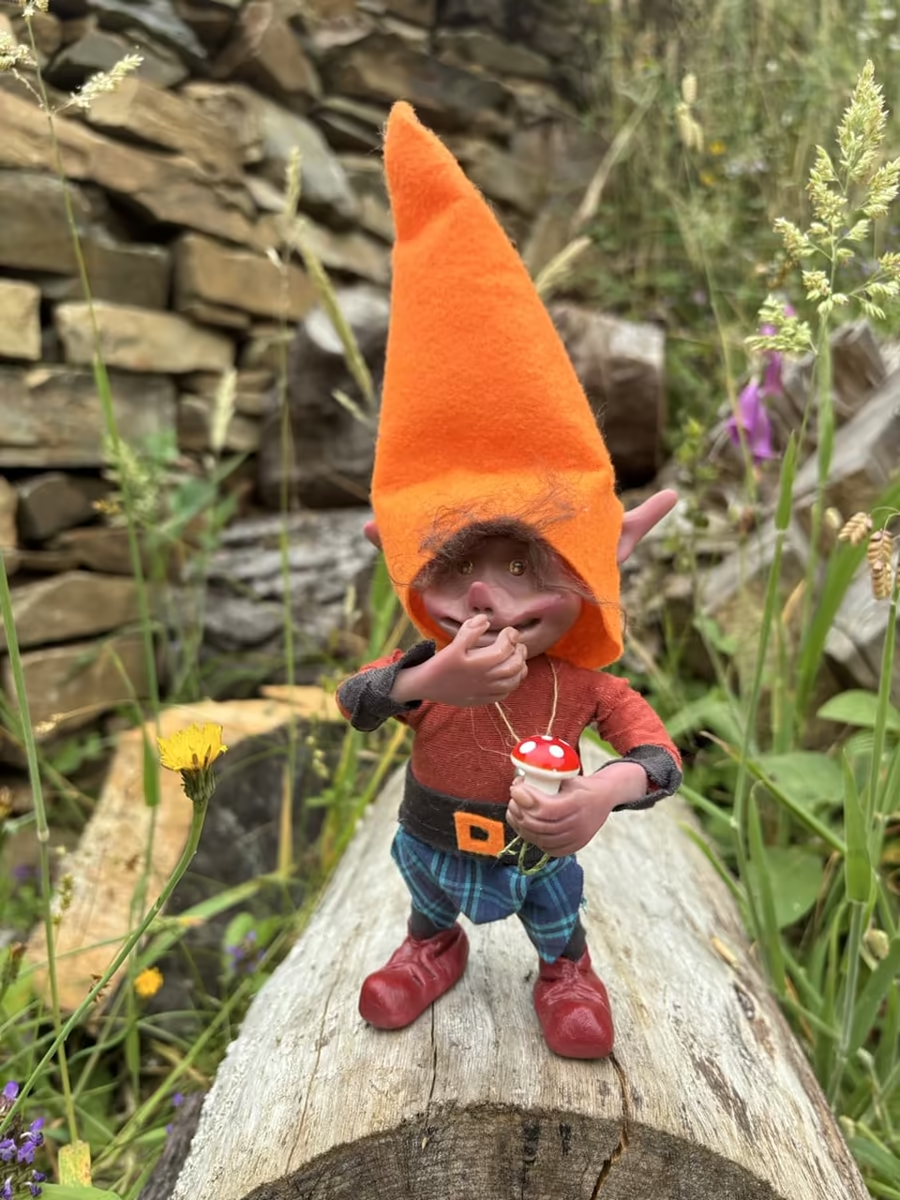
The 13 That Got Side-Eyed Out of Habit
HistoryA bad rap, fueled by repetition (and a bit of copy-paste)
The whole thing with 13 didn’t come from one single incident. It’s more like a cultural cocktail that thickened over the centuries. In Europe, for example, the number 12 was seen as “complete” (12 months, 12 zodiac signs, 12 hours on a classic clock), and 13 was that one joker who shows up late for the photo and messes up the frame.
Over time, that little numerical itch got mixed with stories and habits about bad luck. And like rumors in the forest, when the same detail keeps popping up in tales, songs, and chats, it starts to feel like a law of nature. In the 20th century, pop culture and headlines did the rest, “Friday the 13th” became the quick label for “a creepy vibes day”.
The fun part is that in other places, the suspicious number is a different one (like 4 in parts of East Asia). That snitches on the truth: the fear is not inside the number, it’s in the story we tell about it.
Forest moral: if an idea scares you, ask yourself who told it to you first… and whether it’s worth repeating it, or giving it a brand new meaning. Us? On the 13th of every month we celebrate Good Vibes Day and we go absolutely wild on garlic mushrooms.
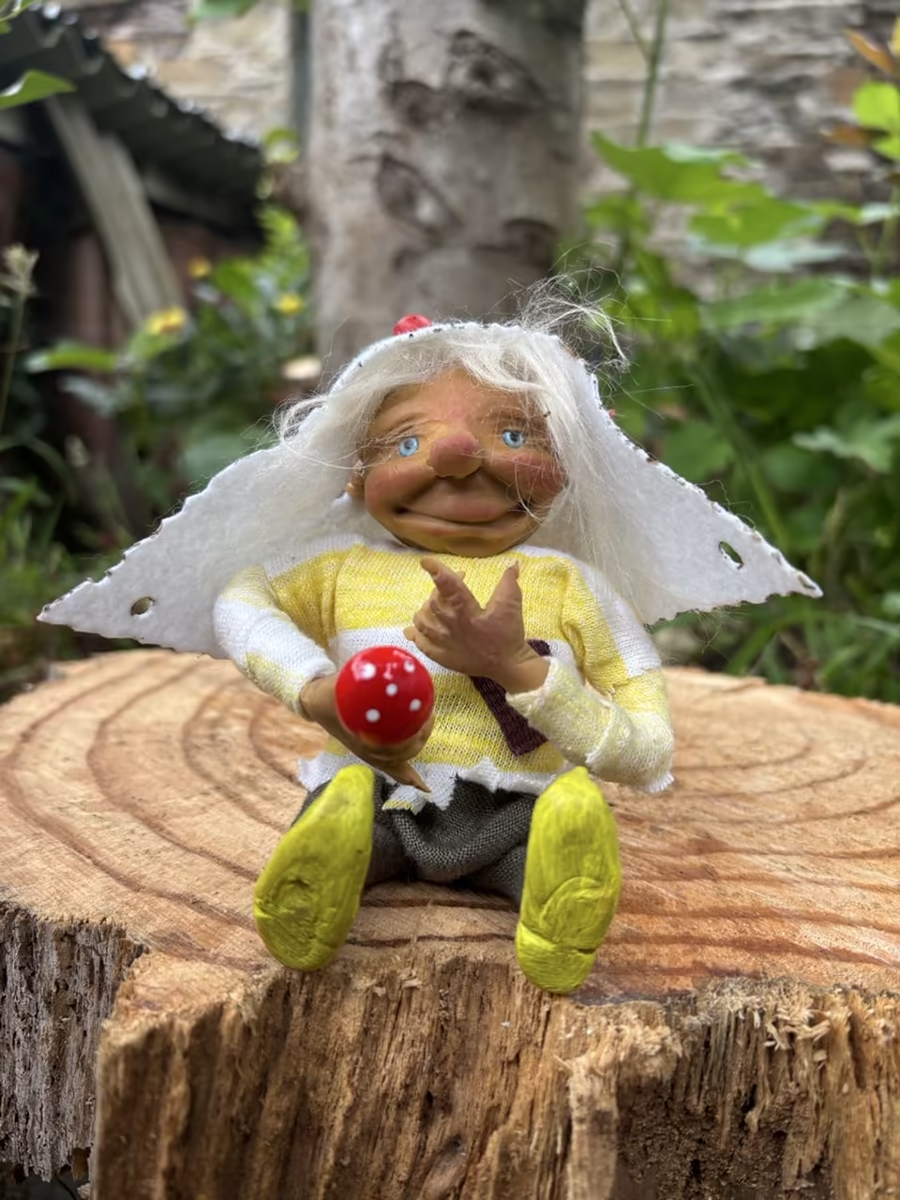
The Day Ice Guzzled a Whole River
HistoryThe Great Stink: London, 1858. Heat that melted everyone’s patience
Picture it: summer in London, the kind of heat that glues you to your chair, and the Thames running lower than an empty canteen. The catch is, back then the river was basically the city’s official trash chute. When the sun really started going for it, the whole thing turned into a nasty stew simmering on low. The stench was so feral that people sprinted across the bridges with a handkerchief pressed to their nose.
What was London’s Great Stink?
Things got so bad that even politicians, who usually sit comfy in their offices, started dropping like flies. In Parliament, which is right by the river, they had to soak the curtains in chlorine just to avoid fainting mid-debate. The press, with a proper smirk, called it “The Great Stink”. The wild part is that, even though people still believed diseases traveled through bad smells (those “miasmas”), the disgust was so real it forced them to stop moaning and start building.
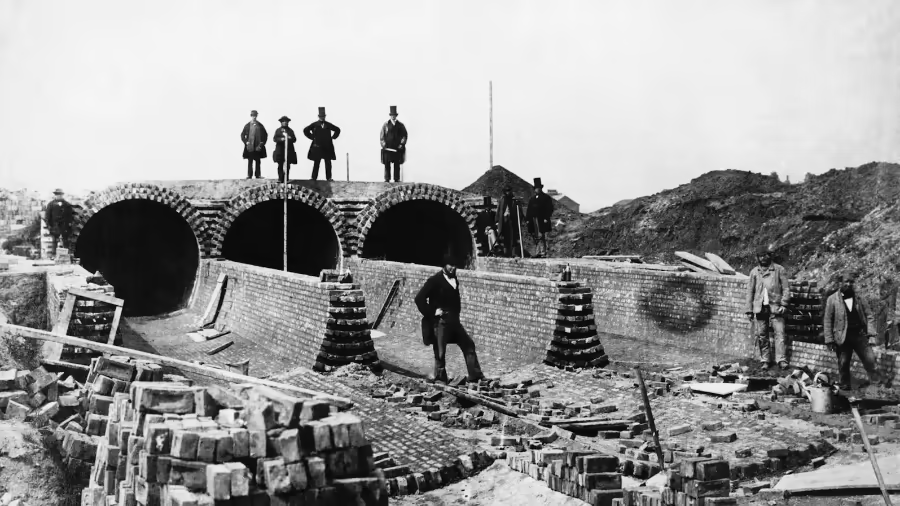
Thanks to that unbearable pong, engineer Joseph Bazalgette designed a massive sewer system that would still blow your mind today. Sometimes history doesn’t move forward because of grand speeches, it moves because something reeks so bad there’s no choice but to fix it.
We like to think small: if something “smells off” in your routine, don’t just pinch your nose. Maybe it’s time to redesign the little pipe where what no longer serves you gets carried away, so your life can smell like fresh grass again.
Post-it: the glue that was born “too weak”
HistoryThe big invention that started as a sticky little fail
In the late 60s, at a company called 3M, a chemist named Spencer Silver was trying to create a super-strong glue for airplanes. But what he got was… kinda weird: an adhesive that did stick, yes, but came off with the tiniest little tug.
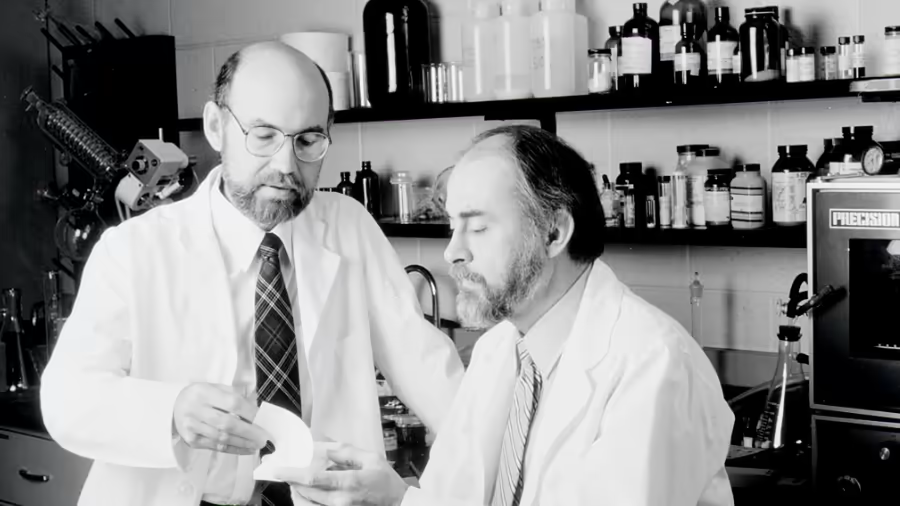
At first, everyone thought it was a useless mistake, until years later the Post-it was born.
How does a Post-it adhesive work?
The secret is in the microspheres. Picture regular glue like a layer of honey: it spreads all over the surface and grabs with everything it has, which is why it’s such a pain to remove. Post-it glue, instead, is made of millions of microscopic little bubbles, like tiny rubber balls that sit apart from each other.
When you stick the note on, only a few of those balls actually touch the paper, so the grip stays gentle. When you peel it off, the bubbles don’t break and they don’t stay stuck to the book either. They go with the yellow paper, ready to bounce onto another page. It’s an invention that wins you over not by holding tight, but by having good manners.
What is pressure-sensitive adhesion?
It’s a system where you don’t need heat or messy liquid glues to keep something in place. You just need a little press with your fingertip. When you press, you make those tiny bubbles we talked about touch the surface.
It’s the technology of “for now”: stick, read, peel, and leave no trace.
What began as a lab mistake ended up changing how we organize our ideas and our fridges. Sometimes an “error” is just a solution waiting for the right problem to show up.
Magikitos are keeping this lesson close: not everything useful has to be permanent or forever. Some ideas work precisely because they let you change your mind with zero guilt. What could you try today “just temporarily” and see what happens?
The lighthouses that blink with a full name
HistoryIn the 19th century, with sea traffic booming and the coastline drowning in close calls, lighthouses became more than glowing poles. They turned into identities.
The big tech leap for lighthouses back then was the use of Fresnel lenses.
What’s a Fresnel lens?
Picture a giant magnifying glass, but “slimmed down”, built from rings of glass that catch all the lamp’s light (the stuff that would normally spill out to the sides) and focus it into one powerful beam that reaches waaaay farther.

But the cleverest move was giving each lighthouse its own “signature”, thanks to different flash patterns.
Specifically, each lighthouse got a unique blinking rhythm, like visual Morse code. For example, one could do two short flashes and a long pause, or one long flash every ten seconds. That beat was like an ID card you could read from the horizon. With nautical charts in hand, a captain could say, “Yep, that blink is Cabo de San Juan, we’re here”, even in the middle of a full-on storm.
And here comes the Magikito bit: it wasn’t just about brute force or raw power, it was rhythm and consistency. Ships stayed safe not because the light “shouted” louder, but because it repeated a recognizable code that built trust, even from far, far away.
We love it because it’s a life lesson: sometimes you find your place not by going faster or shining brighter than everyone else, but by keeping a clear pattern that’s yours. What’s your “here I am” blink?