Eggs in Living Color
ScienceThe first time we spotted a blue egg in the coop, we froze the way you freeze when you see someone rocking a perfect afro on a rainy day: “nope, that can’t be real”.
Well… it is. And it’s not that the hen nipped to the corner shop for a pack of markers. Her body’s got its own little “paint booth” working behind the scenes before the egg ever makes its grand exit.
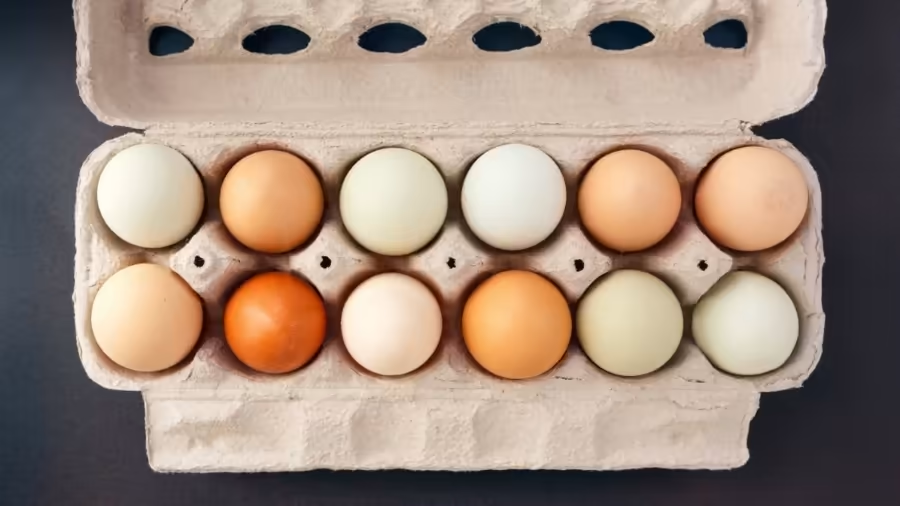
Why are some eggs blue or green?
Because some hens, thanks to their genes, lay down a pigment called biliverdin into the shell while it’s forming. Think of biliverdin like a blue-green ink. If that ink gets added throughout the whole build of the shell, the blue ends up inside the material, not just painted on the outside.
What pigments make eggs brown?
Brown usually comes from protoporphyrin. Different trick this time. It’s more like someone adds a varnish coat at the very end. That’s why brown eggs can have speckles or lighter patches, like when you paint with a brush and the edges end up with a bit more paint.
Does shell color change the taste or nutrients?
Basically, no. Nutrition depends way more on the hen’s diet and health than on shell color. Blue, white, or brown is like the color of a coat, not what’s in its pockets. What can change a tiny bit is thickness or toughness depending on the genetic line, but the “egg on the inside” is still the classic egg we all know.
Magikitos take: nature’s reminding you it’s totally allowed to be a little odd, and still make perfect sense. You’re an egg with personality too. Be kind to yourself today. Maybe your shell isn’t for show, maybe it’s protection you worked hard for.

Brain-Cell Fuel
ScienceWe feel it after about three strides: suddenly the world weighs less, your head lines itself up, and your body goes, “ohhh, okay, this works.”
That’s not runner posturing. That’s biology doing its thing. Running, and aerobic exercise in general, sends your brain a little cocktail of signals that can shift your mood, your focus, and even how you feel pain.
What’s a “runner’s high”?
It’s that cozy wave of wellbeing that sometimes shows up after you’ve been jogging a bit: calm, a cheeky little euphoria, and clearer thoughts. It doesn’t happen every time, and it doesn’t always feel the same. Think of it like a fireplace: if you light it and blow it out two minutes later, it won’t warm the house. Give it a moment and it settles in, then the good part starts.
What’s the deal with endorphins, and why does everyone talk about them?
Endorphins are substances your body releases that act like “internal painkillers.” Picture a tiny maintenance crew with a first-aid kit: when the effort goes up, they go, “okay, let’s turn the pain alarm down a notch so you can keep going.” Important: it’s not that you become invincible, it’s just that your threshold shifts a little.
Magikitos take: if your mental flame feels low today, it’s not always “motivation” you’re missing. Sometimes you’re missing movement. Even a silly little jog, a brisk walk, or taking the stairs instead of the lift, your brain loves it and pays you back with a dose of mental clarity.
Dad with the pouch
SciencePicture this, down in the seagrass meadow, it’s not the mama doing the pregnancy, it’s the papa. Yep, that’s exactly how the seahorse rolls, and the way they run it’s so slick it puts Amazon Prime to shame.
In seahorse world, the female lays the eggs, sure, but then she hands them over to the male. And that’s when the “pregnancy”, seahorse edition, kicks off.
What is the seahorse’s brood pouch?
It’s a pouch on the male’s body, like a grocery bag, except it’s stuck to his belly, full-on “tiny kangaroo” vibe. Think of that inside jacket pocket, the one you use for your important stuff. The female slips the eggs in there, and the male keeps them safe until they hatch.
How do the eggs go from the female to the male?
With a pretty well-rehearsed little courtship dance. They sync up, get super close, and the female uses a small tube (an ovipositor) to place the eggs inside the male’s pouch. It’s like passing a tray of cupcakes into the oven without dropping a single one on the way.
What does the male do while he’s “pregnant”?
He’s not just a storage unit, no. Inside the pouch, the male manages some seriously important stuff, oxygen, nutrients, and most of all salinity (osmoregulation). That part matters because the sea is basically salty soup, and the embryos need steady conditions so they don’t end up all “wrinkled” or “puffed up”. It’s a bit like taking care of bread dough, you can’t just leave it there. You’ve got to give it the right warmth and moisture if you want it to turn out good.
And what’s seahorse birth like?
The male gets contractions and pushes the babies out, sometimes loads of them, depending on the species. It’s got that vibe of “Alright kiddos, out you go, you’re ready to wiggle those tails and explore the sea.”
Magikitos’ take: the seahorse reminds us that caring isn’t a title, it’s something you do. Today, if it’s your turn to “carry the pouch”, do it with pride. And if it’s your turn to ask for help, ask. Raising days can be exhausting too.
Blackout, Manual Included
SciencePicture your body as a house and suddenly, click, the breaker trips. It’s not always an “I’m dying” thing. A lot of the time it’s more like “I’m protecting myself”, because the classic faint is basically a built-in safety system.
The most common version is called vasovagal syncope, which sounds like a comic-book villain but it’s really just an automatic reflex. It happens when your body decides to turn the volume down, fast. Blood pressure drops, sometimes the heart rate slows, and the brain gets a bit less blood for a few seconds. Result, you hit the floor. And weirdly, that can help, because lying down makes it easier for blood flow to get back to your brain.
So what exactly is a faint?
A faint is a brief loss of consciousness because the brain momentarily isn’t getting enough blood. Think of a hose watering your garden. If the pressure drops, the stream won’t reach the pots on the top shelf. Your brain is that fussy little pot, and if the stream cuts out for a moment it goes, “Right folks, maintenance shutdown.”
What’s the vagus nerve, and what’s it got to do with fainting?
The vagus nerve is part of your body’s “calm down and hit the brakes” system. In some situations (pain, seeing blood, heat, standing for ages, dehydration, stress, fear), the brakes get pressed too hard. Blood vessels widen (so pressure drops) and your heart rhythm can slow. It’s like someone at the fuse box going, “We’re using too much, full system cutback.”
What do you feel right before fainting, and why?
Typical signals are cold sweats, nausea, weird yawning, looking pale, blurry vision, ringing in the ears... basically your body warning you something’s off. Sometimes it’s because the brain is already getting less blood. Other times it’s because your nervous system is reshuffling the blood supply, like at a party when you turn off a few lights so the others can stay on.
What should you do after someone faints to recover?
If someone feels faint, the smartest move is usually to lie them down and raise their legs a bit if you can, loosen tight clothing, and get them plenty of fresh air. Once they come around, take it slow. Sit up, drink some water, have a light snack if it sounds good. And heads up, if fainting keeps happening, there was a hard knock, chest pain, shortness of breath, it happens during exercise, or something just doesn’t add up, it’s time to check in with professionals and not try to be the hero.
Magikitos’ take: a faint is often your body saying “enough” in a clumsy but effective way. Today, listen to the tiny warning before the big blackout. Water, shade, sit down in time, and ask for help with zero shame.
The Invisible Nudge
ScienceThis morning we watched a speedboat glide by on the river and, because we’re nosy like that, we just stood there staring at the water like it was a chalkboard: “How on earth does that float, with all that weight?”
The answer is lovely: water doesn’t “hold it up” out of pity, it pushes back because physics. And the more space you steal from it, the harder it pushes.
What is buoyancy?
Buoyancy is that little upward nudge a liquid (or a gas) gives you when you put something in it. Imagine sitting down on a soft mattress. Your weight sinks it a bit, but the mattress pushes back up. Water does the same thing, just in “liquid mattress” mode, and without complaining.
What does Archimedes’ principle say?
It says the upward push is equal to the weight of the water you’re kicking out of its spot. Like when you get into the bathtub and the water level rises. That little rise isn’t for show, it’s water you shoved aside with your body. So the weight of the water you displace is exactly the force the water uses to push you up. It can feel a bit twisty at first, but only until it clicks. After that, you can’t un-know it.
Why doesn’t a steel ship sink?
Because it’s not just the material that matters, it’s the average density of the whole thing. Steel is dense, sure, but a ship is steel plus air inside plus that bowl-like shape. It’s like a big cooking pot: empty, it floats (as long as water doesn’t get in), full of water it gets serious and goes down. The hull makes the ship displace a ton of water before it can sink, and that displaced water weighs so much that the buoyant push balances the ship’s weight.
Magikitos’ take: it’s not always the lightest one that floats, it’s the one that knows how to displace just enough without gulping the water from the inside. Today, be a ship. Set boundaries, leave some space, and you’ll feel the day pushing you up, nice and easy.
Mini Brownies
ScienceWe found an empty little box that said “multivitamin” and we started chewing on it: okay, but what even are vitamins? Is it all hype, or do they actually do something?
Vitamins are micronutrients, tiny little things you need in very small amounts. But without them, your body runs out of basic tools, like a kitchen with no frying pans.
What are vitamins, exactly?
Picture your body as a car. Proteins are the engine parts and the frame, muscles are the wheels, and vitamins are the tiny screws and helper bits that make the whole thing run smoothly. Lots of vitamins work as coenzymes, which is a fancy way of saying: “without me, this machine won’t start, no matter how hard you try”.
Why are some vitamins essential?
Because there are vitamins we can’t make (or not enough of them), so they have to come from food or from the sun. It’s like having an amazing bike, but someone from outside has to bring you the wheels. You can pedal all you want, but without wheels there’s no ride.
Which vitamins matter most?
There’s no absolute queen, because vitamins aren’t a talent show. But there are a few that tend to cause more trouble when they’re missing: vitamin D (because you can’t always catch the sun, and it depends on your habits, skin, latitude, and the season), B12 (if you eat little or no animal-based foods), folate (B9) in diets low in vegetables, and vitamin C if fruit and veg are basically nowhere to be found.
Magikitos take: vitamins aren’t “powers”, they’re the basics of maintenance. Today, instead of hunting for a magical shortcut, think like a workshop: a bit of sunshine with common sense, a varied plate, and tiny, steady consistency. What tool have you been missing lately, light or real food?
The chemistry of a smile
ScienceWe’ve been out here brushing our little toothy-woothies by the river and the doubt-bug has bitten us: what on earth does toothpaste actually do, besides tasting like mint and switching our mouth into “fancy penguin” mode?
Toothpaste is a mix of tools. Not one thing. It’s a whole crew on the job: some scrub, some protect, some make foam, and some keep the texture so it doesn’t feel like construction cement.
What is dental plaque and why does it stick so hard?
Plaque is like a sticky little film of bacteria and leftovers that forms on your teeth. Picture the ring on a mug of hot cocoa: if you don’t rinse it, it leaves a layer that’s a pain to shift. Well, in your mouth that layer is also alive, and bacteria love munching on sugars and spitting out acids, so yeah, even worse.
How does a cavity happen, explained like your tooth is a wall?
Your enamel is like a tile wall made of minerals. When bacteria make acid, that acid starts “popping off tiny tiles” (demineralizing). If that happens over and over and you don’t give it time to repair, you end up with a little hole in the tooth: the famous cavity.
What does fluoride really do and why isn’t it just marketing?
Fluoride helps that wall repair itself better. When fluoride shows up to the dental party, the mineral that forms during repair can be more acid-resistant, like swapping regular tiles for extra-tough tiles. Plus, fluoride can slow down the acid production of some bacteria. It’s not magic, it’s better material and a tiny “turn it down a notch” for the bacterial workshop.
Magikitos translation: a good toothpaste doesn’t yell “be perfect”, it helps you keep your teeth healthy. Today, instead of beating yourself up over a slip-up, think like fluoride: fix a little, reinforce what you’ve got, and keep it moving.
Mold doesn’t give you a heads-up
ScienceOut in the forest we’ve learned it the easy way: the stuff that truly takes over almost never shows up slamming doors. Mold is like that. Today it’s a tiny speck and tomorrow it’s rolled out a soft little green carpet in your tupper.
Mold is a fungus, and fungi are pro-level recyclers. Where there’s food and moisture, they go, “Oh yeah, this place has vibes.” The problem is, not all of them come with good intentions for your belly.
So what exactly is mold?
Think of mold like a “mini forest” growing on your food. What you see as fuzz is actually a bunch of tiny threads (hyphae) weaving a network, like super-fine roots. And even if it looks like it’s only on the surface, those threads often push inward, especially in soft foods.
Are there “good” molds in food?
Yes, and it kind of leaves you doing a double take. In blue cheeses (like Cabrales or Valdeón), they use controlled molds such as Penicillium roqueforti. There the mold isn’t a squatter, it’s a guest with a contract. It helps create the smell, the flavor, and those blue-green veins that are just so cool. The key word is “controlled.” Right species, safe conditions, and a process designed for it.
When should you toss the food, no negotiations?
The golden rule is that if it’s a soft or moist food (sandwich bread, jam, yogurt, leftovers, fresh cheeses, very ripe fruit), the usual move is to throw it out if a little mold patch shows up. On the other hand, with hard foods (aged cheese, cured salami, some firm veggies), you can sometimes cut away a good layer around it (about 2-3 cm) and save what’s inside.
Magikitos’ take: mold doesn’t “attack” you, it lives off you not paying attention. Today, instead of living spooked, check your fridge and your life. What small thing is growing because you’ve left it unchecked?
The gas that makes bread rise
ScienceWe’ve been staring at a dough resting for a while, like watching a cat nap: looks like it’s doing nothing… and then, boom, it’s grown.
The trick to great bread isn’t only good kneading. It’s also knowing there’s a tiny living worker in there putting in the hours: yeast. And yes, it’s a fungus. A teeny one, but with some serious “let me puff up” energy.
What is yeast?
Yeast (properly called Saccharomyces cerevisiae) is a microorganism that feeds on sugars. Picture it like a mini factory with one simple mission: food goes in and energy comes out, plus a few “leftovers” that, in this case, are exactly what we want.
What is fermentation and why does it make bubbles?
When yeast doesn’t have enough oxygen, it does something called fermentation. In plain words, it turns sugars into carbon dioxide (CO₂) and alcohol (ethanol). The alcohol later evaporates in the oven, but the CO₂ gets trapped in the dough making tiny bubbles. It’s awesome because it’s like inflating an air mattress, except from the inside.
Why doesn’t the dough deflate, and how does it stay fluffy?
Because gluten (if you’re using wheat flour) acts like an elastic net. Think of a fishing net: the yeast releases gas and that net holds it. If you knead well, the net gets stronger and stretchier. If there’s no net (or it’s torn), the bubbles escape and the dough goes all sad and flat. That’s why making a fluffy gluten-free bread is so tricky.
Magikitos interpretation: what makes you grow is often invisible and slow. Today, instead of squeezing yourself, ask: what good bubble am I letting form without popping it with hurry?
The Clingy Archive
ScienceWe snuck into a cave and found an old USB stick that said “SUPER IMPORTANT”. We opened it and… 1,490 photos of the exact same cat. That’s when our curiosity sparkled: why is it so hard to delete digital stuff if we don’t even look at it again?
We call it “Digital Diogenes”, because it looks a lot like hoarding… with one brand-new ingredient: digital clutter doesn’t take up space in your living room.
What’s “Diogenes” about keeping digital files?
Picture a wardrobe. If you shove in ten identical coats, you’ll feel the chaos pretty fast. On your phone, though, you can stash ten near-identical photos and… nothing happens. Because we don’t see the bulge, the brain goes: “Yep, toss it all in.” The problem is that later, when you actually need to find something,you get lost in a jungle of copies and suddenly even breathing feels like effort.
Why does deleting hurt more than keeping?
Because our heads come with a built-in little program called loss aversion. It’s like when someone asks: “Would you rather win €5 or avoid losing €5?” A lot of people prefer avoiding the loss. Deleting feels like losing something “forever”, even if it’s just the same lock-screen screenshot… again.
What does “zero cost” have to do with it?
Saving digital bits and bobs these days is ridiculously cheap and fast. One tap and done. Deleting, on the other hand, forces you to decide. And deciding is tiring. That’s decision fatiguelike staring into a drawer full of lidless food containers and freezing. Plus, humans get a bit dreamy about the future… “I might need it one day.” That day almost never comes, and when it does, they don’t even remember what they had.
How can I delete things without fear?
With silly-but-useful rules: “If I’ve got 7 similar photos, I’ll keep the one that actually makes me feel something,” or “If I don’t even know what it is, into the bin.” Turn deleting into a tiny routine, because deep down, deleting can feel really good.
Magikitos’ take: you’re not saving files, you’re saving the laziness of not deleting them. So today, get your sparkle together and feed the recycle bin, she deserves a snack every now and then too.
Liquids that stretch
ScienceThis morning the wind showed up in a bad mood, and one of us said: “It’s zero degrees out here… but who tipped the thermometer off if cold is invisible?”.
The answer is very down-to-earth magic: when something warms up, it usually expands. Meaning it takes up a tiny bit more space. And when it cools, it tightens up. A liquid-in-glass thermometer is basically a translator: it turns “heat you can’t see” into a “level you can see.”
So what is thermal expansion?
Picture a little gang on a park bench. If they’re calm, they can sit snugly together. But if someone puts music on and everyone gets hyped, they need more space and start sprawling. When a liquid’s particles warm up, they move more, bump more, and spread out a hair. That “hair” in a cup doesn’t look like much, but in a super-thin tube it shows up loud and clear.
Why does the thermometer have such a narrow tube?
Because that’s the amplification trick. The bulb at the bottom (the little “belly”) holds a good amount of liquid. When it expands, instead of widening sideways, it has only one way to go: up the capillary. It’s like squeezing a ketchup bottle with an extra-fine nozzle: with just a little pressure, the squirt becomes very visible.
Why do some thermometers use mercury and others dyed alcohol?
Mercury expands quite regularly across a wide range and doesn’t stick to glass, which used to give very crisp readings. But it’s toxic, so nowadays it’s mostly avoided. Alcohol (or similar liquids) is less dangerous and works really well at low temperatures, which is why you often see it in outdoor thermometers, and they dye it so it’s easier to spot.
How do you “calibrate” a thermometer so it doesn’t make up the degrees?
You use reference points. The classic ones are the freezing point and the boiling point of water at normal pressure. It’s like marking on a ruler where “zero” is and where “one hundred” is, then dividing the distance into equal little steps. Without calibration, a thermometer would just be an up-and-down tube with confidence.
Magikitos’ take: heat can’t be seen, but it leaves a trace. Emotions do the same. If today you don’t quite know “what’s going on with you,” look for your measurable trail: how you sleep, how you breathe, how you eat, how you speak. That’s where your inner thermometer begins.
The invisible tug
ScienceThis morning, while we were out mushroom hunting, a pinecone bonked one of us right on the little beanie. Nothing serious, but just enough to remind us: around here, everything kinda wants to head down.
And of course, that sparked the big existential doubt: why do things fall down and not up?
What is gravity in normal-human words?
Gravity is like a giant “c’mere” between masses. Anything with mass (you, an apple, Earth, a mountain) pulls on other things a tiny bit. The more mass it has, the stronger the pull. That’s it. And it’s not that Earth has hands, it’s that its huge chunk of mass makes everything near its surface want to cozy up closer to it.
Magikitos interpretation: gravity is that little reminder that living means having something that holds you. If something lands on your head today, look for what’s tying you to the world: your people, your solid routine, your will to live.
The Conspiring Dust
ScienceWe swear we’ve seen it a thousand times: you clean, you turn around and boom!... the dust is already lining up for an encore. Like it has a permanent contract to live in your living room.
The trick is that dust isn’t “one thing”. It’s a cocktail of microscopic crumbs coming from you, your clothes, the street, and the house itself. Like a weird salad that makes itself and then happily helps itself to every flat surface.
What is household dust made of?
Of a very mixed potluck: skin flakes (yep, in daily life you’re shedding tiny bits of human confetti), textile fibers (from T-shirts, sheets, rugs), pet hair and a bit of dandruff if you’ve got furry roommates, soil particles that come in on shoes, pollen in springtime, and also soot or kitchen particles (aerosolized oils) if there’s a lot of cooking. In cities, a few street-traffic ingredients can sneak in too. And in general there’s almost always a generous topping of microplastics, because we live surrounded by materials that slowly wear down.
Why does dust always come back even if you clean?
Because a home is a nonstop factory of dust. Even with everything closed, air still moves in tiny currents: heating, people walking, opening a door, the extractor fan. That movement keeps particles floating, and when things calm down, they fall by gravity like a slow drizzle.
And then there’s the boomerang effect. Even when you clean, some particles get resuspended (back into the air) just from wiping a surface or fluffing a cushion. It’s like raking leaves on a windy day. You think “done”, and the yard goes “oh no you’re not”.
Magikitos interpretation: dust doesn’t “come back” to mess with you, it comes back because life is moving. If your home isn’t perfect today, maybe it’s not neglect. Maybe it’s a sign of use, of laughter, footsteps, dinner, and being alive.
The science behind hiccups and yawns
ScienceBet it’s happened to you more than once: you’re just chilling and then, bam, a yawn hits you and suddenly your face looks like it’s got a giant hole where your mouth is. And a minute later a hiccup gives you a jerk like your diaphragm’s got a dodgy clutch.
Both are just reflexes. Like tiny automatic body programs, kind of like when your phone randomly restarts. It looks like “for no reason”, but really it was time to reset the system.
What’s yawning for?
For years people said we yawn because we’re low on oxygen, but these days that explanation feels a bit thin. Now it’s thought yawning has more to do with regulating your brain’s state (calm, alert, getting sleepy, and so on) and with the social side of things. Picture a yawn like an automatic system that opens the windows in a house that’s been shut for a while: air comes in, face muscles stretch, your breathing shifts, and your body sort of re-sets itself a little. Some studies even suggest it may help cool the brain slightly, like lifting the lid off a pot so it stops boiling like crazy.
Why are yawns contagious?
Because we’re tribe creatures. Seeing someone yawn can switch on brain networks linked to imitation and empathy. It’s like when one person starts clapping in a room, then two more join in, and suddenly everyone’s giving it a little round of applause. It’s not mind control, it’s your social system answering the group’s call.
In the forest we call it emotional Wi‑Fi. Without saying a word, your body lines up with your neighbor’s.
So what exactly is a hiccup?
A hiccup is an involuntary spasm of the diaphragm (the muscle that works like a piston for breathing). That spasm sucks air in fast and then the glottis (the little door in your larynx) snaps shut. That’s where the classic “hic” comes from. It’s like when something’s not working and you give it a tiny smack to “fix” it.
Why do hiccups show up when you eat or drink too fast?
Because the system that controls hiccups is sensitive to irritation and weird movements in your chest and belly. An overfull stomach, fizzy drinks, swallowing air, sudden temperature changes, all of that can wake the hiccup up. In the middle of this whole situation you’ve got nerves like the vagus and the phrenic, which are basically cables carrying messages between your belly, your diaphragm, and your brain. If those cables get fired up, the reflex can jump.
Magikitos interpretation: yawns and hiccups are two reminders from real life. Not everything is controlled by your head. Sometimes the wisest move is to accept the interruption, breathe, slow down, and let your body run its maintenance routine without you judging it.
Human DNA looks a lot like a banana’s
ScienceWe sat down on a log with a banana in one hand and a mushroom in the other. The banana kept teasing, “You and me, we’re cousins.” The mushroom, though, looked at us like, “Excuse me, I’m immediate family.”
That thing about humans sharing around 50% of our DNA with a banana gets dropped a lot at Christmas dinners, but it needs the right vibe because it doesn’t mean humans have a yellow peel and a creamy center. What’s usually being compared is not your entire genetic sequence letter by letter, but the genes and functions that show up across many living beings.
What is DNA?
DNA is like a huge recipe book written with four letters. Some recipes say “make a protein that builds muscle,” others “make a protein that repairs damage,” others “make a protein that manages energy.” Bananas, mushrooms, and humans share lots of basic recipes because we’re all hardworking cells that need the same things to survive: copy themselves, fix themselves, and not fall apart without warning.
Why does the similarity percentage with a banana look so high?
Because if you compare which recipes exist in both, you’ll find a lot of matches. It’s like comparing two kitchens, yours and your friend’s. Both have salt, water, knives, and heat. That doesn’t mean you cook the same dish, it means you use universal tools. In biology, those tools are often genes that run the basic processes.
Magikitos interpretation: when you hear a percentage about you, don’t wear it like a label. Take it as a reminder that you share a lot with the world, but your exact mix is one of a kind. Which piece of your personal mosaic will you celebrate today instead of comparing it?

Why there are seashells on top of some mountains
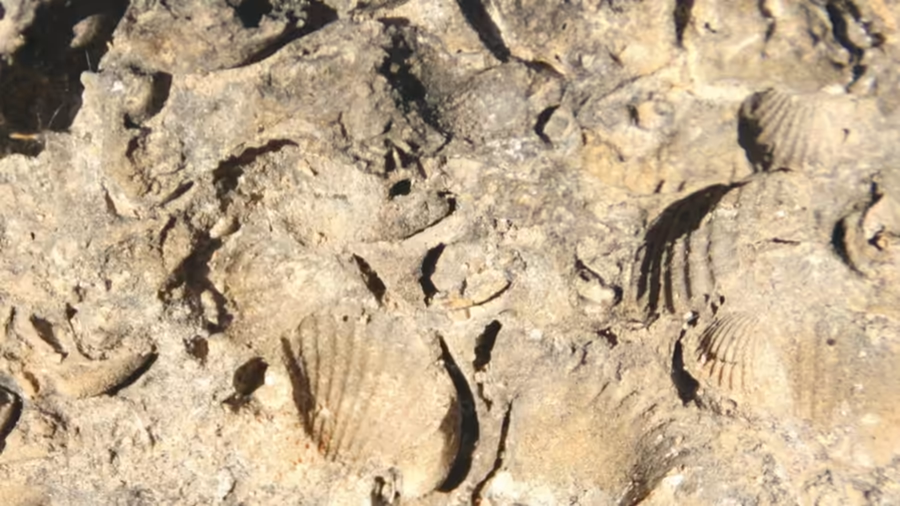
ScienceThis morning, while we were hiking up the mountain, we spotted a tiny shell stuck in a rock, like finding a forgotten flip-flop in the middle of a meadow. And obviously we all looked at each other and went: “Wait, what is this doing up here, mate?”
The answer is as mind-blowing as it’s real. Because where you’re huffing and puffing up the slope today, millions of years ago there were fish swimming around and little critters living their best life under the water.
So what exactly is a fossil?
A fossil is like a 3D snapshot nature took of a living thing from forever ago. Picture a shell sinking to the seafloor and getting covered by layer after layer of sand and mud. Over time, the original shell disappears, but it leaves a perfect mold behind. Then minerals from the ground fill that space until it turns into stone with the exact same shape. It’s like the sea packed a little cookie into a rock Tupperware for millions of years, just so you could stumble upon it today.
How did the ocean floor climb all the way up to the clouds?
To get it, think of Earth’s crust like a puzzle made of gigantic pieces that move with a patience that drives you mad. Sometimes two of those pieces crash into each other so hard that the ground has no choice but to crumple upward. It’s exactly what happens when you shove a rug against a wall: a bump forms and keeps rising into a little ridge. That “wrinkle” in the plates that make up Earth’s surface is what lifted ancient seabeds until they became mountain peaks thousands of meters high.
Is it easy to spot fossils in Spanish mountains?
In Spain we’re pretty lucky, we’ve got open-air geology museums all over the place. In the Pyrenees, the Baetic Systems, or the Cantabrian Mountains, it’s super common to be walking a trail and suddenly see sea snails or corals stamped right into the rock. It’s not that someone carried them up there to look cool, it’s the planet doing DIY on an epic scale. It’s proof that the landscape you see today hasn’t always looked like this, and that the Earth has way more memory than it seems.
Magikitos’ take: if today you feel out of place, remember the shell on the mountain. Maybe you’re not in the wrong spot. Maybe you’ve climbed far and high, but you still carry inside you all the strength of the sea from where you began.
Earthing, the famous one: myth vs reality
ScienceToday we went out barefoot to stomp around on wet grass and one of us goes, “I’m charging up like a phone battery.” And another replies, “Yeah, yeah… just watch you don’t get a pinecone stuck in your heel, champ.” Let’s take apart this trendy nonsense sauce, just a little.
Earthing (or “grounding”) is the idea that touching the ground with your skin clears the bad vibes, lowers inflammation, and fixes half your life. Some people treat it like science, others like a spell fresh out of Hogwarts. We’re going to clear it up once and for all: what’s true, what’s not, and what your feet actually thank you for.
What exactly is earthing?
It’s a practice: keeping your feet (or hands) in direct contact with soil, grass, sand, or rock, with no plasticky sole in between. The theory says the Earth has an electrical potential and that, when you touch it, the charges in your body balance out. Think of it like when you touch a radiator in winter and get a little zap. That’s static electricity and you’re the bridge.
Is there solid proof you absorb electrons and get healed?
The Earth can act as an electrical reference, and grounding a body does allow electrons to discharge. What starts to sound more like fantasy is leaping from that to promises like “bye chronic pain” or “I sleep like a log every night.” There are some small studies with mixed results, and there’s also a lack of credible, well controlled evidence to make strong medical claims. So as a miracle therapy, take it easy.
So why does walking barefoot sometimes feel so good?
Because your foot is a living tool. When you go without sneakers, you change your proprioception, which is basically your body’s internal GPS for where all its parts are.
Think of proprioception as the internal WhatsApp chat between your feet and your brain. If you’re on a thick, stiff sole, the chat has terrible signal. If you can actually feel the ground, the brain gets super fine info: texture, slope, pressure. And that can improve balance, ankle control, and how you distribute load.
What happens to toes in narrow shoes?
If you squeeze your toes into a narrow toe box, you take away their job as stabilizers. Your big toe should push straight, like a proper coworker in a crisp shirt. If you force it inward, the foot compensates and things can get annoying, from calluses to bunions in people who are prone to them. That toe “fan” helps spread your weight and lets the arch do its job without drama.
Magikitos’ take: touching the Earth can be really lovely, sure… but the practical magic is giving your feet space, strength, and real sensations. Today, try a little “mindful barefoot time” at home: toes wide like a fan, shoulders down, and a head that feels less squeezed than your shoes.
Pollination: the secret “trade” between flowers and bees
ScienceToday we watched a bee leave a flower with its little legs covered in powder, like it had just stepped into a bag of flour. And it gave us a proper existential wobble: what on earth is going on in there?
That “silly little stroll” is pollination, one of nature’s biggest “business deals”: the flower pays in snacks, and the bee, without even trying, becomes the messenger of plant love.
So what exactly is pollen?
Pollen is like microscopic “little packets” where the plant stores its male reproductive cells. Think of it as confetti with a mission: it looks like random dust, but it carries genetic info. And a lot of the time it’s a bit sticky or textured, so it clings better to fluffy visitors.
How does a bee pollinate without realizing it’s working?
The bee dives into a flower looking for nectar (liquid sugar, premium fuel) and also pollen (protein for the larvae). While it moves around inside, pollen sticks to its body and to those “little baskets” on the back legs (corbiculae) where it packs it in. Then it visits another flower of the same species and, when it brushes against it, some of that pollen lands in the right spot (the stigma). It’s like walking around the kitchen in socks and accidentally spreading crumbs all over the house. It wasn’t the plan, but there goes your trail.
What happens inside the flower when the pollen arrives?
If all goes well, the pollen grain “germinates” and grows a tiny tube down to the ovule. That’s where fertilization happens and the plant starts making seeds (and often a fruit around them). So yes, without pollination the flower can just stay there looking cute. With pollination, snack time appears: apples, almonds, zucchini, strawberries…
How are bees and wasps different, besides the drama?
In general, bees tend to be fuzzier and more “vegetarian by trade” (they go to flowers for nectar and pollen). Wasps usually have smoother bodies and a sharper waist, and many are hunters or opportunists (they grab other insects or little bits of meat for their young). That’s why, as steady pollinators, bees are absolute machines.
Magikitos translation, aka our take: life runs on tiny trades. You give something (time, attention, help) and without noticing you leave “good pollen” on someone else. What small gesture can you do today so the world has more fruit tomorrow?
Wi‑Fi, Bluetooth, 5G: they’re all waves, but they don’t play the same
SciencePicture a forest with low mist hugging the moss and, at the same time, you sitting on a rock watching a 5G video, vibing to a reggaeton banger on your Bluetooth headphones. All of it travelling through the same air without crashing into each other. The trick is that Wi‑Fi, Bluetooth and 5G aren’t magic clouds, they’re radio: invisible waves carrying info on a highway with very clearly marked lanes.
What is a radio wave?
Imagine tossing a stone into a pond and ripples spread across the water. An antenna does something similar, but with electricity. It “vibrates” and that vibration moves through space. What we send isn’t water or air, it’s an oscillation. To make that wave carry a message (like your favourite song), we change its rhythm or its shape. It’s like smoke signals, just at the speed of light.
Why does frequency change everything?
Frequency is simply how many times that wave vibrates in one second. Think of someone tapping your shoulder. If they tap you a thousand times a second, that’s a crazy high frequency. In radio world, high frequencies (like some 5G) are like sports cars: they carry loads of information and zoom, but one wall or small obstacle and boom, they wipe out and the signal drops. Low frequencies are like a tractor: less payload, but they push through walls and make it way out there without breaking a sweat.
Why does Wi‑Fi die in the hallway?
Most routers run two bands. 2.4 GHz is the all‑terrain one: it cuts through walls and reaches the kitchen, but since everyone uses it (even the microwave), it can get jammed. 5 GHz is the speed demon: it gives you wicked fast internet, but the moment you’re behind a thick wall, the signal throws in the towel. That’s why, if you want to game online or watch a movie, it’s smarter to stay near the router so the “sports car” doesn’t slam into a wall.
And is 5G different?
5G is the master of adapting. It can use low bands to give you coverage in the middle of nowhere, or super high bands so you download a whole season in seconds in the city. The catch with those powerful high bands is that they’re delicate. A single tree leaf or a window pane can slow them down. That’s why you see more antennas, and smaller ones, all over the place. It’s not dark magic, it’s just that those speedy waves need the antenna almost in sight so they don’t get lost.
Magikitos translation: you’ve got your bands too. Some days are low frequency, not much energy, but you go far just by staying steady. And some days are high frequency, a thousand ideas, but you get stuck at the first wall you hit. Don’t fight your coverage. Switch channels, move closer to what matters, and drop all that noise that won’t let you hear your own vibration.
Arabica vs Robusta: why one smells like a gentle caress and the other gives you a proper shove
ScienceThis morning before breakfast we sniffed two coffee jars and something very scientific happened: one smelled like “mmm, that’s lovely” and the other was more like “whoa, this wakes up even my middle name”.
That’s where arabica and robusta beans come in, two species (okay, two whole universes) that land in your cup with very different personalities. It’s not barista posing, it’s biology, chemistry, and a tiny bit of plant survival mode.
What does it mean when a coffee is arabica or robusta?
They’re two plant species: Coffea arabica and Coffea canephora (robusta). Picture two cousins: arabica is the refined, delicate one, it usually does best up in the heights with steadier temperatures. Robusta is tougher to mess with, it handles heat and some pests way better. That lifestyle shows up later in the bean.
Why does robusta usually have more caffeine?
Caffeine, besides putting you on full power, is a natural pesticide for the plant. It’s like the little coffee plant going, “bite me and I’ll ruin your afternoon”. Robusta, which often lives with more bug pressure and rougher conditions, tends to pack more caffeine than arabica.
Why does arabica often taste more aromatic and less bitter?
Here the bean’s chemistry is the boss: arabica usually has more aromatic compounds and, in general, less caffeine and less “astringency”. Robusta often brings more bitterness and a more “earthy” or “dark cocoa” body, which is why it’s used a lot in blends to add punch and crema in espresso. It’s like choosing music: arabica is pretty acoustic, robusta is drums that mean business.
Is arabica coffee better than robusta?
There’s no Coffee Court. It depends on what you want: if you’re chasing floral, fruity, or soft chocolatey aromas, arabica usually hits the spot. If you want strength, crema, and a coffee that lifts even your thoughts off the couch, robusta has its place. And then there’s the roast, the grind, and the brewer, which are like the bean’s “final hairstyle”.
Magikitos translation and interpretation: there are arabica days (soft, chatty, blanket vibes) and robusta days (get-it-done, push-forward, “come on then”). Today, don’t judge yourself by your energy. Ask what kind of cup your body needs and let it have the treat.
From milk to cheese
ScienceThis morning a drop of milk landed on the table and we started wondering: how on earth do we go from “squishy little milk” to a hard Manchego, a creamy Brie, or a blue that stares at you like a misunderstood poet?
The trick is not switching cows, it’s how we handle the proteins so they actually hold hands, and how much water we let them keep tucked inside.
What is curd?
Milk is basically a soup where tiny protein balls float around, pushing each other away. To make cheese, we need those little balls to forget their drama and cling together, forming a net, like a fishing mesh. Rennet is the tool that pulls the magic: it works like tiny chemical scissors that snip the proteins’ “shield” so they turn sticky and bond. That protein net traps fat and water, creating what we call curd.
Why are some cheeses hard and others soft?
This is where the cheesemaker turns into an architect. It all depends on how much water you leave inside that protein net. If you want a soft cheese, you treat the curd with extra tenderness: you cut it into big pieces so it holds onto moisture, and you let it mature for a short time. It’s like a water-soaked sponge that stays soft and juicy. But if you’re after a hard cheese, the vibe changes. The cheesemaker cuts the curd into tiny grains, like rice, so it lets go of as much whey as possible.
Then, sometimes the mix is heated so the protein net tightens up even more, squeezing out every last drop.
In the end, what’s left is a super compact structure that, with time and salt, turns firm and bold.
Salt and the cellar: the final personality
Salt is the time guard. Its job is to pull out the remaining water and decide which good microbes get to live there and bring flavor. A cheese with little water and plenty of salt can nap for years in the cellar, concentrating its power until it becomes a jewel. A cheese with lots of water is a party that only lasts a few days before it goes off. The balance between cutting, heat, and time is what decides if your cheese will be a gentle caress or a full-on flavor punch.
Magikitos translation: making cheese is sorting chaos with three keys: cut to connect, drain to shape, and salt to give it character. If today your day feels like mental whey, maybe you just need a little “curdy-moment”, one small gesture that compacts everything and puts you back in your place.

Why fire climbs and dances: the invisible trick of hot air
ScienceThis morning we watched a flame stretching up like it was trying to high-five the branches, and we got hit with the ultimate couch question: why doesn’t fire just stay put on the ground, like an orange carpet?
The short answer is that fire isn’t “a thing”, it’s a process: a chemical reaction throwing out heat and light, and that heat makes the air move like it’s at a club night with fans on full blast.
So what exactly is fire?
Fire is combustion, meaning a reaction where a fuel (wood, gas, wax) mixes with oxygen and turns into other substances (like carbon dioxide, water vapor, and smoke) while releasing energy. Imagine the fuel is a cookie and oxygen is your mouth. When you “bite” (they react), the cookie changes and you walk away with the energy. Fire does something like that too, just way wilder and with zero manners.
Why does the flame go upward?
Because warm air weighs less than cold air. That’s called buoyancy. Picture air like a bunch of people in an elevator: if they suddenly spread out and take up more space (hot air), then in the same volume there’s less “stuff”, so that bundle is lighter. Result: hot air tends to rise and cold air drops down to take its place. Classic “move over, I don’t fit here”.
What is convection, and why does the flame look like it’s dancing?
Convection is that loop-the-loop movement of air: warm goes up, cool comes down, and a current forms. In a bonfire those currents aren’t neat or chill, they’re turbulent, full of little swirly eddies. That’s why the flame flickers, stretches, shrinks, and pulls weird choreography. It’s like when you boil water and you see bubbles and whirlpools, heat is basically directing traffic.
And why is there smoke sometimes, and almost none other times?
When combustion is “clean” (good oxygen mix and high temperature), almost everything burns and there’s less visible smoke. If there’s not enough oxygen or the temperature is low, unburnt particles (soot) stick around, and that’s the darker, grumpier smoke. It’s like cooking: do it at the right heat and it comes out nicely golden. Do it kinda meh and it’s half-raw inside and full drama on the outside.
Magikitos translation: if today you’re “dancing” on the inside, maybe you’re not falling apart, maybe you’ve got emotional convection. Drop the temperature a notch (rest, water, food), let some oxygen in (a little walk, talking to someone), and you’ll see the flame turns useful instead of exhausting.
Mycelium: the forest’s underground highway
ScienceWhen you spot a mushroom peeking out from the moss, you’re really only seeing the tip of the iceberg. The real heavy stuff is under the ground, where there’s an endless network of super thin white threads called mycelium. It’s like the forest has its own internet, made of natural cables that link all the trees together, forming what scientists jokingly call the “Wood Wide Web”.
So what exactly is mycelium?
Picture mycelium as the mushroom’s real “body”, a tangle of fibers that look like spiderwebs but are tougher than you’d guess. It’s like millions of microscopic roots stretching out for miles. These threads are legit scouts, cruising through the soil looking for water and minerals. But mycelium has a tiny problem, it can’t cook up its own food because it lives in the dark. That’s where the trees step in to sign a pact.
What happens when mycelium hugs a root?
When a mycelium thread meets a tree root, they hug so hard they basically become one. That friendship deal is what we call mycorrhiza. The tree is a pro chef that uses the sun to make delicious sugars, but it can’t reach every corner of the soil. The fungus, born and raised as a treasure hunter, brings back water, phosphorus, and nitrogen from places the root would never reach on its own. It’s a “snacks for supplies” trade that keeps the forest alive.
How does the trees’ group chat work?
The wild part is that this wiring also sends info packets in real time. If a tree on one side of the forest gets attacked by aphids, it releases a chemical alarm signal through the fungus threads. Nearby trees get the message and start making bitter compounds in their leaves so the bugs won’t munch on them.
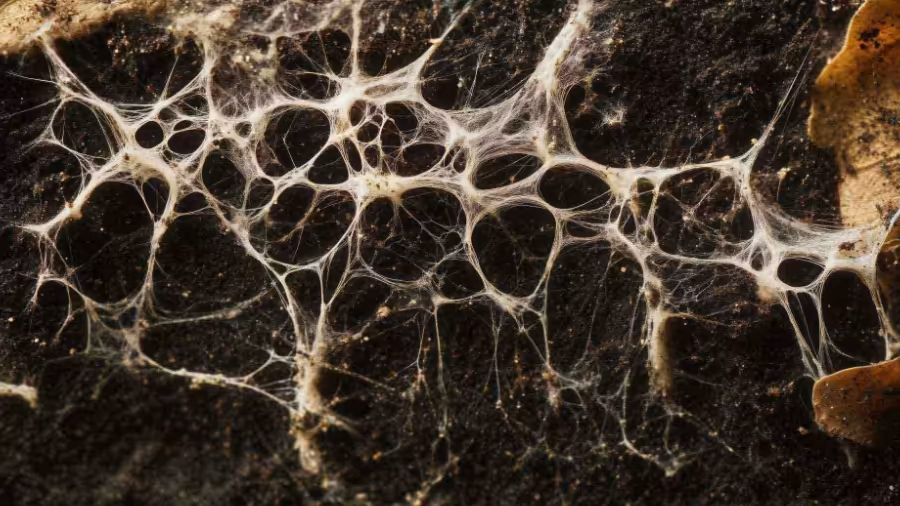
They’ve even seen “grandpa and grandma” trees using this network to send extra nutrients to younger trees stuck in the shade that can’t cook very well. It’s a mutual support system, and mycelium takes a small commission for being the messenger.
In the end, without this thread-connection and that deal of helping each other out, the forest wouldn’t last a single round against a drought or a pest invasion. It’s a massive team where nobody gets left behind if the network is healthy.
Magikitos translation: on the outside you look like an independent human who can handle everything solo. But underneath, what really saves your life is your people-network. Don’t be a lonely fungus, take care of your connections and keep the wiring fresh, because it’s what keeps you standing when the world gets tough.
Shinrin-yoku: why the forest loosens that knot inside you
ScienceYou’ve definitely lived this at least once. You step into the woods with your head full of noise and ten minutes later, your bad mood drops off and your face de-stresses all by itself. It’s not just that green looks pretty, it’s that your body is reacting to a natural medicine that doesn’t come in pills. In Japan they call it Shinrin-yoku, which means “forest bathing”, and it’s the cheapest way to reboot your brain. (Our full shinrin-yoku deep-dive explains the science.)
What happens to your body in the woods?
Picture your body with a panic button (stress) and a calm button (rest). In the city, with the noise and the rush, the panic button stays on 24/7. But when you stroll slowly between the trees, your brain switches on the parasympathetic nervous system, the one that basically tells you, “Easy, buddy, you’re safe here.” Scientists have measured that cortisol, the hormone that winds us up, drops fast after a while under the branches.
What are phytoncides?
Here’s the wild part. Trees release substances called phytoncides, kind of like their protective shield so bugs and fungi don’t mess with them. When you walk through the forest, you breathe in that “invisible soup” of natural oils. Not only does it make the air smell ridiculously good, it also helps your defenses get stronger. It’s like the trees are lending you a bit of their security system so you can feel more protected too.
So is the forest a pharmacy?
More like a peace switch. You don’t need to run a marathon or reach the highest peak for it to work. You just need to be there, touch the bark of a trunk, or listen to the leaves moving. Your body reads it as “no danger nearby” and decides it can stop burning energy on being scared. In the end, the forest doesn’t ask you to do anything, it just helps you come back to yourself.
Magikitos tip: today give yourself ten minutes of “bathing” with no records to chase and no medals to win. Just stay there and breathe. The forest doesn’t demand results, it just tidies up your wires so you come home with a full battery.