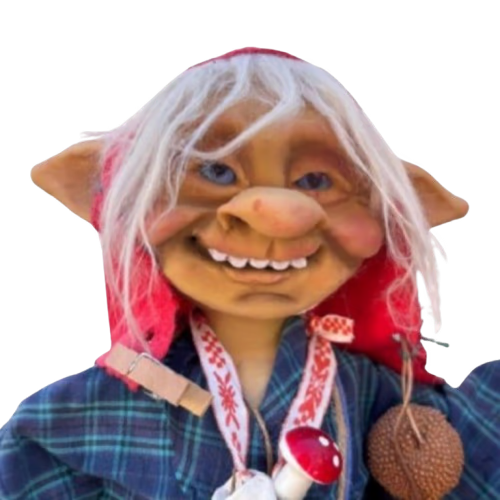
Invisible homeowner, huh?
Fun factWe love that the word “brownie” sounds like a cosy little biscuit… and then you find out its roots are actually proper folklore gold.
In old Scottish and Northern English tales, a brownie was a household spirit that came out at night to help with chores. The name most likely comes from their brown colour, the rough, earthy look of these little beings who blended right into the woodwork.
Where does the word “brownie” come from?
From that straightforward description: brown little creature → brownie. It’s like when you call your cat “Ginger” because, well, look at her. Same energy, just way older and with centuries of fireside stories behind it.
Why are brownies so linked to luck and good vibes?
Because if you woke up and the kitchen was magically tidy, or the cow had been milked, or the bread had risen perfectly, it was easy to think someone helped. And your brain went: “That was the brownie, obviously.” It was the old way of explaining those happy little coincidences that make your day better.
Magikito thought: maybe brownies don’t live under the stairs… maybe they live in that energy of “I take care of my home and my home takes care of me.” What tiny thing could you sort out today so good vibes have somewhere comfy to sit?

A Frog with a Family Tree
Fun factToday we went full-on pond philologists. A little ribbit popped off in the puddle and we thought... hang on, where does the word “frog” actually come from?
This word is old-school in the best way. We’re talking proper Old English here, back when everyone was speaking something that sounds like a different language entirely.
Where does the word “frog” come from?
From Old English frogga, which might be connected to the Proto-Germanic root meaning “to hop”. Makes sense, right? You see something small and green absolutely launching itself across a pond and you go: “that’s a hopper, that is.” Some scholars also link it to Old Norse froskr and Old High German frosc, all cousins in the great Germanic frog family.
Magikito takeaway: knowing where a word comes from is like shining a little torch on your day. If something in your head feels a bit odd today, ask yourself “where is this coming from?” and watch the pond get a whole lot clearer.
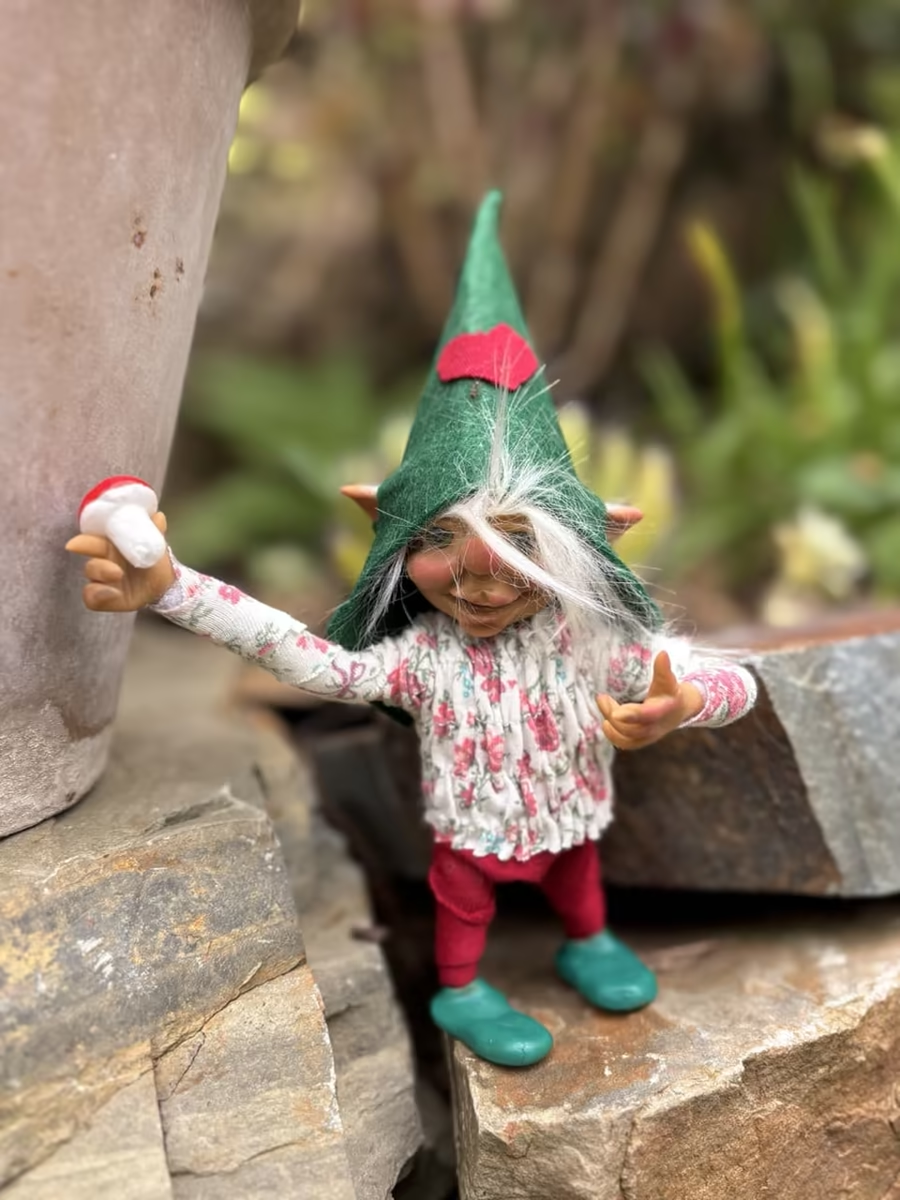
Moon-Mode Jumps
Fun factHere’s one of those “wait, what?” facts: on the Moon you’d weigh about six times less… without losing a single kilo
On the Moon, gravity is roughly one sixth of what it’s on Earth. Which means that if here you do a sad little hop and not even the cat notices, up there you could pull off a waaay more epic jump without your knees filing a complaint (okay, the spacesuit is not exactly jump-friendly, but you get the vibe).
Why do you weigh less on the Moon but your body doesn’t shrink?
Because mass (how much “stuff” you’re made of) doesn’t change just because you travel. What changes is your weight, which is the force a place uses to pull you downward. It’s like carrying the same sack of potatoes, but the floor has less motivation to hold it down.
Magikito conclusion: change the “pull” and everything changes. If you feel heavy today, maybe it’s not you… maybe it’s the place, the rush, or the pressure. What would happen if you gave yourself a little Moon time, even if it’s just slowing down?
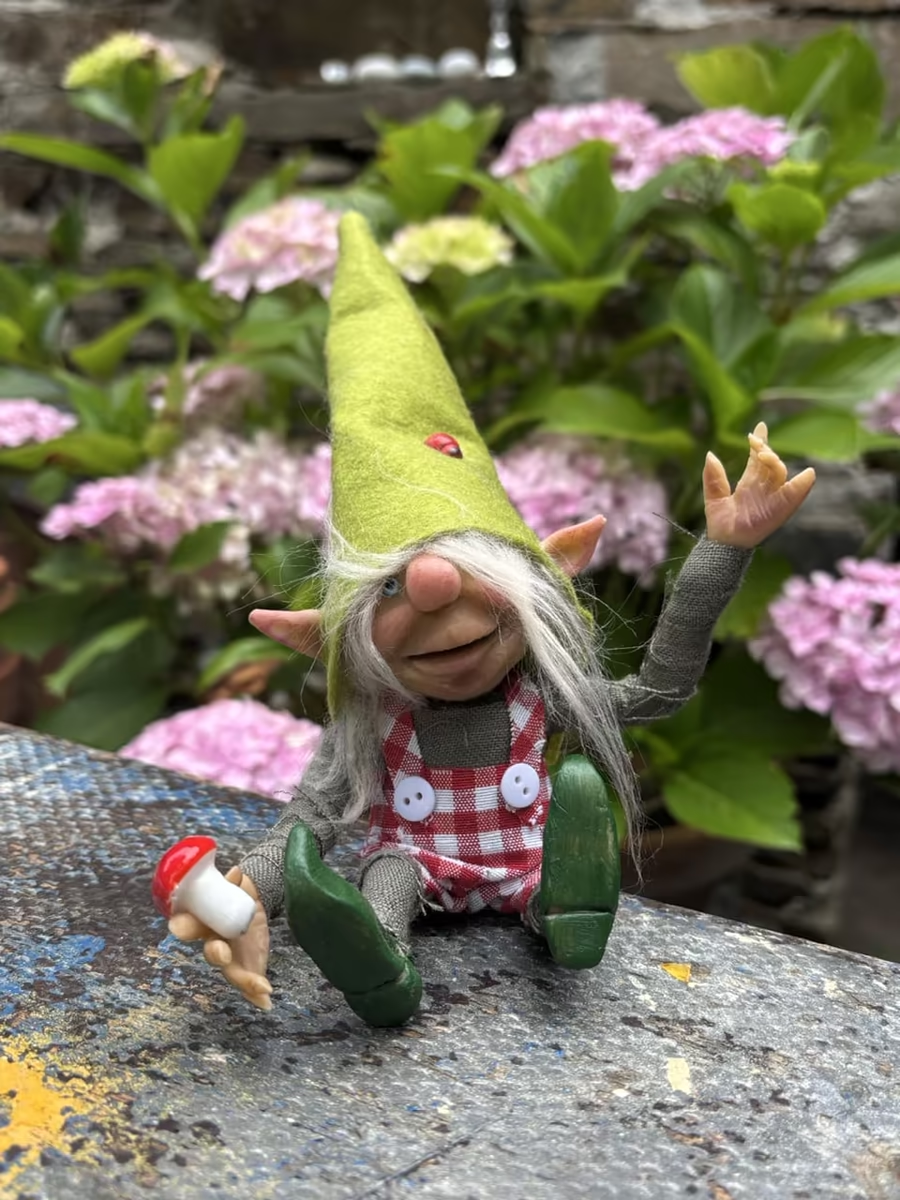
How to hunt clams and coquina clams, the art of reading sand like it’s a WhatsApp chat
Fun factSome people look at the shoreline and see “sand”. And then there’s the shellfishing crew, who look at the exact same sand and go, “yep, there’s a dinner hiding under here that’ll hit different”.
Looking for clams and coquina clams (those tiny, delicate little beach clams) is like playing “Where’s Waldo?” but with little waves and fingers going numb.
What signs does a clam leave in the sand?
One of the classic clues is a tiny little hole, or two, or a mini “8” shape. Lots of clams have siphons (like little straws) to breathe and filter water, and that leaves marks. It’s like when you pull the straw out of a soda and you get that little circle in the foam. Same vibe, but ocean edition.
Why do more clams show up at low tide?
Because when the tide is out, areas get exposed where they’re buried just a few centimeters down. That’s when the ground basically opens up and you can search without fighting the waves. The tide is the sea’s supermarket schedule. If you show up when it’s closed, you just get water and frustration. So yeah, you know what they say, the early bird gets a little help from the sea!
And coquina clams are often right in that strip where the waves break softly. Some people use their hands or a small rake and go slow, like they’re combing the sand. You just need patience and a sharp eye. This isn’t about brute force, it’s about keeping your wise grandma sensor fully switched on.
Magikita conclusion: some days life hides like a clam. You don’t pull it out by yelling. You get it by reading the tiny signs, waiting for low tide, and putting your hands where you need to, with zero “ew” energy.
Coffee makers at home: the “tribe” that defines you without you even noticing
Fun factWe’re about to drop a woodland truth on you: the coffee maker in your kitchen says things about you, even if you never signed any manifesto.
We see it like clans from Taramundi, each with its own little ritual.
What are the most common coffee makers, and what kind of coffee do they usually give you?
- Italian (moka): intense and classic, with that “glug-glug” that sounds like home. If someone at your place says “now this is real coffee”, there’s probably a moka nearby.
- Espresso (manual or super-automatic): short coffee, crema, and that bar vibe while you’re still in slippers. This is the “I don’t negotiate with anyone in the morning” machine.
- Filter / drip: big mug, gentle and steady. It’s the “I’ll keep working in little sips” coffee maker, like carrying a liquid blanket for hours.
- French press: body and those coffee oils, a more “rounded” texture. Perfect if you’re into the ritual of waiting 4 minutes while staring out the window like that counts as meditating (spoiler: it kind of does).
- Capsules: fast and zero drama. They’re the emotional microwave of coffee: boom, cup, go live. And if you feel fancy one day, you can always get picky then.
Very silly but true fact: a lot of “which coffee maker is better” arguments are actually “which morning am I about to face” arguments.
Magikita conclusion: pick your coffee maker like you pick your clothes, based on the day. And if your brain is running slow today, you don’t need to change your whole life. Maybe you just need to change the method and make yourself a cafelín with a bit more love.

The fungi that make zombies
Fun factYou’ve probably heard scary stories, but nothing beats what goes down under the forest leaves when an ant bumps into the wrong fungus. This isn’t a zombie movie, it’s nature playing 4D chess just to survive. There’s a fungus called Ophiocordyceps that can “hack” an insect’s brain and turn it into a remote-controlled puppet.
How does this natural hack work?
It all starts with an invisible spore landing on the little critter. The fungus grows inside, and instead of killing it right away, it takes over its muscles. It forces the ant to ditch her buddies, climb up a plant, and clamp down on a leaf with all its strength, in the exact spot with the perfect humidity and temperature for the fungus. Once the insect is locked in place, the fungus finishes the job and sprouts a stalk out of the insect’s head to fire new spores from up high.
Why do something so wild?
It’s not that the fungus is the neighborhood villain, it just found the most efficient way to spread its “seeds”. By making the insect climb to a high, breezy spot, the spores can travel much farther on the wind and infect more bugs. It’s pure chemical engineering written into the fungus’s DNA. The insect stops being a living creature and becomes a biological launch tower that helps the fungus conquer new territory.
The craziest part is how precise it is. The fungus knows exactly which muscles to lock so the insect’s jaw won’t let go, not even after it’s dead. It’s a macabre choreography that’s been running for millions of years in the quiet of the forest.
Magikitos interpretation: if today you feel like an idea or an impulse is dragging you, without you meaning to, to a place that isn’t good for you, pause for a second and check who’s actually flying this thing. Make sure your inner mycelium is always yours, and that nobody is using you as a launch tower for their own plans.
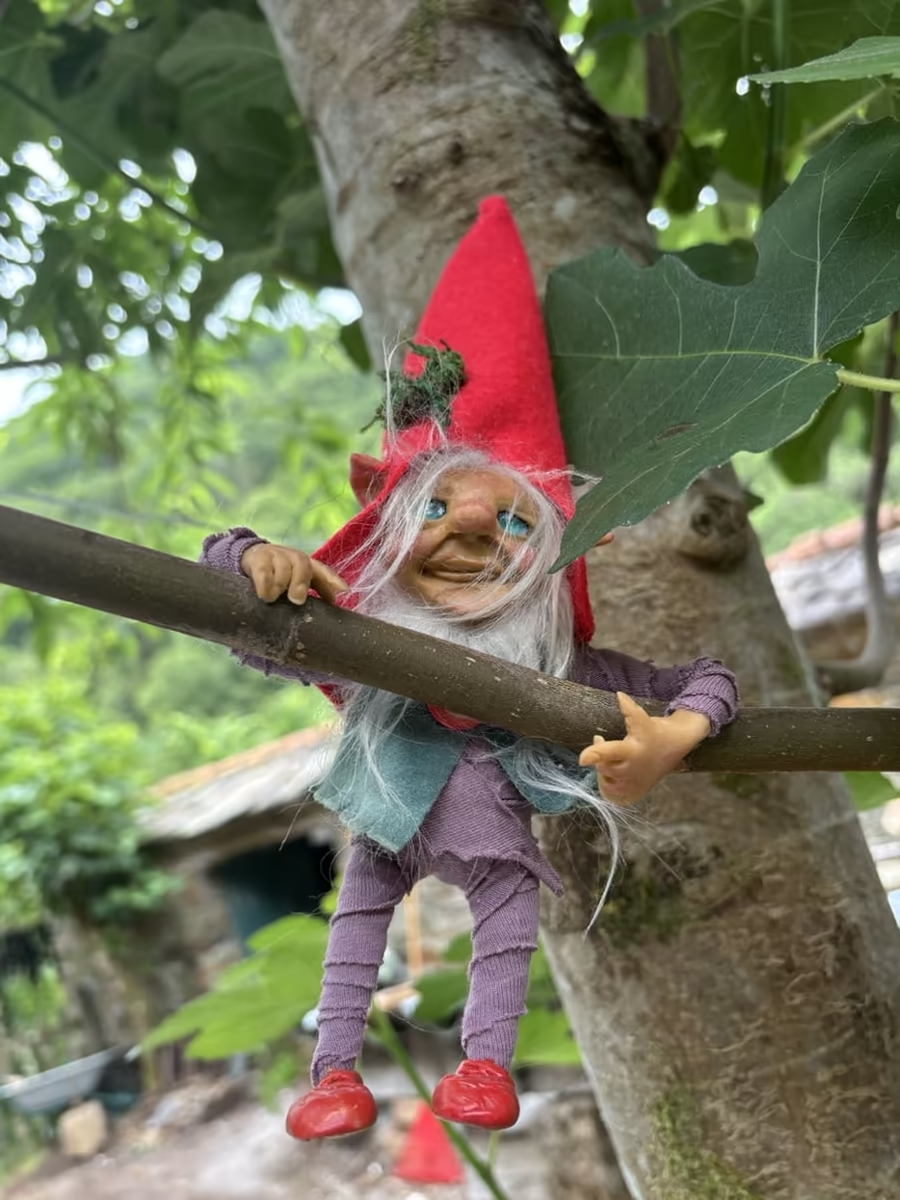
Komorebi: the light that slips through with manners
Fun factSometimes you’re walking along and the ground fills up with little patches of light that dance, like the forest is tossing shiny confetti. It’s not the sun blasting straight down, and it’s not full shade either. It’s that soft light that has to politely ask the branches for permission to pass. In Japan there’s a gorgeous word for this moment: Komorebi.
How does Komorebi actually work?
What you’re seeing is an obstacle course. The leaves act like a giant sieve that splits sunlight into thousands of golden threads. When the wind nudges a branch, those threads shift around and the shadow changes shape, like it’s alive.

It’s light with texture, filtered and calm, and it only shows up when the trees decide to share the sun with you.
What’s the etymology of Komorebi?
Its name is like a three-piece puzzle that clicks perfectly into place. First comes Ki, which means tree. Then there’s Komore, the act of slipping out or sneaking through a narrow gap. And it ends with Bi, which means sun. Put together, the word paints that beam of light that made it through the leafy maze to reach the ground. It’s almost like the light had to make an effort just to say hi.
The funny thing is, once you learn its name, you stop seeing “random light spots” on the ground. You start noticing the wind’s rhythm in the shadows, and how the colour shifts depending on which tree is above you. By naming it, you turn an ordinary moment into a private little gift the forest gives you just because you happened to walk by.
In the forest we use it as a sign: if today feels a bit grey, go find a slice of Komorebi, even if it’s in a window reflection. That light sneaking in wherever it can is proof there’s always a crack where a little calm can slip through.
The shortest sound in the world
Fun factCan a sound exist that lasts less than a blink?
Yep. There are sounds so fast they could happen thousands of times in the time it takes you to close and open an eye. In labs they create “single-cycle pulses”, basically the shortest signal you can possibly make. It’s not a tune or a song, it’s more like a microscopic air bump. The wild part is your ear can still catch that signal even if it lasts next to nothing, like when a tiny twig snaps in the forest silence and your head turns instantly.
Why doesn’t a mini-sound feel like a musical note?
To get it, picture the difference between a single clap and the sound of an engine running. For your brain to feel like it’s hearing a musical note, it needs lots of waves in a row, repeating with a steady rhythm. It’s like the sound has to “draw” a pattern in your head so you can say “yep, that’s a C”.
A single-cycle pulse is like a whip-crack. It shows up and vanishes before your brain can even decide if it’s high or low. Instead of a clean note, what you hear is a snap or a dry click. It’s like stuffing every musician in a band into one room and asking them to play one note all together for a thousandth of a second. You wouldn’t catch the song, but you would feel the hit of sound at full power.
Magikita conclusion: sometimes one tiny signal, like a small gesture or an inner click, isn’t a melody that lasts all day, but it’s strong enough to flip the whole scene. Don’t underestimate short moments, that’s where movement usually starts.
The Moon’s reflection on the sea
Fun factYou know that thing that happens a million times when you’re strolling along the beach at night. You stop and stare at the Moon sitting over the water, and the glow isn’t a neat round blob. It looks like an endless road of light rolling straight toward you. And if you move along the shore, that road follows you like your ride-or-die bestie.
Why does the Moon’s reflection on the sea look like a path?
To get it, picture the sea as a floor covered in shattered mirrors that never stop wriggling. If the water were as still as your bathroom mirror, you’d only see a perfect circle. But because the sea has waves and ripples, every little patch of water acts like a tiny mirror, bouncing the Moon’s light back.

The funny bit is that from where you’re standing, you can only catch the reflections from the waves that are tilted just right toward your eyes. Since there are thousands of tiny ripples between you and the Moon, all those sparkles line up and boom, you get that shiny “path.” The light is actually going everywhere, but you only receive the little “flashes” aimed at your exact spot. You’re the main character of your very own lunar highway!
Rain smells like happy soil too: Petrichor
Fun factWhy does that first post-rain smell make you want to inhale like you’re a tree on a mission?
You know the moment. After loads of sunny days in the woods, the first drops fall and suddenly everything smells like pure bliss. That legendary scent has a name that sounds like a spell: petrichor. What lots of people don’t know is that this word hides a story of gods and myths that’s going to leave you properly mind-blown.
Where does the word petrichor come from?
To get it, we’ve got to take a little brain-trip to Ancient Greece. The word splits into two parts. “Petra” means stone, but the juicy bit is the second half, “Ichor”. For the ancient Greeks, ichor was the blood of the gods, a golden, magical liquid that ran through immortal veins instead of the red stuff we’ve got. So when we say petrichor, we’re literally saying that the smell of rain is like the gods’ blood running through the veins of stones.
Why does that first post-rain smell make you want to breathe like you’re a tree?
It’s probably happened to you. After many sunny days in the forest, the first drops fall and suddenly everything smells like heaven. That mythical scent has a name that sounds like a spell: petrichor. What lots of people don’t know is that this word hides a story of gods and legends that’ll leave you totally wowed.
What is petrichor, really?
That signature petrichor smell comes from a substance called geosmin. Picture the soil as home to invisible mini-bakers, teeny-tiny bacteria. When the ground is dry, these bakers make geosmin and stash it on the surface like sacks of flour. The moment raindrops smack the ground, they trap little air bubbles against the soil. It’s like the rain makes tiny soap bubbles that shoot upward, loaded with that baker “flour”.
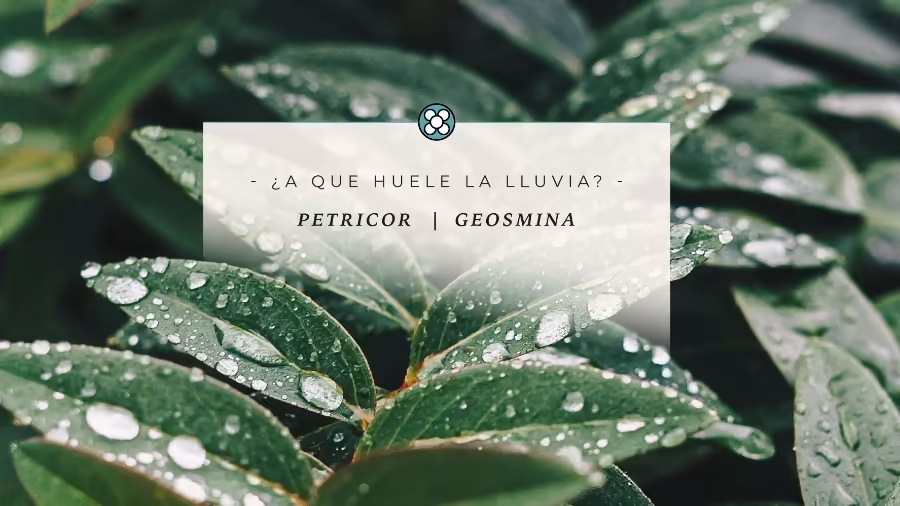
When those bubble-babies pop in the air, they fling the geosmin scent straight into your nose. That’s why it hits hardest right at the start of a storm, because thousands of “divine blood” bubbles are bursting at once. Humans are ridiculously good at detecting this aroma, even better than a shark sniffing blood in the ocean, because for our ancestors, smelling rain meant life and food were close.
Magikita conclusion: some things only smell good when they come back after a dry spell. If today you feel something getting better with just a couple drops of attention, you know what to do. Water it a little and enjoy the gods’ aroma waking up again.
Smells travel differently depending on the humidity
Fun factWhy does fresh toast sometimes smell all the way from the neighbor’s place… and other days you only catch it if you shove your nose right up close?
Because smell isn’t some free-roaming spirit. It’s basically a whole crowd of tiny molecules cruising through the air. And the air, depending on whether it’s dry or humid, either gives them a smooth highway or makes them run an obstacle course.
So what does humidity have to do with scent?
With more humidity, there’s more water floating around in the air. Some aroma molecules latch onto those micro-droplets, and that makes it harder for them to scoot about. So the smell stays closer, heavier, more “right here.” When the air is drier, certain scents spread out and travel farther, happy as anything, like they’re rolling downhill on a scooter.
In the woods we use it as a home-oracle: if your toast doesn’t “sing” today, don’t get grumpy. Maybe the day is in sticky mode, and it’s one of those times where you’ve got to lean in closer to the good stuff to really enjoy it.
The car that looks like it’s rolling backwards
Fun factHave you ever seen a wheel in a video that looks like it’s spinning the wrong way?
In the forest we call it “the proud wheel”. You can see the cart moving forward down the path, but the wheel looks like it’s going backwards, like it just wants to disagree with the oxen. It’s not that the wheel has lost its marbles or that the driver accidentally threw it into reverse. It’s really a little trick your eyes and cameras fall for when they watch something spinning super fast.
What is the stroboscopic effect?
To get it, picture one of those tiny flipbooks where you draw a little doodle in the corner of every page. If you flick the pages fast, the drawing looks like it moves. Video cameras do the same thing, they take lots of pictures one after another, really quickly, then stitch them together. The glitch happens when the wheel spins at a speed that doesn’t line up with the camera’s rhythm. Imagine the camera snaps a frame when one point on the wheel is right at the top. If, by the next frame, the wheel has almost done a full turn but stops just a tiny bit before reaching the top again, your brain gets confused. It thinks the wheel moved a little backwards instead of making almost the whole turn forward. It’s like blinking super fast while someone is dancing. You only catch little slices of the movement and your brain fills in the rest the best it can.

This happens to us in the workshop too with fans, or with some lights that flicker so fast we don’t notice. They still change the way we see things that move. In the end, what we see depends completely on the rhythm we use to look at the world.
Magikita conclusion: sometimes the “unbelievable”, or what looks like it’s going backwards, isn’t out there in the world. It’s in the way we’re looking. If you change the rhythm you use to watch your problems, you might realize they’re not going backwards at all. They’re moving forward in a way you just hadn’t decoded yet.
Why do we draw the heart “wrong”?
Fun factHave you noticed how the heart we doodle looks nothing like the real one, not even on a foggy day?
If you look at a cartoon heart and then at a real one (the one thumping inside you), you’ll see they’re as similar as chalk and cheese. Basically, not at all.
A proper, organic heart is more like a fist with tubes, but the red symbol everyone draws is way more sleek and cute.

The funny thing is that this drawing didn’t come from painters who studied medicine, it came from century after century of people scribbling and refining the vibe.
Where does the heart shape come from?
No one knows for sure, but there are a few theories lurking around that we absolutely love. One says that thousands of years ago people drew ivy leaves, the kind that twist around and hug forest trees, to show that two people were bound together. Another theory says it comes from an ancient plant called silphium, whose seeds had that exact shape, and it was used so much to talk about love that it basically became love’s official logo. Over time, artists rounded the corners until we got the heart we know today: ❤️.
Why does everyone draw the simplified heart?
Picture this. You want to tell someone you love them with a quick drawing in the sand or on the fogged-up window of their ride. If you had to draw a real heart with all its veins and ventricles, you’d be there forever. The little heart icon won because it’s easy to repeat: two curves, a point downwards, and boom, message delivered. It’s like a secret code everyone understands in one second without having to be some big-time artist.
In the forests of Taramundi, we know the important thing isn’t that the drawing is perfect, it’s that when someone gets it they go, “yep, that hit me right in the heart”. Sometimes the simplest thing is what leaves the deepest mark.
Why does snow “crunch” differently depending on the cold?
Fun factHave you noticed snow can sound like a cookie… or like sad cotton too?
On snowy days, when the whole forest turns white, we love listening to what our footsteps have to say. Sometimes the snow sounds like a party, other times it’s a bit “squish squish”. It’s not magic, it’s just temperature remixing your boots’ soundtrack without warning.
Why does snow crunch?
To get it, imagine snowflakes as super thin tiny glass cookies. When it’s crazy cold (way below zero), those little cookies are stiff and hard. When you step on them, they all snap at once. That “crack” you hear is thousands of icy micro-structures popping into pieces under your weight. It’s like crushing extra-crunchy cereal in a bowl.
But when the sun warms things up a bit and we’re close to zero degrees, the snow gets lazy. A thin film of water shows up on top, like the cookies got dunked in milk and turned soft-ish. Instead of breaking with a sharp sound, the flakes stick together and squish without complaining, soaking up the noise instead of letting it out. That’s why your steps sound duller and more muted, like you’re stepping on a pile of damp cotton.
It’s brilliant because, without even looking at a thermometer, your ears and your boots already know if the ground is in crunchy mode or in soft mode. It’s like an ankle-height weather report.
Magikito conclusion: if your day is crunching today, maybe you’re in rigid mode and you need a little calm. If your day goes “squish”, maybe you need less toughness and to let yourself flow a bit more. In the end, both sounds still point you back home.
The “click” language: chatting with real clicks
Fun factWhat if we told you there are languages where a click counts as a letter?
In several languages in southern Africa (like some in the Khoisan family and also Bantu languages like Xhosa or Zulu), there are consonants made of clicks. They’re not special effects or “joke sounds”. They are a normal part of words and they change meaning, just like a “p” or a “t”.
How do you make them? You create a tiny pocket of vacuum with your tongue inside your mouth, then release it in one go. Different clicks pop out depending on where your tongue touches, dental, lateral, and so on. That “tsk” we use for disapproval can be a crisp, precise sound over there.
Magikito conclusion: the world is packed with conversations (explore some in the Slangtionary) that sound like a weird little whisper… until you learn the secret code.
The water dance: whirlpools that even “hook up”
Fun factCan one whirlpool chase another like they’re playing cat and mouse?
Yep, and it’s super weird to catch in the wild: two nearby vortices can interact and do this kind of dance. If they spin in the same direction, they tend to orbit each other and, over time, can merge into a bigger one. If they spin in opposite directions, they sort of “push” each other away and can split up or fizzle out sooner.
This isn’t poetry, it’s fluid dynamics. You see it in the ocean, in the atmosphere, and even in lab demos with colored dyes, where it looks like the water is plotting a whole drama series.
The most Magikito part is the absurd little moral: some things, when they’re alike, stick together and make an even bigger mess. And others, just for being contrary, dissolve fast.
If today you feel in “whirlpool mode”, look at yourself kindly. Maybe you’re just trying to find someone to spin with, without splashing yourself all over the place.
The handbag was invented for one very specific reason
Fun factWhy did the handbag show up if pockets already existed?
There was a time when clothes lost their pockets in a pretty… strategic way. At the end of the 18th century, dresses changed shape and got more fitted. That made the inner pockets disappear, because there was simply nowhere left to hide them.
What are inner pockets?
Picture this: back then, pockets weren’t sewn into the garment like they’re now. They were more like two separate little pouches tied around the waist with a ribbon, under the skirt. They were huge and you could stash basically anything, but once dresses got slimmer, those pouches made awkward bulges and looked terrible.
To fix the space problem, the reticule became the big hit (also spelled retículo).

Pretty wild how this whole story began, right?
What is a reticule?
It was the great-great-great-grandparent of the handbag: a small, elegant little pouch worn hanging from the wrist. Since clothes no longer had their own storage built in, people started carrying their things on the outside.
The fun part is the handbag wasn’t born just to show off, it was pure textile architecture. If the structure of your outfit won’t let you carry anything, you invent an external accessory. And once that habit stepped onto the stage, it never left. Today we carry half our life in there: keys, gum, and even parallel universes.
We Magikitos see it as a big lesson: sometimes it’s not that you need something new, it’s that you’re trying to make up for what’s missing in the foundation. And wow, that explains a lot of human choices.
The weirdest map: an island that never was
Fun factWhat if we told you that for years people kept drawing an island… that was totally made up?
On North Atlantic maps, an island called Frisland showed up for centuries. It looked so official, so perfectly placed, so “proper map-like” that loads of people just accepted it as real. Most likely it started as a messy mix of travel tales, copied charts, and someone getting a bit too creative while reading old voyage stories. And once you draw it, others copy it, and suddenly the lie has a coastline, mountains, and even a whole vibe.
The wild part is that maps can inherit rumors too. Back then, fixing them was slow. You needed expeditions, you needed someone to come back alive, and you needed a cartographer to feel like rewriting the world in ink.
So yep, there were sailors out there with a ghost island living rent-free in their heads. And honestly, that feels very human.
Magikito conclusion: sometimes the mistake is not getting lost, it’s following a borrowed certainty without asking, “Wait… does this actually exist?”
Bialetti’s last trip: a moka turned into an urn
Fun factCan you imagine your final goodbye happening inside your own invention?
Well, this actually happened: when Alfonso Bialetti (the man behind the iconic moka pot, the “Moka Express”) passed away, his ashes were placed inside an oversized moka. Not a bar story. It’s a real fact, quoted all over Italy and retold as a design-history curiosity from everyday life.
And it leaves us staring into our coffee, somewhere between a laugh and a little bow of respect. Because some people sign paintings, others sign buildings, and Bialetti signed breakfasts. There’s no monument more stubborn than something you use half-asleep every morning, hair doing its own thing, whispering “just one more sip before work”.
The weirdest and sweetest part is that the moka, which runs on pressure, turns into a symbol of the total opposite here: rest. Like saying, “let me be, I’m having my little coffee in peace”.
Magikito reflection: how lovely it would be to leave behind something so humble and everyday, something people hold close without even realizing it.
Sleepytime infusions: the trick isn’t magic, it’s gentle chemistry
Fun factWhy does valerian feel like it whispers “shhh” from the inside?
In the forest we’ve got a little ritual: when the afternoon starts buzzing, we pull out the kettle like someone grabbing the off switch for the brain lights. And it’s not just an English habit we decided to steal. A lot of “sleepy” plants have compounds with real effects, even if they’re subtle and they hit everyone a bit differently.
- Valerian: the root contains valerenic acids and other compounds linked to modulating the GABA system, which is basically your brain’s natural brake. It doesn’t knock you out, it turns the volume down.
- Passionflower: it has flavonoids like vitexin. Traditionally it’s used for nerves and falling asleep, also tied to that GABA calming vibe.
- Lemon balm (melissa): rich in rosmarinic acid, famous for soothing both your belly and your mind, which are sometimes the same creature with two heads.
Extra dose: if you keep feeding your day caffeine late into the evening, no little flower is doing miracles. Infusions help… but the night is the boss.
That “beep” you never hear: the black box isn’t black
Fun factCan you imagine losing something in the sea and it going “beep beep” for a whole month?
The famous plane “black box” is actually usually bright, shouty orange, so it’s easy to spot among debris, even underwater. Plus it carries a little device that, if it ends up in the ocean, sends out acoustic pulses so they can track it down. The funny part is that this “beep” isn’t like a whistle, the kind the PE teacher blasts and you can hear from the beach. It’s usually ultrasonic, and it travels better through water than through air.
It cracks us up because it’s the opposite of a mystery. From the outside, it looks like the plane vanished into the sky. On the inside, everything is logged with pin-point precision, like the sky keeps a homework notebook.
Magikito conclusion: if one day you feel like a “black box” about to burst, at least go orange. Asking for help is also a way of landing.
The world’s longest echo (with a little scare, too)
Fun factCan you imagine clapping… and getting clapped back half a minute later?
In some truly huge places, sound can bounce around so much that the echo takes ages to return. A famous example is in very long underground galleries: echoes lasting dozens of seconds have been recorded, as if the air needed a moment to think up its reply.
The funny part is that when an echo arrives late, your brain reads it almost like it’s “something else” rather than your own sound. That’s why in caves or tunnels people end up speaking softly… not out of respect, but to avoid summoning a “second me” on a delay.
Magikito conclusion: if your words come back late, it wasn’t indifference… it was sleepy acoustics.
Language and its semantic haze: calima, fog and mist aren’t the same
Fun factFog, mist, calima… are we naming the same mystery?
Today we felt like playing language detectives, and we discovered that even when everything looks like the same grey “smudge,” each thing has its own name depending on how much (or how little) it lets us see:
We talk about Fog when visibility drops below 1 kilometer. It’s full-on “hide-and-seek mode”: the water droplets are so dense that the world seems to close in around you. Mist on the other hand, is its more discreet cousin. It still lets you see beyond 1 kilometer. It’s like the forest puts on a soft silk filter… but still lets you guess the path.
And Calima… ah, that’s a different kind of trick! It has nothing to do with water. What’s floating is solid particles: dust, sand in suspension, or even ash. The result isn’t a damp grey, but a milky sky and an orange-ish or strange light, like the day wrapped itself in a blanket of fine earth.
Magikito conclusion: sometimes what looks the same on the outside has a different ingredient on the inside.