
On His Own
Five days, a postcard and three words in the space left over
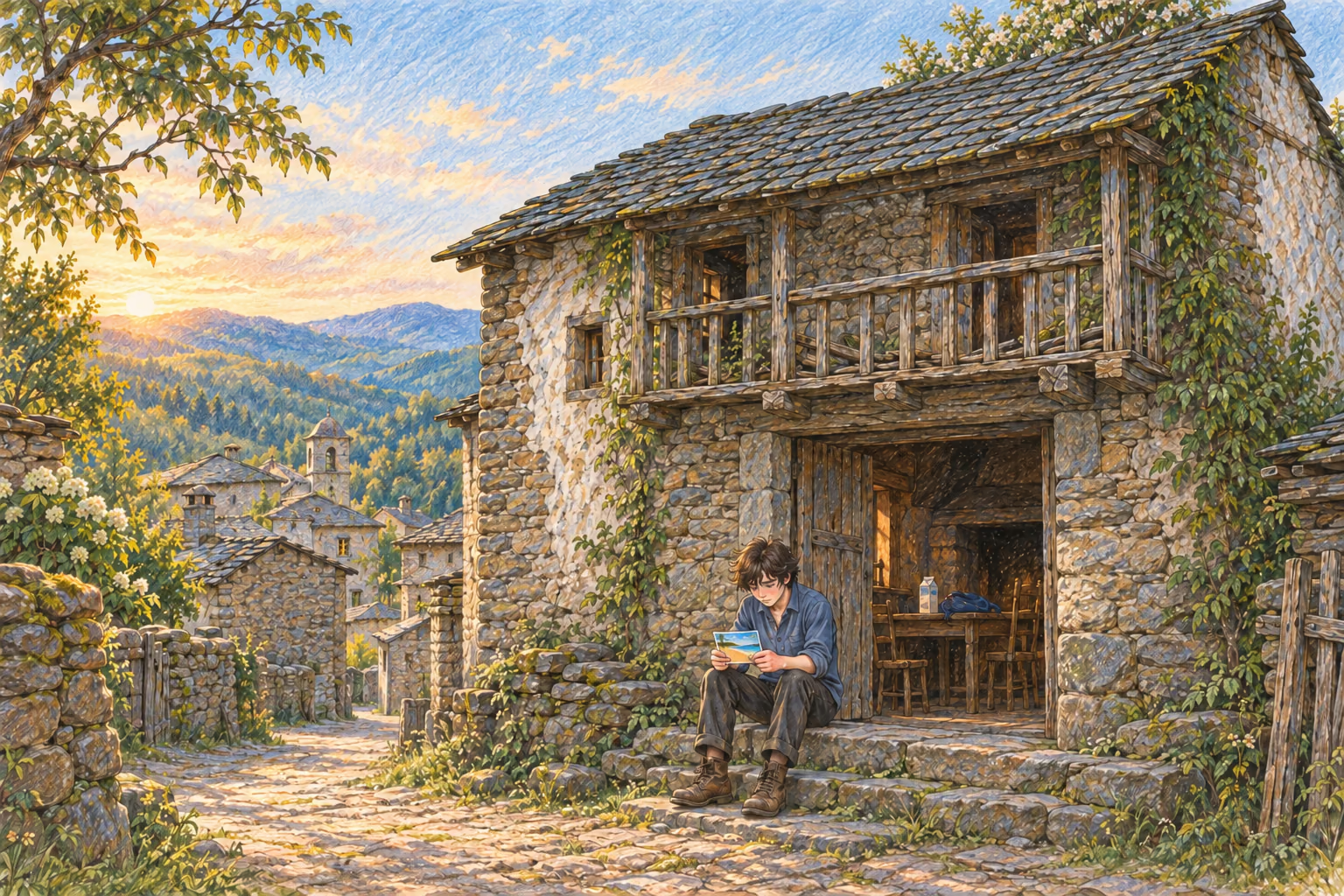
The first day he looked for her.
He knew she wasn’t in any ditch, because he’d heard the car come up at eleven and go back down. He looked for her anyway. He went down to the shop and Trini told him she hadn’t been in. He walked as far as the bend at the bottom, looking to see if the grass on the verges was flattened or standing.
Nothing.
He got back at four, soaked, and sat down in the kitchen with his boots on.
The second day he didn’t do anything. And that scared him, because he always did something. He stayed in the hammock until eleven. He made himself a coffee and drank it cold. He didn’t sweep. He didn’t take a single slate up. He didn’t carry on with the frame of the balcony door, which he’d had half-done since July.
At midday he went out onto the balcony, which was where there was a bar of signal, and looked at his account. A hundred and thirty-eight euros. Úrsula’s ladder not paid for. And in Trini’s book, three weeks of beers that weren’t his.
Then he went down to the garden and counted the slate still to go up.
Three thousand six hundred.
On his own, at a hundred and eighty a day, that was twenty days. There were thirty-five left before the order ran out. That week it had rained on four of them, and you don’t go up on a wet roof.
He counted it again. It came out the same.
And he couldn’t have cared less.
That night, in the hammock, it came back.
The pit of his stomach one. The one that hadn’t turned up for weeks and that he’d got quite fond of, without telling anyone, it had been so far away.
All of it. Hadn’t lost a thing.
And that was with half a roof done by his own hands.
The other hammock, a metre and a half away, was empty. With the fabric still sagging where she’d slept.
On the third day he rang Hortensia from the balcony. He told her everything, without dressing it up.
Hortensia went quiet for a very long time.
“Oh my God, love. It was me.”
“It wasn’t you.”
“It was me, I took the phone off the Guardia Civil.” Her voice sounded odd. “I’ve spent my whole life sticking my nose in where it’s not wanted. I’ve sorted out weddings and I’ve sorted out inheritances, and it’s always come off, and you get used to it coming off.”
“Hortensia.”
“What?”
“You took that phone to tell her to let her live.”
On the other end there wasn’t a sound.
“And then you texted me to make sure she was the one who found out. With an ‘okay?’ on the end. I’ve got it here.”
“I know,” said Hortensia. And blew her nose.
What really got to him was a line of his.
I’ll let you know.
It came out on its own, at all hours, in his own voice.
And another one that wasn’t his.
And you didn’t say anything either, did you?
On the fourth day he came down to the kitchen and made himself a coffee. The first hot one in four days. When he turned round with the cup, Gorgorito was sitting on the back of the chair opposite.
Axel stood still, waiting for the wind-up. The chocolate thing. The greedy-guts thing.
Gorgorito stayed as he was, hands on his knees, looking at him.
Axel sat down and drank his coffee. The other one didn’t move the whole time. Not a word.
When he got up to wash his cup, the chair was empty.
The postcard came on the fifth day. Trini brought it up herself, and she only came up that hill for birthdays.
“This came.” She handed it over and didn’t leave. “And another thing. If anyone rings the landline again asking about you lot up here, my shop sells bread and nothing else.”
“Trini, it wasn’t you, love.”
“I know it wasn’t me.” She pushed her glasses up her nose. “But it was my phone.”
A cardboard postcard, with a hideous photo of a beach that had nothing to do with anything. On the back, Clara’s handwriting, very round:
AXEL! Your parents gave us the address. You’re in a house! With a roof and everything! Send us a photo, we don’t believe it. We’re keeping the games, thanks. We play nearly every Thursday. Love, CLARA.
And underneath, squeezed into the bit that was left, in much worse handwriting:
I thought you’d get over it in two weeks. I was wrong. B.
Axel sat down on the step with the postcard in his hand. Behind him, through the open door, you could see the unopened carton of milk and the empty blue rucksack on the table.
And that’s where, finally, the tears came.
His eyes were still like that when the folder guy came up, with his gilet zipped to the neck, in August.
“Afternoon.” The advert smile. “Álex, isn’t it?”
“Axel.”
“That’s it. Axel.” He looked at the rucksack through the open door. “I heard, man. I’m sorry.” He really was sorry, and that was the worst bit. “One thing and I’ll be off.”
He sat down on the wall without anyone asking him to.
“Look, I’m going to be straight with you, because you’re one of the authentic ones. We don’t buy houses. We restore heritage. We give the village a second life.” He opened the folder without looking at it. “And the thirtieth’s coming up fast. The council’s already asked the demolition people in Oviedo for a quote. For the third.” He looked at the sky, like someone warning you it’s going to rain. “We don’t want it to come to that, yeah? But it will.”
And out of the folder he took a very clean little metal plaque, with its little leaf drawn on it and its two words in English, just like the ones on the four boarded-up houses. And a little bag with four screws in it.
“We brought that one ready-made,” he said, seeing him look at it. “Saves two trips.” He shut the folder. “You know the lady. She trusts you. You tell her when the time’s right.”
Axel opened his mouth to say okay. It came out on its own, like the “it’s fine”.
“No,” he said.
The folder guy smiled harder.
“Have a think about it, mate. No rush.”
“No.”
He didn’t dress it up.
The folder guy sat there a second with the smile on, waiting for the rest. It didn’t come. He got up, took his phone out and took a photo of the front of the house, with the order on the door and Axel on the step.
“For the ‘before’ shot,” he said, smiling.
And he went off down the street.
Axel stayed on the step watching him go down. Waiting for something. A slate in front of his trainers. Anything.
Nothing. The four-by-four got to the bottom without a scratch.
That night he got up on the stool and looked up the chimney. Yayo was still there, curled in a ball, with his bit of blanket underneath.
“Oi, mate.”
Nothing.
“I’ve fucked it up.”
Nothing.
“And I don’t even know how to say sorry. What comes out is explaining.” He shifted his weight onto the other foot. “Which is what I’m doing now with you, and you’re asleep. That’s how bad I am at it.”
He got down off the stool.
A rage came over him, the kind that doesn’t warn you. He grabbed the broom, planted himself in the middle of the kitchen and swept five days of dirt and ash in a straight line towards the bottom of the stairs. On purpose. With feeling.
When he got to the last step he lifted the broom and stood there waiting.
Nothing happened. The milk on the table, the rucksack next to it, and upstairs the elder tree moving in the air.
He stood there with the broom in his hand, feeling like the stupidest bloke in the northern hemisphere.
Then he picked it all up and swept it again from the beginning. The other way. Towards the door. Slowly and properly, the way they’d told him.
Costs nothing.
At quarter past twelve, down below, outside the hotel, a car started honking.
It honked for a minute. Stopped. Started again.
At one it was still going. At two the lights came on in half the bottom street. At three Axel went out onto the balcony in his boxers and saw it from above: the four-by-four in the car park outside the hotel, with all four indicators flashing like a funfair, nobody inside and nobody near it.
A hotel window opened.
“Somebody turn that thing off, for God’s sake!”
And shut again.
And Axel laughed. On his own, on a balcony, at three in the morning. For the first time in five days.
It honked till ten past six.
At half seven he went down for bread, because he hadn’t bought anything in five days.
The folder guy was in the shop, with bags under his eyes down to his chin and his gilet done up wrong, paying for a coffee.
“All night,” he was telling Trini. “Nobody touching it. And it’s new, you know? New.”
Trini rang it up without looking up.
“Martens.”
“Sorry?”
“Pine martens.” She tore off the receipt. “They get in the engines for the warmth. One twenty.”
The folder guy paid and left looking at the floor.
Trini looked at Axel for a second over her glasses and went back to her boxes.
He went up with the baguette under his arm and stopped in front of the door. The order was still in its plastic sleeve, with its stamp and its date. He read the whole thing, as if he didn’t know it by heart.
Then he went in, put the bread on the table, next to the milk, and opened the milk.