
With Nobody
Five days, a postcard and two words in the space that was left
The first day he looked for her.
He went down to the shop and Trini told him she hadn’t come by. He went out to the road and walked two kilometres to the bend below, looking at the verges, looking at whether the grass was flattened or standing, which was the first thing she had taught him. He asked at the three houses on the bottom street.
Nothing.
And he knew perfectly well she wasn’t in any ditch, because he had heard the car come up the street at eleven and go back down again. He walked the two kilometres anyway, looking at the mud on either side. The other option was to sit down.
He got back at four in the afternoon, soaked, and sat at the kitchen table with his boots still on.
The second day he did nothing. And this surprised him, because he always did something. He got up, sat on the bed until eleven, went down, looked at the roof without climbing up, made himself a coffee, drank it cold. He didn’t sweep. He didn’t lay slates. He didn’t carry on with the window frame, which he had half done.
There were four and a half weeks left until October. He knew that perfectly well. He stood looking at the hole at the back from the vegetable patch, counting them, and he didn’t care in the slightest, and that was the first thing that properly frightened him.
By the middle of the afternoon he had spent eleven hours waiting for something to make a sound.
At night, in the hammock, the one from the kitchen came back.
Two fingers below the breastbone. The one that hadn’t visited him for months and that he had, without telling anybody, grown almost fond of for how far away he kept it.
It was whole. It hadn’t lost anything on the way.
And he had mended a roof.
The third day he rang Hortensia. He told her the lot, whole, unadorned, just as it was, which was what she had asked him for over the business with the house and worked for this as well.
Hortensia went quiet for a very long while.
“Oh, dear God,” she said.
“Yes.”
“Oh, dear God, love, it was me.”
“It wasn’t you.”
“It was me, taking that call from the Guardia Civil.” She sounded very bad, her voice odd. “Sticking my nose in where nobody asked me from minute one. And I have been like this all my life, you know? All of it. I have fixed weddings and I have fixed inheritances and I have put my hands into things that weren’t mine, and it has always turned out well, and a woman gets used to it turning out well.”
“Hortensia.”
“What?”
“You took that call to tell her to let the girl live.”
Nothing was heard at the other end.
“And then you took it again, and that time you didn’t.”
“Aye,” she said.
And neither of them knew what to add to that.
What galled him most, when he sat down and looked at it straight, was one very specific thing. It wasn’t having talked to Irene.
It was the sentence.
I’ll let you know.
It repeated itself on its own, at all hours, in his own voice, and every time he heard it he felt a physical shame, the kind that makes you clench your teeth in the middle of the street. Because that sentence hadn’t been said by a bloke who was helping.
There he got stuck. He got stuck because the list of things that came rolling in on top of him had nothing to do with it: the rounds he had paid for, the money he had lent and never asked back, the house moves he had turned up to without anybody calling him, the screwdriver before anything had broken.
He didn’t understand what all that was doing on the same list as that sentence.
There was a second sentence, and that one was worse because it wasn’t his.
And you didn’t say anything either, did you.
A bloke with his hand on the roof of a car had said it to him, on his way somewhere else and meaning to hurt, and it had been rattling around inside him for days without permission.
And what he couldn’t get his head round was how both of them could be his: the keeping quiet when he should have spoken and the speaking to somebody it wasn’t his place to speak to.
It seemed to him there was something there, something almost visible, like a word you have on the tip of your tongue.
He spent two days on it and it didn’t come.
The fourth day Gorgorito appeared. He was sitting on the back of the chair opposite when Axel came down in the morning.
Axel stopped in the doorway and waited for the wisecrack. He waited for the chocolate line, or the greedy-guts line, or any of his usual ones.
The brownie stayed as he was, hands on his knees, looking at him.
Axel sat down, made his coffee and drank it. And the other one stayed the whole time.
When he got up to wash the cup, the chair was empty.
The postcard arrived on the fifth day. Trini brought it up in person, having gone four days without speaking to anybody out of shame, and handed it to him at the door without coming in.
“This came.”
“Thanks.”
“I didn’t know anything, Axel.”
“I know that, Trini.”
“It’s just that I thought that…”
“It’s all right. It wasn’t you.”
Trini nodded and went down the street.
It was a postcard. A real postcard, the cardboard kind, with a hideous photo of a beach that had nothing to do with anything.
On the back, Clara’s handwriting, very round:
AXEL! Your parents gave us the address. So you’re in a house! With a roof and everything! Send us a photo because we can’t believe it. Everything the same here, lots of work and not much fun. We’re keeping the board games, thanks, we play nearly every Thursday. The Carcassonne box broke. Love, CLARA.
Underneath, squeezed into the bit of space that was left, in much worse handwriting:
I thought it’d wear off in a fortnight. I was wrong. B.
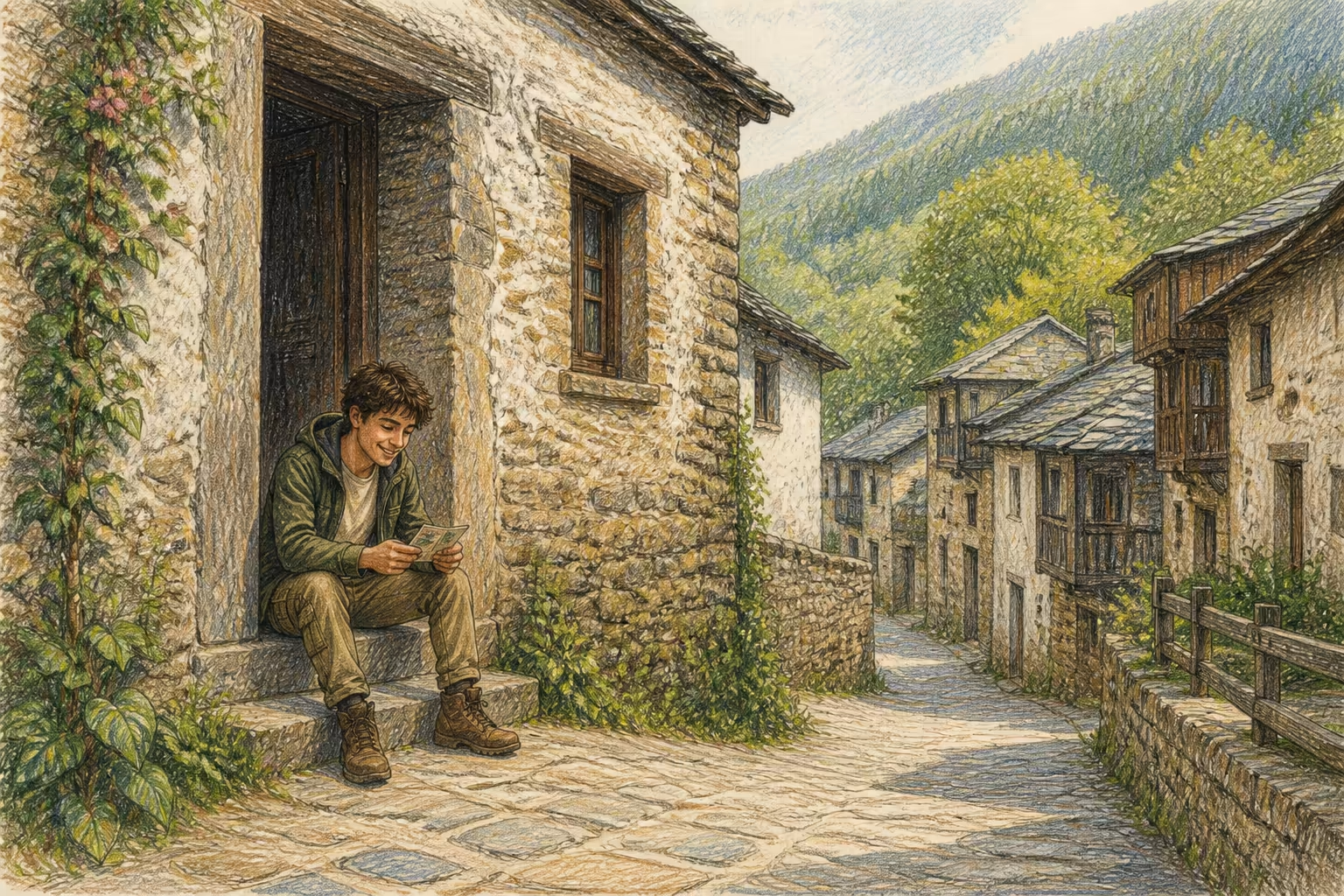
Axel sat down on the doorstep with the postcard in his hand.
And there, at last, the tears came. Not for Bruno, or Clara, or the board games. For the I was wrong.
Because he had spent five days looking for the way to make that thing fixable. Five days turning it over to find the angle, the sentence, the good explanation, the way to make it understood. And a bloke he hadn’t seen for six months had just written him two words on the scrap of cardboard his wife had left over.
Without explaining anything. Without fixing it.
I was wrong. And that’s that.
That night he took the stool up and looked into the chimney. Yayo was still there, curled in a ball, with the piece of blanket underneath him.
“Listen,” he said to him.
Nothing.
“I’ve messed it up.”
Nothing.
And he stayed up there, with his head inside a chimney, telling it to a sleeping creature because there was nobody else.
“The thing is I don’t know how you say sorry without explaining anything. I’ve never done it.” He shifted his weight on the stool. “I did it to fix things. That’s true. I rang that woman because I heard her crying on the phone and I thought they were misunderstanding each other and that somebody had to get in the middle.”
Nothing.
“And in six months I didn’t tell her once. Six months. And it wasn’t that I couldn’t find the moment: it’s that every day I decided it wasn’t that one.”
Nothing.
“And on top of it she asked me.” His voice slipped a little. “She asked me to my face, on a bridge, and I told her I was talking to my mother.”
He got down off the stool.
A rage came over him of the sort that gives no warning. He grabbed the broom, planted himself in the middle of the kitchen and swept five days of dirt and ash in a straight line towards the foot of the stairs. Towards there. On purpose. With feeling.
And when he reached the bottom step he lifted the broom and stood there in the kitchen, waiting.
Waiting for what, he didn’t know. A noise. Something falling. Anything.
Nothing happened. Absolutely nothing happened: the house stayed as it was, the milk on the table, the table where it always was, and upstairs the elder tree moving with the air that came in where it was supposed to come in.
He stood there a long while, broom in hand, feeling like the stupidest man in the northern hemisphere.
And then he picked up the dustpan, swept the whole lot again from the beginning and took it the other way, towards the door, slowly and properly, the way they had told him.
Because it costs nothing.