
Twenty-Four
Fourteen people came up a cobbled street with a pot of tripe
They found out through an envelope that arrived at the shop on a Tuesday. It was for Eva, the sort you had to sign for, with an insurance company’s letterhead and an address written by hand in very upright lettering. Eva stared at it for two seconds. It looked familiar, though she couldn’t remember where from.
Trini got out the receipts book.
“Full name. Not your ID, I know who you are.”
Eva rested her hand on the envelope and hesitated for barely a second. Axel noticed because he was beside her and had spent five months watching her avoid saying her surname.
“Eva Moreno.”
She said it in full, in her ordinary voice, and Trini wrote it down just as she’d have written any other name she was given that Tuesday.
“And when’s your birthday, love?”
“Eleventh of the eighth.”
Trini stopped her pen.
“This month?”
“This month.”
“Well, that’s Thursday.”
“Oh,” said Eva. “So it is.”

She put the envelope in her rucksack without opening it and went out. Axel stayed inside three seconds longer, looking at the book. Eva Moreno, in Trini’s handwriting, between a gas bottle and a box of eggs.
That night, peeling potatoes in the kitchen, he had a go.
“Here. It’s your birthday on Thursday.”
“Uh-huh.”
“How old?”
“Twenty-four.”
“We’ll have to do something, then.”
“No. I don’t do birthdays.”
“Never?”
“Never.”
They carried on peeling.
“In my house birthdays were a lunch with twenty people I didn’t know at all,” said Eva after a while. “In a dress my mum picked. And a cake from a posh cake shop with a chocolate plaque with my name on. And everyone saying ‘haven’t you grown’. And at six they’d go and I’d be left in the dress in a tidied-up living room.”

She threw the peel in the bucket.
“I haven’t told anyone what day it is in years.”
“Okay,” said Axel.
The next day, while paying for the milk, Axel decided to mention it to Trini.
“Trini, about Thursday.”
“Thursday what.”
“She turns twenty-four.”
Trini stopped counting out the change halfway.
“Ah.”
Trini finished counting out his change, and Axel left without being quite sure what he’d set in motion, and went up the hill biting his nails.
Thursday began like any other day. On Tuesday and Wednesday they had fitted the other two beams with Úrsula and the neighbours. They had breakfast, tidied up, and Eva went up to the roof to pass him slates.
At half ten a delivery man came puffing up the cobbled street with a box. The label was handwritten: “For the girl who sings. Alimentación Trini”. Trini had told him to go on up, there was only one girl in the village who sang.
It was a microphone. A proper one, a studio one, in a black case with foam cut to fit and a folding metal stand.

Víctor opened it, because Eva wasn’t opening it.
“Happy birthday!”
Eva looked at the open case on the table.
“And what’s this for?”
“What do you mean, what for?” Víctor laughed. “For recording you.”
“Yeah. But what for.”
He laughed again, because he thought it was a joke, and started putting the stand together.
Axel was in the doorway with a bucket.
Eva didn’t look at the case again. But when Víctor went down for ice, Axel saw her run her hand over the foam, once.
At eleven Úrsula appeared to collect a slater’s hammer she hadn’t needed for weeks. An hour later the frying-pan lad turned up with a fairly daft question about the water. At one, Sabino settled on the opposite wall with his walking stick, and there was no shifting him.
“What’s going on today?” said Eva at half one.
“What would be going on?”
“Axel.”
“Nothing, love. What would be going on on a Thursday?”
At seven Trini appeared dragging her shopping trolley up that cobbled hill, a feat in itself, with half the lower street following behind.
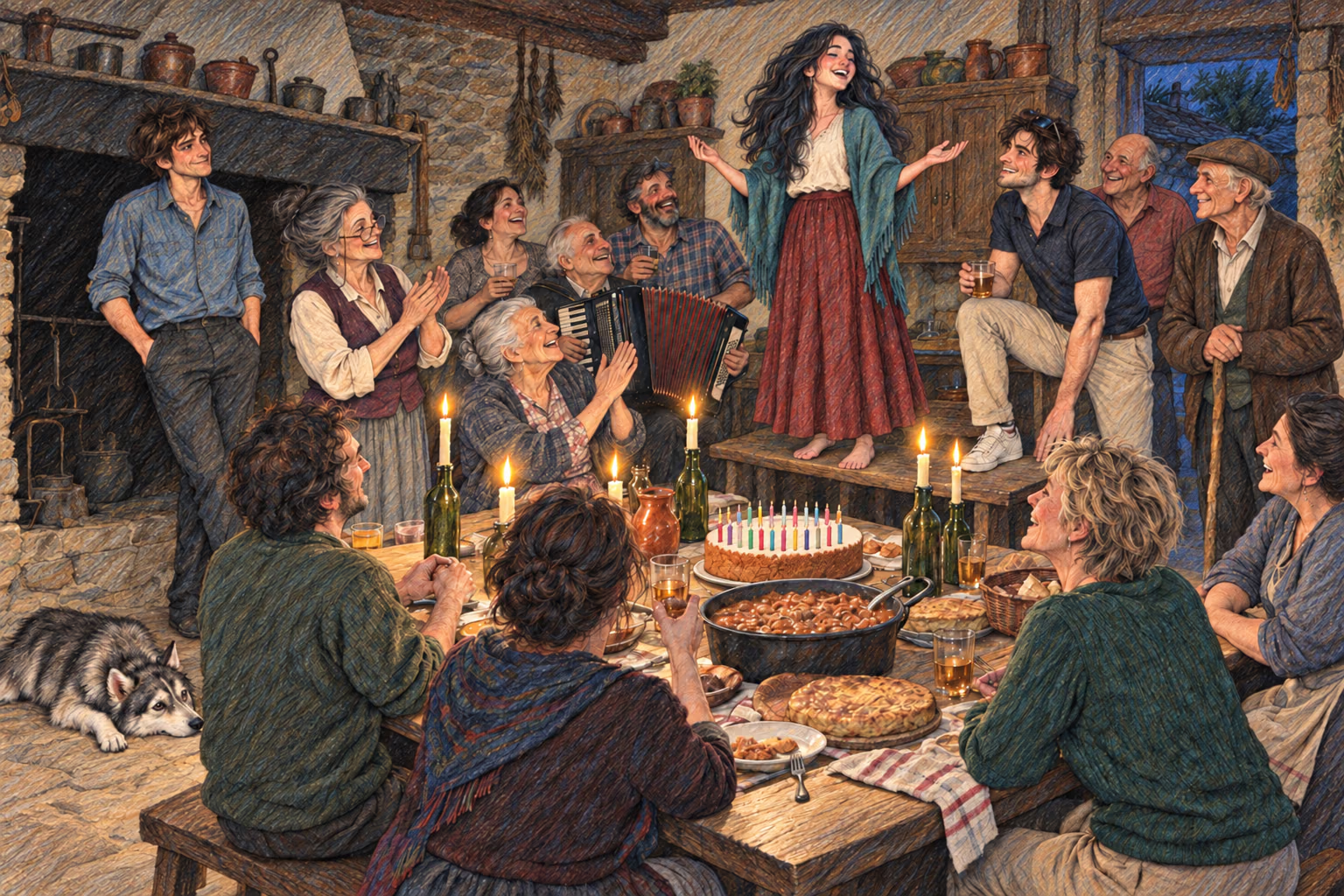
They brought a table, two benches and a whopping pot of tripe that had taken two people to carry up, cooked by a woman Eva had never met, plus two Spanish omelettes, an empanada, a crate of cider and a homemade cake somebody must have baked behind somebody’s back. They’d put twenty-four candles on it from two different packets: twelve white ones and twelve with little clowns.

Fourteen of the twenty-six neighbours came up. The woman on the corner stayed home: her face appeared behind the net curtain for a moment, then she switched off the light.
Eva stood in the middle of the kitchen with a tea towel in her hand, not knowing what to do.
For over an hour, Eva stayed in a corner with a glass she wasn’t drinking from, saying as little as possible. Axel didn’t go to rescue her. Sabino did, beckoning her over after sitting for two hours without speaking to anyone.
“Come here, girl. Sit down.”
She sat down.
Without looking at her, the old man told her a very long story, completely unfunny, about a donkey he’d sold Hortensia’s father.
“Because the donkey wasn’t bad-tempered, mind. It had a bad leg. And a leg you can see. But that day it was raining and the donkey was in mud up to its hocks, and in mud you can’t see a leg. And I knew it. And I spent the whole morning showing him the donkey from the other side.”
Twenty minutes later Eva was in stitches.

From there on the party took care of itself. Tripe eaten standing up. A bottle of something homemade that scraped your throat. Someone put a plate down on the floor for Kika and Kika pushed it all round the kitchen with her nose until it was under the bench. The lad with the frying pans turned out to have an accordion.
At eleven, with the hearth cold and six candles burning in bottles, eleven people were singing a village song Eva didn’t know. She listened to the end. They’d spent all afternoon asking her to sing, with a persistence that could wear out a mule, and she’d already said no four times. At twenty past eleven she climbed onto the bench.
She sang three songs. By the third they were joining in with the chorus, which she’d just made up and which caught on at once. An eighty-year-old woman knew the whole thing and kept time with her hand.
Víctor, who filmed everything, had his phone in his hand with the screen off. He didn’t lift it once.
When Eva got down off the bench, he got up on it.
“Hang on! Hang on!” Two claps. “You lot need to know this.”
Sudden silence.
“This girl’s coming with me in September!” He pointed at Eva with his glass. “There’s a studio waiting for her. What she’s just sung, you’ll all be singing it down the street tomorrow. Let more people hear her, for God’s sake!”
The place went up. Úrsula whistled. The lad with the frying pans hit three chords on the accordion. Sabino raised his stick. The tripe woman took Eva’s face in both hands.
“Aren’t you lucky, love.”
Eva blushed, laughed and lowered her head. She didn’t quite say yes, but neither did she correct anyone, and when they asked which city she’d be going to, she said they’d see.

Leaning against the hearth, Axel kept turning September over in his head. He waited for Eva to explain a little more, and when she didn’t, he too stayed quiet.
They all left at one, with twenty minutes of goodbyes in the street.
The two of them were left alone in the kitchen, with the table a disaster.
Eva sat down on a bench.
“You all right?”
She nodded.
She began to cry, sitting very straight with her hands on her knees. She didn’t cover her face or make a sound, and seemed as surprised as Axel by the tears falling from her eyes.
Axel sat down next to her. He lifted his hand to put it on her back. He left it a hand’s width away. He lowered it to his own knee.
“Sorry,” she said.
“There’s nothing to be sorry for.”
“You know the worst bit?” She wiped her face with her sleeve. “Nobody knows me. And they came. The tripe woman doesn’t even know my name, Axel. She asked Trini at the door.”
Axel nearly told her there was someone who knew her, someone who’d been asking since June whether she was eating, sleeping and laughing. Irene would have been the fifteenth that night. He kept it to himself and stayed sitting beside her.
They finished clearing up at two. Going down with the rubbish, Axel found a large mother-of-pearl button in the middle of the second step. He bent to pick it up, looked at it for a moment and put it in his pocket.