
Tuesdays
Nobody’s firewood, an empty vase and thirteen loaves
The council surveyor came up on Thursday the twenty-ninth, the day before the order ran out.
They’d been waiting for him for three weeks. Trini said he came up on Thursdays. Sabino said when it wasn’t raining. On the Wednesday it rained.
Thursday dawned dry. At eleven they heard a car on the bend.
Out got a man of about fifty, who put on a white hard hat in the middle of the street, where nothing could fall on him but the sky, and took out a grey folder with a torn corner. It wasn’t the other folder.
Úrsula was waiting at the door with her arms folded. Axel behind her. Eva on the step, barefoot. Sabino on his wall, eyes shut and not asleep.
The surveyor didn’t say hello. He stood under the eaves with his head tipped back and stayed like that for four minutes. Then he took a measuring gadget out of his pocket, pointed it at the front of the house and looked at the screen.
“Eleven forty,” he said, to nobody, and wrote it down.
Sabino didn’t open his eyes.
“Damp’s gone, then.”
The surveyor asked for the ladder. He went up. He tapped the slate with his pen, row by row, first the eaves and then the whole roof. Úrsula had her hands shoved in her overall pockets, which was how she prayed.
In the corner house, on the first floor, a net curtain moved.
He came down and went into the house without taking his hard hat off. In the back bedroom he stopped dead.
Three metres of tree growing in the middle of a room and coming out through the roof.
He stood there with his pen in the air.
“And this?”
“That comes with the house,” said Úrsula.
He looked at the tree. He looked at the skylight. He looked at Úrsula. He rested the folder on his knee and wrote something, two long lines, that nobody saw.
Eva had stopped moving. So had Axel.
“Who did this?”
Axel put his hand up, like at school.
“We did. With help.”
He signed. He peeled the plastic sleeve off the door, took out the four drawing pins one by one and put them in his pocket, because the drawing pins belonged to the council.
“That’s it, then,” he said.
And he went off down the street.
On the wood there were four little holes left and a paler square, the size of a sheet of paper, where the sun hadn’t reached in six months.
“Is that it?” said Eva.
“That’s it,” said Úrsula.
“All those stamps for that.”
The net curtain on the corner stayed still. Then it closed.
The folder guy was never seen on the top street again.
On the third, no machine came up.
The plaques stayed on the boarded-up houses. Axel counted them as he went past.
Four.
The firewood turned up the following Thursday, stacked by the door. Oak and chestnut, and not a word about who from.
“Trini, that’s worth a bit of money.”
Trini didn’t look up from her accounts.
“Well, don’t bring it down here, love, I haven’t got room.”
The electricity came in November, with an electrician from the bottom street, who took half his pay in firewood. The firewood that was nobody’s.
Axel earned a day’s wage here and there with Úrsula on other people’s roofs, now that he knew how. The first one went entirely on the ladder. Two hundred and ten euros. Úrsula counted it twice in front of him, licking her finger.
“And don’t mention it to me again,” she said.
Eva sang in the shop on Saturdays and at closing time Trini gave her whatever there was in a tin, without counting it. And Eva took it, which was new as well. With the first tin she crossed out a line in the little notebook. Axel didn’t ask which one.
In November the house was signed over, at two notaries, and Eva signed with an ID card that smelled new. Axel’s dad put in part of the money and hung up before anyone could say thank you.
The nine-degree afternoon was a Wednesday in January, at half five, with the hearth drawing terribly because the wind was coming from the north. Axel sat on the bench with his hands pulled up inside his sleeves and thought, with total clarity, that the whole thing had been a stupid idea.
In detail. He thought about a radiator. About a little flat with the heating included in the service charge. And the words “service charge” sounded beautiful to him.
And there was the hollow, in the pit of his stomach. Right where it lived.
He stayed like that for twenty minutes.
Then Eva came in with her face red from the cold and a sack of chestnuts someone had given her.
“Bloody hell, it’s brass monkeys in here.”
She got the speaker out of the drawer, which hadn’t made a sound since the robbery, and put something on. She switched it on herself.
She sat down next to him without taking her coat off.
“You all right?” she said.
“No.”
“Okay.”
She kicked her boots off without undoing them. She put her legs up on the bench. And she tucked her feet under his thigh, without asking.
They were frozen.
Axel didn’t say anything. They stayed like that, looking at the rubbish fire. Twenty minutes later the wind changed and the hearth started to draw. After forty the kitchen smelled of chestnuts. And Axel didn’t think about the radiator again all winter.
People started asking Eva for her thing.
It began with a nine-year-old girl from the bottom street. Half an hour on Tuesdays, in the kitchen, no sheet music. By the third week there were two. Before spring, five.
“Don’t look at me,” she’d tell the nine-year-old, who sang looking at her face. “Look at the window. And sing like nobody can hear you, because up here nobody can.”
One afternoon Axel heard her at the fountain, singing on her own the whole chorus from the tripe night. Nobody had recorded it that night.
One Saturday in March Eva took the school rucksack down from its corner, blew the dust off the top and took the kids up the mountain. A sheet of plastic, five metres of rope and a small fire. She taught them that if you leave the matches outside the plastic you’re an idiot and nobody tells you twice.
What she didn’t tell them was who she’d learned it from.
The rucksack didn’t go back to its corner. It stayed in the byre, hanging on a nail next to the blue one.
In February Axel had gone down to the hotel to ask for work, after two weeks of walking past it. What embarrassed him was how much he wanted it.
They asked him what he could do. He said four years on reception and five languages, and saying it, it sounded like nothing. Not to the owner. He started on the Monday.
On the first day, flicking back through the register, he came across the summer. Víctor. Seven weeks. In the box for other guests, nothing.
He shut the book.
He was doing the same thing he’d done four years before. Telling someone that number five looks onto the courtyard and nothing’s going to bother them.
What had changed wasn’t the job.
It was that at ten he locked up, walked up a cobbled street and knew the name of everyone he passed.
And there was one who rang the bell on the desk when there was nobody there. Ding. The third time, Axel saw a hat duck down behind the plant pot.
“That’s the draught,” said the owner, without looking. “That door sucks the air through.” And, already on the stairs: “My father used to say the same.”
One night in March, just before closing, a bloke of about thirty came down to reception for a glass of water. He’d been walking for two days and he was working on Monday. He asked what everybody asked him. How he’d ended up there.
And Axel told him.
“Look at that.” He pointed his chin at the vase on top of the cabinet, empty, because it had never occurred to anyone to put anything in it. “They give you one when you’re born. Empty. And you don’t get another one. What you’ve got to do is fill it with things that have really happened to you. The more the better.” He shrugged. “Mine had four years of nothing in it. And a bit of pizza.”
The bloke looked at the vase.
“And what if it fills up?”
“God, I hope so.”
He gave him the key to number five and the bloke went up.
Axel was left on his own. And it came to him that it was the first time he’d said it out loud. To a stranger.
And that he’d spent three years with someone and never said anything like it to her. Not half a sentence.
They lit the oven in March.
Sabino said from his chair that he remembered Hortensia’s mother’s bread, and three days later there were four people in the garden arguing about how you cure a bread oven. Slowly, it turned out. Four days of small fires, so the stone doesn’t crack.
Eva lit the first one. She put her arm right in to the back of the mouth, for paper, and pulled out a brochure folded in four, grey with soot. She didn’t unfold it. She put a match to it.
It burned green and blue, twisting.
“That’s not paper, lad,” said Úrsula, with her sleeve over her nose. “That’s varnish.”
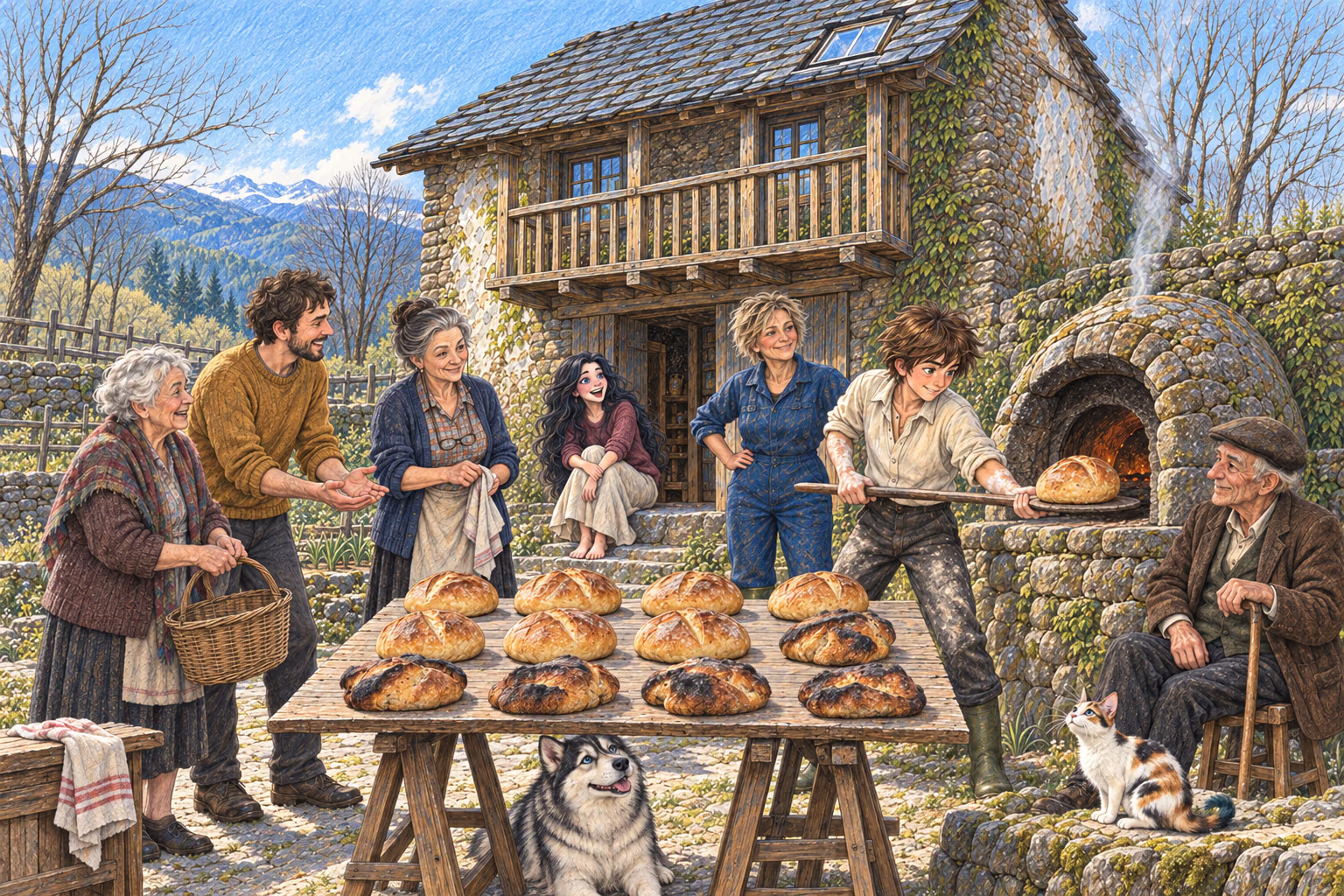
On the morning of the fifth day it was the kind of cold that cuts your face. Axel kneaded thirteen loaves, because thirteen was the number. Eight came out well and five came out so-so.
He took them out one by one with the peel, flour up to his elbows, and put them on a board across two trestles. Eva, barefoot on the step, laughed at the wonky ones. Kika got under the board in case anything fell. Fay watched it all from the wall, without coming down.
And half the street started coming up.
Up came Trini, glasses dangling, who’d shut the shop for an hour. Up came Úrsula in her overalls and wellies. Sabino was already in his chair. Up came the lad with the frying pans, without the accordion but with his hands, which were what was needed.
Up came the woman from the corner house, with a basket.
It had a cloth over it and she stopped two metres from the oven.
“Morning,” said Axel, with the peel in his hand.
She looked at the oven. She looked at the roof. She looked at him.
“Morning.”
And she held the basket out to him to fill.
Nobody paid for anything. And a week later there were a dozen eggs, a rabbit and a sack of chestnuts at the door, and nobody ever said who they were from.
That night Axel rang Hortensia to tell her, and he couldn’t get it all out, because halfway through the first sentence she was already crying and saying how silly, love, it’s only bread.
“Tuesdays,” she said, when she’d got over it. “In my house it was Tuesdays.”
And from that March on it was Tuesdays.
The following Tuesday, without it being anyone’s birthday, Axel went out onto the balcony and rang his dad.
“What’s happened?”
“Nothing. I’ve made bread.”
His dad went quiet for a while.
“And did you leave the mouth open at the start, to let it breathe?”
They talked for an hour. About ovens.