
The Soppy One
Somebody was crying in a pelota court and it was not because of the storm
Over the next ten days they crossed two provinces, didn’t talk about anything important once, and the three of them agreed, without having said so, that this was excellent.
The storm caught them out in the open and it was one of the good ones.
First everything went yellow. Then a wind got up that pulled the map out of their hands and carried it off up the field. And then, with no further warning, water started coming down as though somebody were throwing it out of a bucket.
They ran.
They ran two hundred metres along a dirt track that was turning into a river, with Kika howling from sheer nerves and Fay inside Eva’s sweatshirt, which is a place Fay had never been and did not want to be.
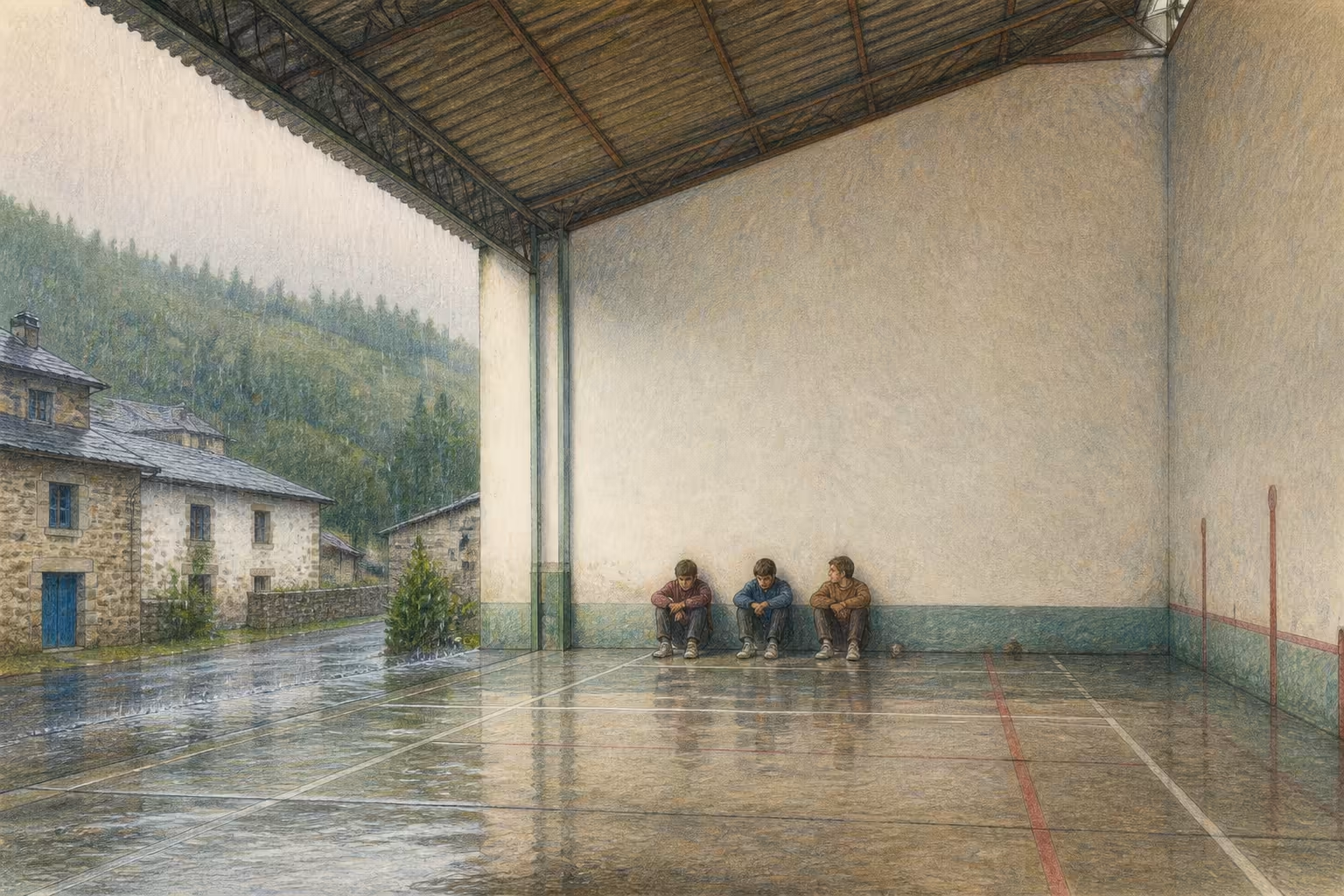
They reached the pelota court. It was at the entrance to the village, in a bit of waste ground: a village court, with the big wall at the far end and a sheet-metal roof covering half the floor, empty, the lines on the ground half rubbed out and a goal spray-painted on the wall.
They got in under the roof, dripping, and the metal above them sounded as though the world were ending.
“Good grief,” said Hortensia, wringing her hair out with both hands.
They sat down against the far wall, in the dry part. They got things out and put them out to drain: the checked blanket was soaked through one corner, the pot had filled with water all by itself and Axel emptied it with a swipe.
Kika shook herself right next to Hortensia.
“Now really!”
After that they couldn’t stop laughing for a good while. Eva took off her sweatshirt, let go of the cat, which shot off to a corner to lick its dignity, and was left in a T-shirt stuck to her body with her hair dripping, and she started laughing too. It was a good while. One of the best.
When they calmed down, the rain was still going. It was six in the evening and it was as dark as nine. Eva leaned against the wall, stretched out her legs and started humming, quietly, almost inwardly, watching the rain fall off the edge of the metal.
And that was when Axel saw him.
He was on the ground, three metres away, half tucked behind the rucksack. He was small and soaked through, he had a sort of scarf that went three times round his neck and trailed on the floor, and his nose was red.
And he was crying.
Not snivelling. Really crying, shoulders and all, very slowly, without making a sound.
Axel kept still.
“Hey,” he said, very quietly, so as not to break Eva’s song. “What’s the matter?”
The little creature lifted his face and sniffed up his snot.
“Have you hurt yourself?”
He shook his head.
“Is it the water?”
He shook his head again. And went back to looking where he had been looking.
He was looking at Eva.
Axel turned round slowly. Eva was just the same, leaning on the wall, with her wet T-shirt, humming something with no words, her hair stuck to her face and her bare feet stretched out on the cement.
Nothing. Absolutely nothing was happening.
He looked back at the floor.
“Because of her?”
The creature nodded, very hard, twice, and burst into tears again.
“But she’s fine.”
And then the little creature made a noise that was half hiccup and half word, and covered his face with the scarf.
They were there two and a half hours. Two and a half hours on three metres of cement under a metal roof, with the rain coming down in front of them like a curtain, and it wasn’t boring, and that was the part Axel found hardest to explain to himself afterwards.
Hortensia told the story of a cousin of hers who married the same man twice.
“Twice, all right. The same one. They divorced in eighty-seven, which back then was a scandal, and she went off to Barcelona and he stayed. And nine years later they ran into each other at an aunt’s funeral, and eleven months after that they got married again in the same place, with the same priest, who was already half deaf and didn’t remember.” She flicked a drop off her arm. “And I went to both weddings, and at the second one she was far better looking. Far. Twenty years older and a dress of nothing at all. And I remember looking at her and thinking: this one knows what she’s doing now.”
Eva fell asleep for twenty minutes sitting with her back against the wall and her mouth open. Kika went in and out four times and came back soaked all four times and shook herself over everybody all four times, and on the fourth Hortensia said things to her that you don’t say to an animal.
After an hour and a half they stopped talking and the three of them sat looking at the rain, saying nothing, without it needing filling. Axel tried to remember, without meaning to, the last time he had spent two and a half hours doing nothing.
And nothing came.
“What’s your name?”
He sniffed up his snot.
“Ñoño,” he said, in a voice like a wet rag.
“Well, it suits you.”
“I know it does.”
Then he did something Axel found hard to understand. He stood up, rearranged the three-turn scarf, crossed the three metres of wet cement at a short trot and planted himself next to Eva’s bare foot.
He sat down there. On the floor. Right up against her ankle. Without touching her, two fingers away, the way you sit next to a stove.
Eva was still singing with her eyes half closed, watching the rain fall off the edge of the metal.
She moved her foot. Two inches. Just enough to leave him room.
Axel saw it and didn’t think about it, because he was thinking about something else.
Axel didn’t ask again. He sat there, with his back against the court wall, listening to the metal and to Eva’s voice.
And he started looking at her in a way he had never looked at her before.
He noticed she was singing for nobody, as she had been doing all her life.
He noticed she didn’t have a single photograph.
He noticed she hadn’t taken anything from the heap on the pavement, not even the painting of the boat, although she had stood in front of it a good long while.
He noticed she had said “I’m not going back” on a verge the way you say something you’ve had said for years.
Something came into his throat, because he hadn’t noticed any of that until that moment and now it seemed to him it was written on the wall in spray paint, next to the goal.
“I know,” he said to the creature.
And he put a finger on his shoulder, which was the size of a fingernail.
“Who are you talking to?” said Hortensia, from the other side.
“Nobody.”
“Ah.”
She smiled with enormous affection and went back to her own business.
When Axel looked at the floor again, there was nobody there. Only the rucksack, a puddle that had got in underneath and, on the cement, next to Eva’s foot, a little wet mark the size of a button.
Which was water. Which was obviously water, because in there everything was wet.
It cleared at nine. They came out onto the waste ground with the sky still black on one side and clean on the other, and the air smelled of wet earth in that way that makes you want to breathe deeply even when you don’t need to.
They had dinner in the court, on the floor, with the stove working perfectly and the bottle half full.
At some point, while Hortensia was telling some story about a market, Axel got up, took the checked blanket, which was almost dry by now, and put it over Eva’s shoulders without saying anything.
“I’m not cold,” she said.
“Mmh.”
She didn’t take it off. She didn’t take it off all night, not when it stopped being chilly, not when Hortensia said twice that it was lovely in there. She fell asleep with it on.
And Axel, who was falling asleep a metre and a half away, thought thank goodness that corner of the blanket had dried, and dropped off perfectly content.