One Hundred and Seventy-Nine
It rained three days running and they counted the photos one by one
It rained three days straight.
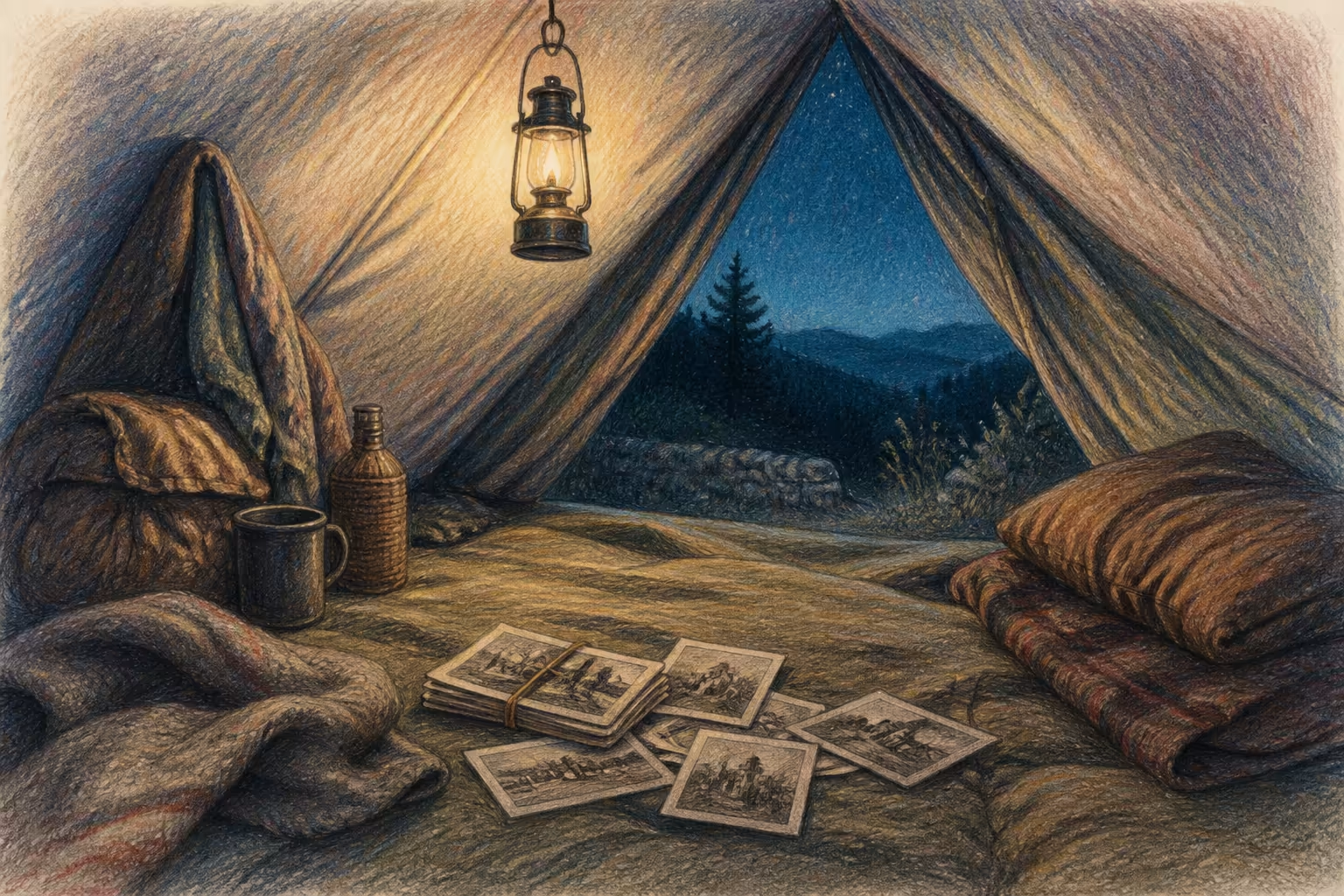
On the third they got into the tent at seven in the evening and didn’t come out again, because outside there was nothing to do but get wet. All three of them were lying down, with the torch hanging from the roof, and Kika curled up in the doorway like a furry plug that smelled of wet dog, which is a smell that in a two-man space has a notable presence.
“I’m bored,” said Hortensia.
“Go to sleep.”
“I’m not sleepy, son, it’s seven o’clock.” She was quiet a while. “Go on, show me something.”
“Show you what?”
“Anything. I’ve spent three days looking at the same green plastic.”
And Axel, without thinking about it much, put his hand in the side pocket of the rucksack and pulled out the bundle. It was a wad of small photographs, the kind you get developed, held together with a hair elastic. They were worn at the edges and some had the mark of a drawing pin at the top.
“Ooh,” said Hortensia, sitting up. “Give them here, give them here.”
“There are a hundred and seventy-nine.”
“You’ve counted them?”
“I counted them when I took them off the wall.”
Eva turned onto her side, propped on an elbow.
“A hundred and seventy-nine exactly?”
“A hundred and seventy-nine.”
“You are not well.”
“I know.”
He started from the top. The first was him at sixteen, with a criminal fringe, at a concert.
“Is that a fringe?”
“That was the year two thousand and fifteen, Hortensia. Everybody had that.”
The second was a goat.
“And this?”
“A goat.”
“I can see it’s a goat. What’s it doing on your wall?”
“Because that goat got onto the roof of a car.” Axel laughed to himself. “We were camping and the daft thing got onto the roof of some man’s car, and the man came out in his underpants.”
“And why isn’t the man in the photo?”
“Because the man was very frightening.”
Hortensia passed the photo to Eva without stopping laughing, and the rest came out one by one. An enormous plate of rice, made by him, which had turned out, according to him, “average but historic”. Bruno with the scissors in his mouth. A road sign with a very funny village name on it that he had no intention of saying out loud. His father under a car. Clara asleep on a sofa with her mouth open. A dog that wasn’t Kika but looked like her.
“And this one?”
It was a woman from behind, crouched down, in a small shop, guiding somebody’s foot into a shoe.
“My mother.”
“Working?”
“It’s that she’s like that.” Axel turned the photo to see it better. “My mother looks at people’s feet before their faces. Thirty years in a shoe shop. She walks down the street and says to you, ‘that one’s a size forty-one and she’s wearing a forty.’”
“Well I never.”
“And she’s right, all right. Which is the worst part.”
Hortensia held onto the photo a moment longer than she needed to.
“It happens to me with hands,” she said, and didn’t explain why, and moved on to the next. “And who’s this?”
“That’s Bruno again, but with long hair.”
“Bruno had long hair?”
“Bruno had hair down to here. That’s why he became a hairdresser, he says. So it wouldn’t happen to anybody else.”
Hortensia went through them one by one, slowly, with her thumb, and on the twentieth Axel realised she was looking at them in a particular way: not the way you look at a nice photograph, but the way you look at a document.
“Listen,” she said.
“What.”
“In three quarters of the photos you’re carrying here there isn’t a single place.”
Axel stared at her.
“What?”
“There are no landscapes, my boy.” She held the wad in front of him and fanned it with her thumb. “There are faces here. There’s a kitchen, there’s a table, there’s a bench. And the ones that have a landscape behind are because there was somebody in front.”
“Well, it’s that you take photos of…”
“No, no. It’s a good thing.” She gave him the wad back. “I have two shoeboxes full of photographs and in half of them the house is in it. The house from the front, the house from the back, the house with snow. And in the house there’s nobody.” She lay back down. “You have a hundred and seventy-nine faces and I have two boxes of façades. And both things say something, mind. It’s just that yours says something better.”
They were at it an hour. Hortensia laughed at nearly all of them, and the ones she didn’t laugh at she asked about, and Axel answered, and halfway through half the stories he forgot the ending.
“This is a whole life,” she said at one point.
“It is a whole life.”
“Well then, listen.” Hortensia was going through the photos the way you go through a pack of cards, with her thumb. “And girlfriends?”
“There aren’t any in there.”
He said it quickly and without looking up, and moved on to the next one before anybody had time to say anything. Hortensia didn’t catch it, because Hortensia was already back on the goat.
Eva sat working out in silence how many photographs a person takes in three years with somebody and how many you have to take off a wall for there to be none left.
Then it came out. It was in the pile of the Norway ones, between one of the harbour and one of a plate of salmon: two lads in their twenties on a bench, with two identical hats, laughing at something that had happened just before the photo.
Axel looked at it for half a second and moved on.
“Ooh, wait,” said Hortensia, “that one…”
“That one’s from Oslo.”
And he got out the next one, which was a crooked lamp post, and started telling the story of the crooked lamp post in great detail, much more detail than the lamp post had.
Eva didn’t open her mouth. But she kept looking at his hand, because Axel had put the photo of the hats at the back of the wad, underneath all of them, and while he talked about the lamp post he was turning it over with his thumb, again and again, without noticing.
Hortensia was laughing at the lamp post.
Eva lay there another twenty minutes, listening to stories about photographs, and didn’t ask a single time.
When they finished, Axel put the elastic back on and put the wad in the side pocket. Hortensia fell asleep within four minutes and started snoring almost as well as Eva.
“Listen,” said Eva, very quietly.
“What.”
“Why do you carry them?”
Axel lay thinking, looking at the torch.
“Because the things that happen get forgotten,” he said. “Seriously. All of them get forgotten. I didn’t remember the goat thing, and it was hanging there on my wall, and I saw it every day coming out of the bathroom. And I saw it and I didn’t see it. But if you take the photo away, it’s gone. And then it’s as if it hadn’t happened.”
Eva was quiet for a while.
“I haven’t got any,” she said.
And she turned over.
Axel opened his mouth to ask if she wanted one, and it seemed to him such an enormous stupidity that he didn’t say it.
There, lying on a green plastic sheet with the torch hanging from the roof and the rain coming down on it, with a hundred and seventy-nine photographs back in a side pocket, it came back.
Two fingers below the breastbone, in the usual place and with the same face on it.
The first thing he thought was that it was the rain. That they had been shut in there for three days and that anybody would. He gave himself that explanation and it lasted four minutes.
Because after four minutes he remembered that he had done the biggest thing a person can do. He had let go of a flat, a job and a city in four minutes from the floor of his kitchen. He had walked more in two months than in his whole life. He was sleeping on the ground in the middle of nowhere with a sixty-five-year-old woman snoring a hand’s width away and a dog in the doorway.
And that was still there. Whole. Without having lost anything on the way.
He lay awake a long while with that, and he didn’t tell anybody, because there was no way of saying it out loud that didn’t sound ungrateful.
Outside it was still raining. The rucksack was leaning against a tree, covered with the rain jacket, with the hundred and seventy-nine inside. It crossed his mind to go out and tuck it further under the branches, he worked out how wet he was going to get on the way and decided they would hold out.
They held out.