The Pavement
A whole house out on the street and a pot that wouldn’t fit in the rucksack
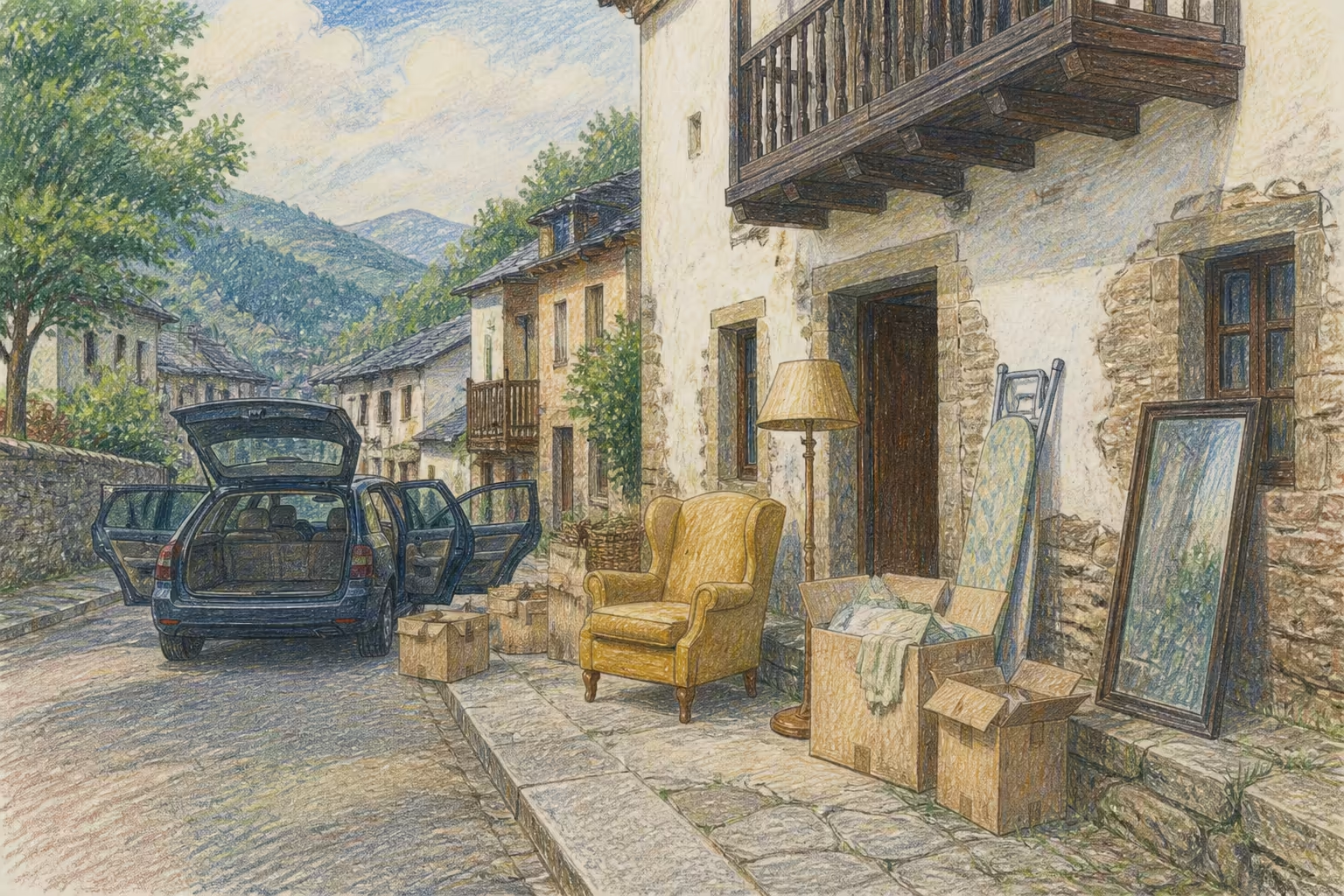
The car had been parked in the middle of the village since the morning, with the boot open and all four doors as well. Beside it there was a heap of things on the pavement.
Not a heap of rubbish. A heap of things: a floor lamp, cardboard boxes, an ironing board, a mirror leaning against the wall, a mustard-coloured wing chair. And a man of fifty-something, in a T-shirt, hands on his hips, looking at the boot the way a man looks at a maths problem.
“It won’t fit,” he said, without looking at them, as they went past.
“Sorry?” said Axel.
“It won’t fit.” He turned round. “Sorry. I’ve been talking to myself since seven. Miguel Ángel Fresno, pleased to meet you.”
He shook hands with all three of them, very formally, in the middle of a pavement full of furniture.
“It’s my mother’s house,” he said, and pointed at a doorway with his chin. “She died in January. And now it has to be emptied, we’re selling it.”
“Oh. I’m sorry.”
“Mmh.” He raised a shoulder. “She was ninety-one. It isn’t one of the sad ones.”
He looked at the heap on the pavement again.
“The trouble is I can’t fit half of it. And I can’t just throw all this away, come on. These are good things. Look, that mirror my parents bought when they got married, in sixty-seven, and I’ve done my hair in it all my life. And now I stand looking at it and I think: where do I put it? Because at my house there is a mirror. And it isn’t that mine is better, all right. It’s that it’s up.”
They spent an hour helping him bring boxes down. Nobody decided it: Axel picked one up, and Hortensia went behind him, and on the third trip Eva went up too.
The house smelled of shut-up rooms and old soap. There was a kitchen with tiles halfway up the wall and a 2019 calendar pinned up with a drawing pin.
The man kept pointing.
“That to the left, that goes in the car. That to the right, that goes on the pavement.”
The left filled up straight away. The right wouldn’t stop growing. On the right there was a whole coffee service, not a chip on it. A hand-embroidered tablecloth. A painting of a boat. An iron of the old sort, the heavy kind.
“I can’t manage all of it,” said the man, on one of the trips down, more to himself than to them. “Because if I take it all, where do I put it? At my house, on top of my own things? And then I die and my children carry it down to the pavement again.” He laughed a little. “Some business that is.”
When they finished, the boot was full and on the pavement there was a whole life. The man got three beers out of the car, warm, and handed them round.
“Take whatever you want,” he said.
“No, come on, we’re walking.”
“Well, that’s exactly why. Whatever fits.” He took a swig of beer. “I’d rather somebody took it who’s going to use it.”
And there Axel’s problem began.
Because Axel had a rucksack measured to the millimetre. Every single thing was inside for a reason, and he knew the reason for each one. He had spent three days making that rucksack and he had bought half of what was in it that same January. He had weighed the spork.
Now he had in front of him a pavement full of good things.
He spent ten minutes circling the heap like a dog round a puddle. Hortensia, on the other hand, picked up a checked blanket in three seconds, folded it and put it under her arm.
“This. It’s perishing cold up there.”
Eva took nothing. She stood a good long while in front of the painting of the boat and did not take it.
Axel stood planted in front of a pot. It was an aluminium pot, fat, dented on one side, with two handles and a lid that wasn’t its own but fitted. The size of a small washbasin. It was exactly what he needed to stop cooking in a camping pan the size of a plate.
And it weighed what a pot weighs.
“That was the stew pot,” said the man from behind him. “Half the family has eaten out of that.”
Axel picked it up. He weighed it in his hand. He put it down again. He picked it up again.
“Do you know what this weighs?” he said to Eva.
“Yes.”
“The thing is it doesn’t fit.”
“I know.”
“I mean, it would fit. But I’d have to take things out.”
“The thing is I’m carrying a titanium kettle.”
“Uh-huh.”
“Titanium, Eva. It weighs ninety grams.”
“And it holds two cups.”
“Two and a half cups.”
“Two and a half cups,” she repeated, and took a swig of beer, and helped him absolutely not at all.
“The thing is it was a present.”
“Ah, well then.” Eva nodded with great gravity. “That settles it.”
“Settles what?”
“That it’s settled. That you take the kettle and cook on a plate.” She sat down in the mustard wing chair, in the middle of the pavement, legs crossed, like a lady in her sitting room. “I can see it perfectly from here.”
Hortensia was laughing so much she had to put her beer on the ground.
Axel opened the rucksack right there, on the pavement, in front of a stranger and two people who were having the time of their lives. He took out the titanium kettle, which was terribly expensive and very beautiful. He took out the second pair of trousers. He took out an entire toilet bag with five things in it that he hadn’t opened in three weeks.
And he put the pot in.
It stuck out of the top, the flap wouldn’t close all the way and the whole thing looked dreadful.
“Right,” said the man, looking at him. “That’s that, then.”
They shook hands again.
That night Axel made a stew. He had almost nothing: an onion, two potatoes, half a chorizo they had bought in the village and a handful of lentils from a packet Hortensia had been carrying since day one. But he had a proper pot. He put it on the fire and spent forty minutes stirring with a stick, crouched down, with a look of absolute concentration.
It came out delicious. It came out so good that Hortensia had two more helpings and then mopped up with bread, and Kika ate what was left at the bottom, and Eva said “bloody hell” with her mouth full, which from her was a standing ovation.
Axel sat looking at the empty pot with a very odd thing in his chest, because he had enjoyed cooking that more than almost anything he had done in the last year.
“Listen,” he said. “We emptied the whole house, didn’t we?”
“The whole thing.”
“And we brought down even the curtains.”
“Even the curtains.”
And he sat looking at the fire.
“We didn’t ask what she was called.”
“Miguel Ángel,” said Hortensia. “Fresno. He told us twice, my boy.”
“Not him.”
And there Hortensia stopped chewing.
The three of them sat quiet for a fairly long while, with the name of a ninety-one-year-old woman making a gap in the middle of the night, and none of the three of them could fill it.
In the morning, when they went back down the street to leave the village, the heap on the pavement was still there almost whole.
Almost.
Because the painting of the boat was gone.
Axel stopped. He looked at the gap. He looked at the empty street, at half past seven in the morning, in a village where nobody was awake. Somebody must have taken it, he thought. Anybody could have taken it, it was on the pavement and it was free.
He looked at Eva out of the corner of his eye, just in case.
Eva was walking in front, hands in her pockets, and she wasn’t carrying anything.