
How Lovely
Axel showed it to somebody and was told how lovely
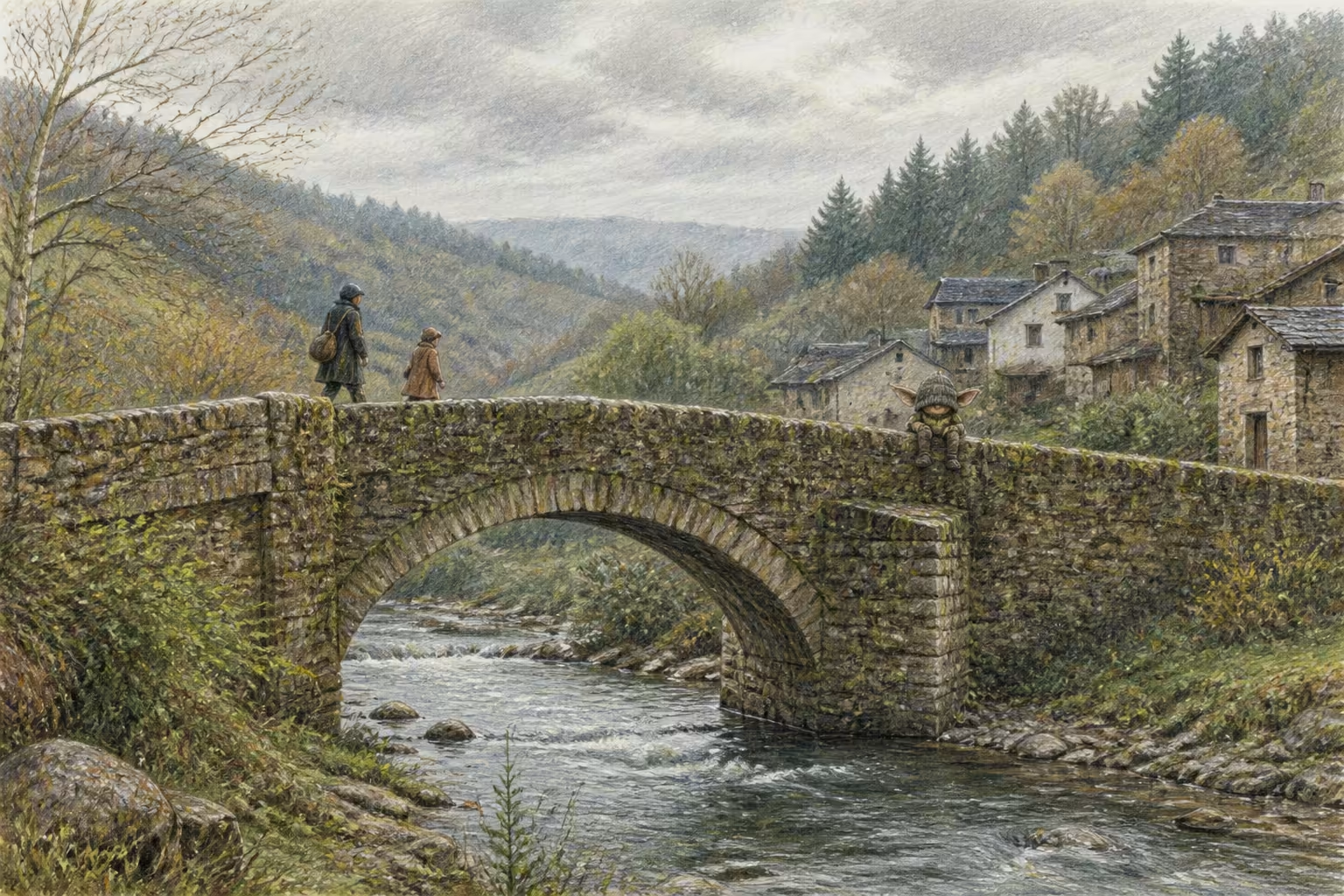
After that village they went nine days without seeing anybody. Nine days of B-road and hard shoulder, sleeping wherever they could, eating the same thing, with the conversation on autopilot, which is the part of the road nobody tells you about afterwards.
He turned up on a bridge.
They were stopped halfway across, looking at the river below, when Axel lowered his eyes and found a thing sitting on the parapet, a hand’s breadth from his elbow. He was shorter than Gorgorito and a good deal rounder, with a woolly hat that covered half his face and enormous ears sticking out from under it that didn’t go with anything.
“Afternoon,” said Axel, no longer startled. He was starting to get used to it, and that frightened him more than the surprise did.
The little creature turned round.
“EH?”
“I said afternoon.”
“AH! AFTERNOON!” He said it at the top of his lungs, as if they were thirty metres apart. “WHAT A LOVELY DAY!”
It was drizzling.
“Who are you?”
“I WANT WHAT?”
“Who you are.”
“LITO!” He tapped himself twice on the chest, very satisfied. “LITO, ALWAYS HAVE BEEN!”
“Right. Lito. I’m Axel.”
“OF COURSE THERE’S LENTILS!”
“Sorry?”
“AT MY AUNT’S HOUSE! THERE ALWAYS IS!”
And he laughed enormously, slapping his knees, delighted with a conversation he was not having.
Axel spent the whole morning with a thing in his chest, and it was this: he wanted to show him to somebody.
Not Eva. Eva was a different matter. Eva had said “a rat, or I don’t know what” and since then had never said yes or no again, and he didn’t dare push her.
It was Bruno.
That annoyed him, because it had been three years since he’d stopped feeling like telling Bruno things and it felt like a filthy trick to start feeling it again over a deaf creature in a woolly hat. Bruno would have been the first he told. He had told Bruno, in fact, at twelve, in a tent in his back yard, and Bruno had gone quiet for a good while and then said:
“Right. And do they eat?”
Just that. No arguing. Without asking if he was sure. He spent three years asking him things about it, with the same face he used to ask about football, and one day at secondary school he stopped asking, and Axel never knew whether it was because he got bored or because he felt sorry for him.
Of the nine hundred things he missed about that bloke, the one that caught him off guard on a bridge that morning was this: that he was the only one who had never asked him for any proof.
Another one came to him, and that one he had never thought before.
That as a kid he saw them all the time. All the time: in the school playground, in the neighbour’s garage, behind the telly. And that then, at some point between fourteen and twenty-odd, he stopped seeing them and never noticed that he had stopped seeing them. There was no last one. He didn’t say goodbye to anybody. One year he saw them less, and the next less, because what was the point.
And he had been three weeks away from home and he was already up to five.
So he wanted to show Hortensia. Because Hortensia was the most normal person he had met in his life, an ordinary woman of the old sort, the kind who buy three jars of sauce just in case. And if Hortensia saw it, then it wasn’t just him.
Lito went along the verge with them, hopping about, singing something horrible. And level with a junction, Axel couldn’t hold out any longer.
“Hortensia.”
“Tell me, son.”
“Look over there.” He pointed at the ground, a metre and a half away, where Lito was at that moment sitting on a stone scratching an ear. “There. Right there.”
Hortensia looked.
She really looked. She stopped, put her hand up as a visor and spent two long seconds looking at the stone. And Axel knew, from the way her face moved, exactly what was coming next.
“Oh,” she said.
She smiled. It was a marvellous smile. Warm, whole, without a drop of mockery. The smile you give a child who shows you a drawing of something you can’t make out.
“How lovely, son.”
Axel lowered his arm.
“Mmh.”
“No, seriously, I think it’s beautiful,” she said, and put a hand on his shoulder for a moment as she passed. “I like people who see things. I had an aunt who talked to her dead husband every night, and she was the cleverest woman in the family.”
And she carried on walking.
It went down worse than if she had laughed. If she had laughed, Axel would have laughed too and that would have been that. If she had said “you’re off your head”, it would have been a joke between the two of them, and a joke between two is a place where two fit.
But she had said “how lovely”.
“how lovely” means “it isn’t there, but I love you all the same”.
He spent two kilometres turning it over, and along the way they appeared to him, one after another, everybody who had said it to him before in other words. His boss at the hotel, who one day asked him, very kindly, if he was sleeping well. A teacher in second year who sent a note home about the drawings notebook.
And her.
She used to say “the thing about you is you overthink everything”, and she said it in a soft voice, the voice of somebody closing a door very slowly so as not to wake anyone. They were together three years. They never talked about why it ended, because there was no why: one Sunday she was there and the next she wasn’t, and in between there were some very correct messages. Axel took it well, because he took everything well, and within a week he was explaining to a mate that deep down it had been the best thing for both of them. He explained it so many times he almost believed it.
There, walking along a road with a twenty-centimetre creature shouting lentils on his left, he realised something that hadn’t occurred to him in two years: that he had never told her. Not once. Not a chance. That he had spent three years with a person without telling her the one thing he had inside.
That maybe that was what she noticed. The overthinking.
Lito, meanwhile, was up ahead trying to catch a butterfly and failing in a spectacular fashion.
“THIS ONE’S MINE!”
And it wasn’t his.
They ate on a threshing floor, sitting on some bales of straw. Eva sat next to him, bit into the bread and stayed quiet for a while.
“What did she say to you?” she asked.
“Who?”
“Hortensia. At the junction.”
Axel shook his head.
“How lovely.”
Eva nodded slowly, chewing. And she didn’t ask what was at the junction, and she didn’t tell him she saw it too or that she didn’t. What she did was stay sitting there, shoulder to shoulder, until he had finished eating, and when he got up to brush the straw off she passed him the bottle without his asking.
And at some point in the silence, it passed.
Lito said goodbye in mid-afternoon, on a bend, for no apparent reason.
“I’M OFF!”
“RIGHT!” shouted Axel, playing along.
“YOU WANT WHAT?”
“I SAID RIGHT!”
“AH! WELL, SEE YOU LATER!”
He went into a hole in a stone wall and didn’t come out. Axel gave the hole a second.
Behind him, Hortensia was telling Eva that her husband had a cousin who was stone deaf and refused to wear his hearing aid, and that at weddings he’d answer anything at all and there’d be terrible confusions.
“Once he told the bride the rice was overcooked. And they’d asked him about the dress.”
Eva was laughing. Axel laughed too.
“And did he know he wasn’t following?” he said.
“Well, of course he knew. He wasn’t stupid.”
“So why didn’t he wear the hearing aid?”
Hortensia thought about it for a while, and walked a few metres before answering.
“Because the aid whistled,” she said. “And because by answering anything at all, at least he was talking to people.”