
A Whiff of Fiesta
An empty square, a song and a van full of scaffolding in the morning
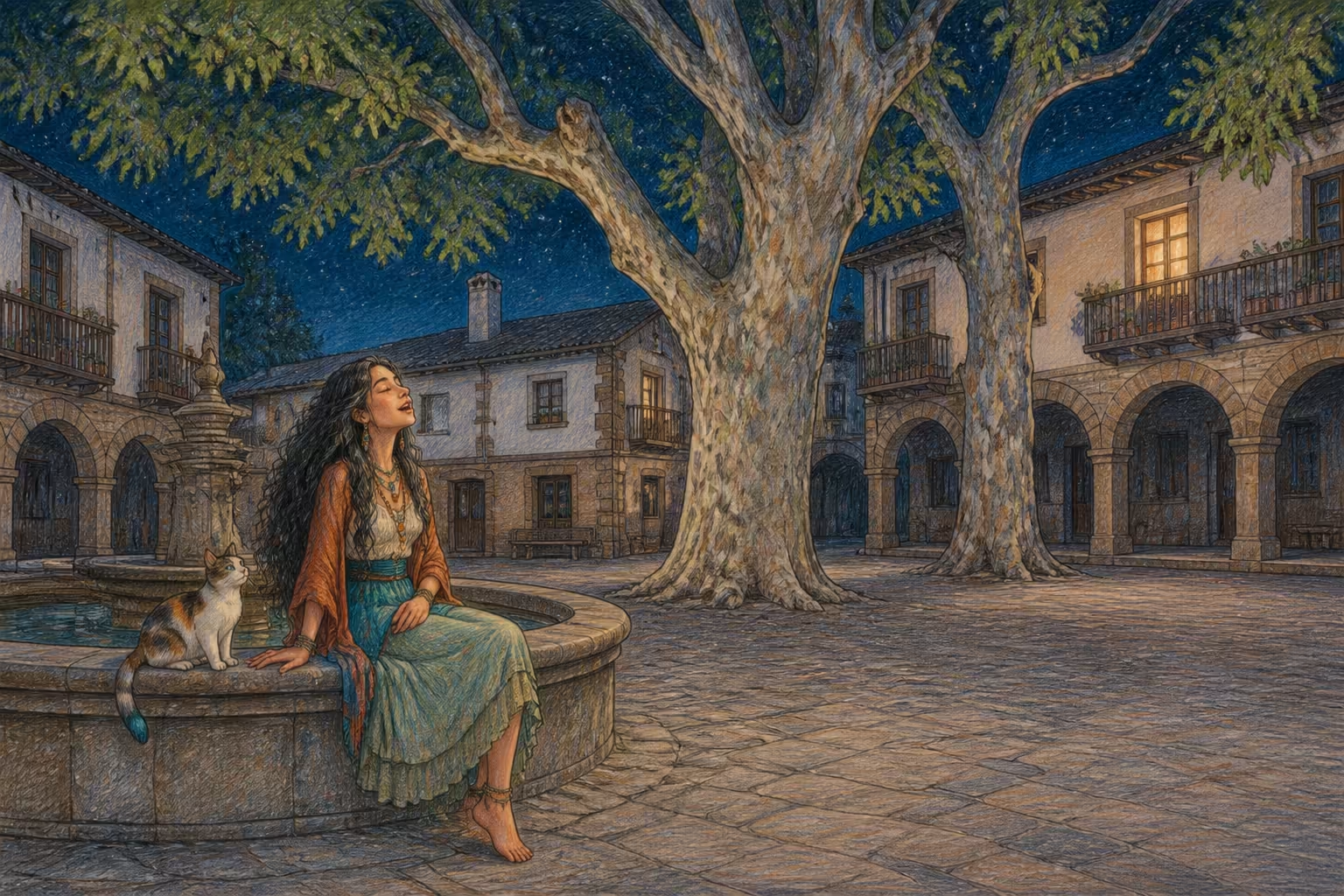
They arrived at the village on a Thursday afternoon and Axel got the feeling their clock had broken.
It wasn’t that it was empty. There were people: there was a bar open, a man watering some pots, two little girls on bikes going round and round the fountain. But it was as though the whole village were half a tone short.
The square was big, square, with arcades along two sides and some enormous plane trees in the middle. It was a good square. The sort you do something in.
And there was nothing.
“What a lovely square,” said Hortensia.
The man with the pots looked up.
“It was,” he said, and went on watering.
They had dinner in the bar: packet soup, omelette and a rough wine that Hortensia said was delicious out of politeness. The man from the bar didn’t talk much, but when Hortensia asked him about the square he leaned on the counter with both hands, the way a man leans when he has spent a long time waiting to be asked.
“There used to be a festival here, you have no idea. Three days. And not one of these festivals they have now, with a band that turns up and gets paid and goes, no. Here they’d build a stage out of planks and up went whoever wanted. My uncle had a list, all right, a list in a notebook, and he’d put you down: you at nine, you at twenty past nine. And the fellow from the garage would go up and play the accordion and a young girl would go up and recite and the sewing women would go up and do a thing they did with aprons that was enough to kill you laughing.”
“And what happened?”
“Well, nothing. It just stopped being done.”
“Something must have happened.”
“It didn’t.” He picked up a glass and began drying it. “The one who organised it died, who was my uncle, and that year it wasn’t held out of respect. And the next year it wasn’t either, because after all, it wasn’t held last year. And the year after that somebody said something in the bar and it came to nothing. And now that’s twenty.”
He stood there thinking, glass in hand.
“The thing is it was nobody, all right,” he said. “There was no row, nobody fell out with anybody, nobody said ‘that’s the end of it.’ It simply…” he made a gesture with the cloth, like somebody shooing a fly, “it just stayed left.”
“Well, well.”
“Well, well.”
He finished drying the glass and set it upside down.
“I haven’t got a room. But if you want to stay in the square, fine by me. The fountain gives good water.”
They stayed in the square. They put the tent up under the arcades, in a corner where it was in nobody’s way, and Axel got out the coffee pot and put it on the stove on top of a terrace table that had been cleared and tipped over, because Hortensia had got it into her head that a coffee in a square is a different thing from a coffee on a verge.
“It’s the same coffee pot, Hortensia.”
“It’s the same coffee. The square is a different one.”
They went out to sit on the rim of the fountain, because it was a beautiful evening.
And Eva started singing.
It wasn’t anything special. She started singing the way she always did, without warning, quietly at first, one of hers. Only the square had arcades, and arcades have a thing about them: they give you back your voice.
Axel noticed straight away. Eva’s voice went and came back, hung about up there a moment and came down into the square again a fraction late, as though there were somebody else singing from the far end. She noticed too, because she stopped for a second, laughed and carried on louder.
And she sang for a good while. She sang three or four things one after another, with no names, making up the words as she went as she always did, with Kika asleep at her feet and Fay sitting on the edge of the fountain like a vase.
A light came on in a balcony.
Then another.
In a second-floor window a shutter opened and stayed open.
Nobody came out into the street. Nobody clapped. Nobody said a word. And when Eva stopped, the square went so quiet you could hear the water in the fountain.
“Right,” said Hortensia, getting up and straightening her cardigan. “I’m off to bed, there’s walking tomorrow.”
And none of the three of them thought anything more of it.
Axel was woken by a metallic noise. He looked at his watch: twenty to eight. He came out of the tent with his hair flat on one side, and in the middle of the square there was a van with its doors open and three men unloading iron. Long lengths of iron, the paint flaking off, with that coat of thick dust that only settles on things that have spent years stacked in a closed-up place.
The sort you build a stage with.
The man from the bar was in his doorway with his coffee in his hand, watching.
“Morning,” said Axel.
“Morning.”
“And this?”
The man took a sip of his coffee.
“They were in my uncle’s hay barn.”
“The iron?”
“The iron, the bulbs, the planks and two boxes of bunting. And the list, that was there too, in a shoebox, in my uncle’s handwriting and everything.” Another sip. “Twenty years they’ve been in there. I knew. Everybody knew. And this morning my cousin came round at half seven and said to me, ‘we’re getting the iron down.’ And I said all right then.”
“And why this morning?”
There the man turned and looked at him very calmly, the way you look at somebody who asks one of the questions that don’t have answers.
“Well, that’s what I’m asking myself,” he said, and went into the house.
One of the men, a big fat fellow in a hi-vis vest, shouted from the van:
“Boss! Do we put the stage here or next to the plane trees?”
The man from the bar answered from inside, without coming to the door.
“Next to the plane trees! That’s where it always went!”
They packed up the tent with the van unloading iron ten metres away. A woman came out of a doorway with a box of coloured bulbs. A lad came out with a ladder. Somebody had opened the bar early and put the radio on. Nobody explained anything to them, because nobody was explaining anything to anybody: people came out and picked things up, as though the whole thing had been decided months ago.
Hortensia swung the rucksack onto her shoulder.
“Are we staying?” said Axel.
Hortensia looked at Eva. Eva was standing in the middle of the square with the cat in her arms, watching the woman with the bulbs.
“No,” she said.
“No? Woman, they’re going to put on a…”
“No.” She turned round. “Because it’s theirs.”
She set off towards the way out of the village, and them behind her. When they got to the corner Axel turned round one last time: they had half the stage up and were arguing about where to put the speakers.
They walked a kilometre and Axel couldn’t hold it in.
“It’s daft not to stay.”
“Mmh.”
“I mean, they’ve all seen us and nobody has said anything. Nobody has thrown us out.”
“Nobody has thrown you out, no.” Hortensia was walking in front without turning round. “And if you stay, you’re in the photos. And those photos are going to be looked at thirty years from now, in this very square, and there’s going to be a fellow with a rucksack that nobody knows who he is. And you won’t care, because you won’t be here. But they will care, because when the one showing the photos gets there, somebody is going to have to say ‘he wasn’t from round here.’ And that gets said once and then it gets said always.”
Axel shut up.
“Mind, it isn’t a bad thing,” she added, more gently. “I have been one for getting in everywhere, and I have gatecrashed weddings that weren’t mine. But there are days that belong to the people, my boy, and today is one.”
Hortensia, walking in front setting the pace, was heard to say a little later, to nobody:
“Twenty years in a hay barn.”
And she quickened her step.