
The Bell Tower
A village under the water and a house that slipped out of her mouth
Mid-morning they came to a junction with two arrows. One said the coast. The other said nothing, just a name and a line that went off upwards, towards some hills you could see in the distance, blue from far away.
Axel stopped to look at the one for the coast. He was fond of that idea: cliffs, lighthouses, people with boards under their arms. He’d been seeing it inside himself for months.
While he was looking at it, Fay came out of the ditch, crossed the whole junction without looking at anybody, took the road going up, sat down twenty metres along and waited. Kika went after him like a trailer.
“That way,” said Eva.
“The thing is, there’s no sea that way.”
“Uh-huh.”
Axel stood there a moment with his hands on the rucksack straps.
“Right,” he said. “Up we go then.”
He turned. And it didn’t cost him as much as he’d expected.
“Let me get this straight,” said Hortensia ten minutes later, setting the pace. “You leave your house, you drop everything, and you don’t know where you’re going.”
“North.”
“North is half the country, my boy.”
“North and the coast. The sea thing, the cliffs, the waves.”
“Do you surf?”
“No.”
“Ah.”
They walked on a few metres.
“So then what?”
And there Eva, who had been quiet for half an hour, said:
“He came because of a slice of pizza.”
Hortensia stopped dead in the middle of the road.
“Sorry?”
“Eva.”
“He choked on a slice of pizza and it changed his life.”
“That’s not how it was.”
“That is exactly how it was.”
“It was not exactly how it was.” Axel started walking faster, with great dignity. “It was a big slice.”
“It was a frozen pizza,” Eva went on, delighted. “Microwave.”
“Pre-frozen.”
“And what’s that?”
“It’s a different thing.”
“And he banged himself against the worktop here, in the belly, like a wild boar, and the slice went flying.”
“Like an animal, he said! He said it, I never said wild boar.”
Hortensia was looking from one to the other with her mouth open and a joy that was climbing up her face.
“Hang on, hang on. Stop.” She raised a hand. “Were you on your own in your house?”
“On my own.”
“And you thought you were dying?”
“I thought I was dying, yes. And I thought something very odd, which was: bloody hell, what a stupid life.” He opened his hands. “And from the kitchen floor, without getting up, I quit my job.”
Hortensia went quiet for three steps. And then she let out an enormous laugh, the sort that doubles you over.
“A pizza!” She held her belly. “Oh, dear God! A pizza!”
“All right.”
“No, I think it’s bloody marvellous, mind.” She dried an eye with her wrist and started walking again, and she said it looking straight ahead, as though it were nothing at all. “It took a man dying for me. You’ve got off with a pizza.”
She carried on walking, two paces in front, as though she had just remarked on the weather.
Around twelve Axel said that maybe the upper track took longer, but you saw more.
“Very observant.”
She said it without turning round and without raising her voice, and Axel was still left with his mouth half open.
“Right.”
They walked two hundred metres.
“Sorry,” said Eva.
“It’s fine.”
“No, it isn’t.” She yanked her rucksack back into place. “It’s just that today, no.”
Hortensia was two steps ahead and didn’t turn round either.
“Ah, you’ve got your period.”
Eva stopped dead.
“Well, honestly.”
“What?”
“You don’t say it like that.”
“And how do you say it?” Hortensia kept walking. “Love, I had my period for more years than you have been alive. You can tell me and I’ll understand, which is more than this one is going to do.”
Axel put both hands up without anybody having asked him anything.
Eva opened her mouth to answer and nothing came out. Three paces later a laugh escaped her through her nose, the kind that escapes exactly when you are deciding to get angry and there is no way back.
“It’s just that you’re…”
“I’m what?”
“Nothing.”
“Right then.”
That night, driving the pegs in, Axel saw her look at the sky for a good while. There wasn’t much to look at: half a moon lying on its back above a hill, still with light in it.
“What are you looking at?”
“The count.”
“What count?”
“Mine.” She pointed up with her chin, without taking her hand out of her pocket. “I haven’t got a phone.”
And she got into the tent.
Axel stayed outside with the peg in his hand, looking at the moon the way you look at a device that had been hanging up there your whole life and you never knew what it was for.
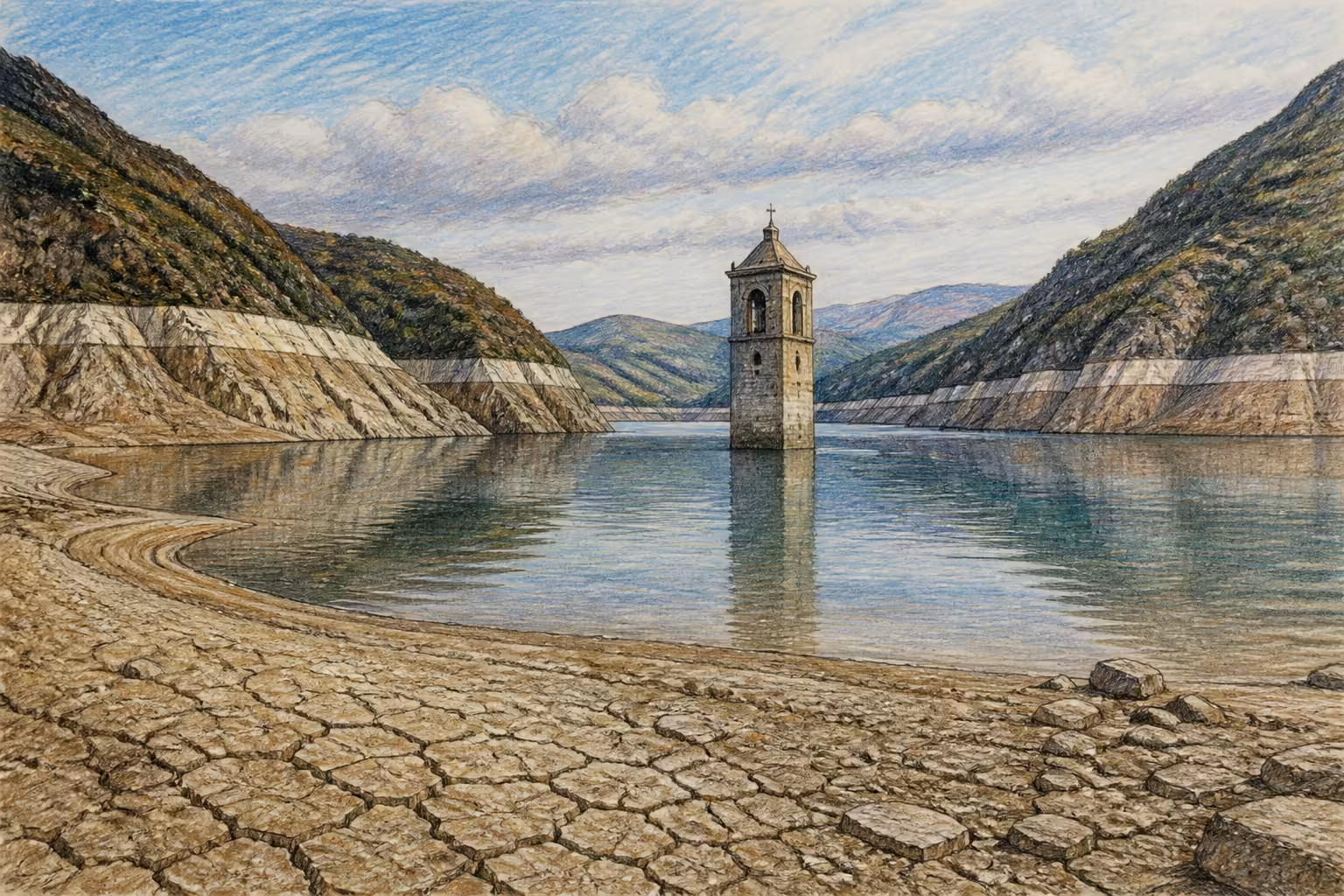
Two hours later the valley opened out and the water appeared. An enormous reservoir, long, set down between the hills, with water a dark green that was nothing like any river’s. The road skirted it along the top, and down below the banks were dry cracked mud, with a white line marked clearly on the rocks, well above the water, saying how far it had come once.
“It’s terribly low,” said Hortensia.
Kika ran down towards the mud and started smelling things.
And then Eva stopped.
“What’s that?”
In the middle of the water, about two hundred metres from the shore, there was a tower. A stone tower, square, with two windows at the top and a gap where there had once been a bell. It came out of clean water, with nothing around it. Like a finger.
“A bell tower,” said Hortensia.
“And what’s it doing there?”
“Well, being where it was.”
She leaned on the crash barrier and stayed a while without speaking, which in her case was news.
“There was a village down here,” she said. “They flooded it to build the reservoir, sixty years ago, thereabouts. They gave people a piece of paper and a deadline, and the deadline was short. And I know that because it was talked about in my house, all right, talked about a great deal, and always in a low voice, the way you talk about things that happened to somebody else and could have happened to you.” She pointed at the water with her chin. “They moved the dead from the cemetery, they did do that. And for the living they built a new village up there, with all the houses the same and the streets straight and the numbers painted on. And there are those who say they came out of it better off, because the new houses had water inside and the old ones didn’t. And maybe that’s true. But I have been in that new village three times in my life and I have never seen anybody out in the street. Not once. And in mine, which is falling down, there is always somebody in a doorway.”
“And the houses stayed down there?”
“Whole. With the doors shut and everything, and that is what used to give me a feeling inside when I was little.” She made a small noise with her mouth. “When the water drops a lot, like now, things come up. The year of the big drought they say even the streets came out.”
The three of them stood looking at the tower. It was a beautiful place and it was horrible, both at once, and none of them knew what to say for a good long while.
They went down a dirt track to the shore, because Eva got it into her head.
Up close it was worse. In the dry mud there were things: a piece of wall a hand’s breadth high with a perfect corner, half a staircase that went nowhere, a flat stone with a square hole in the middle that who knows. Eva walked barefoot over the cracked mud and stopped at every single thing.
Kika found a shoe and brought it over very proudly. A real shoe, leather, gone hard as a stone.
“Drop that, you filthy thing,” said Hortensia.
She stood looking at it. She stood looking at it too long.
“These houses were like my mother’s,” she said.
Axel lifted his head.
“And where was that?”
“Up there.” A gesture with her chin towards the hills, very quick, the same gesture with which you point at a thing you don’t want to point at. “In the mountains.”
“And is it still standing?”
“Now see if you know what this is,” said Hortensia, bending down to pick a twisted piece of iron out of the mud, “because I haven’t the faintest idea.”
And from there she got onto mushrooms, very loud and very fast, and she didn’t let go of it all afternoon.
Axel looked at Eva. Eva raised her eyebrows half a millimetre.
They had both heard it perfectly.
They slept that night a kilometre from the reservoir, on a level patch among pines from where you could still see the water. They had a shared tin of bean stew and bread for dinner, with Kika following every spoonful with her eyes like saucers and sighing like a widow.
The rucksack didn’t fit, as always. Axel took it out, put it against a pine, threw the rain jacket over it and got in, and by now he hardly thought about it.
Before falling asleep, with the zip open a hand’s width, he looked for the patch of water visible between the trunks. Very black, very still.
Down there was a square.
Down there was a street somebody walked home along.
He fell asleep with that.
In the morning, when he came out of the tent for a pee, the leather shoe was on the ground in front of the door. He stood looking at it a while. Then he looked at Kika, who was lying two metres off with her head between her paws, very calm, wagging her tail twice.
“You daft thing,” he said to her.
And he scratched her ears.