
The Odd One Out
Eva did not speak all day, and then she spoke to a dog
Eva didn’t speak all day.
It wasn’t a door-slamming sulk. It was worse: it was one of those polite silences, the kind that shut you out without you noticing the door has closed. She walked with them, she stopped when they stopped, and when Hortensia offered her a piece of bread she said “thanks” and ate it.
Axel tried three times. The first with something daft, to make her laugh, and nothing. The second with a question about the route, so she’d have to answer something, and she answered in three words.
And the third was the bad one.
“Listen, if you want we can talk about this morning.”
Eva didn’t even turn her head.
“I don’t want to.”
“Right, but sometimes it helps…”
“Axel.”
There he stopped. He shut up and carried on walking, and it cost him a physical effort, like holding in a sneeze. Because he was a fixer. His whole life he had been a fixer: somebody’s thing broke and he had the screwdriver out before they’d asked. His ex had said as much to him once, and not as a compliment. And for the first time in a long while it occurred to him that maybe that wasn’t a virtue but a compulsion, and he walked the rest of the morning with that idea circling and no good place to put it.
Hortensia, on the other hand, talked for the three of them.
“At school we had a priest called Don Anselmo who used to fall asleep during Mass,” she said, without anybody having asked her anything. “During Mass. Him. The one saying it. He’d start reading the gospel and his voice would fade out, and there’d come a moment when he was just standing there, on his feet, with the book open and his chin on his chest. And us waiting. Forty girls looking at a priest asleep standing up.”
“And nobody said anything to him?”
“Who’s going to say anything to a priest, child?” She laughed to herself. “What we did was cough. One of us coughed and then another and then another, and when there were ten of us coughing the man would wake up, say ‘so, then’ and carry on wherever he fancied. Sometimes from a different gospel.” She lifted a shoulder. “And that man taught every one of us to read. Every one of us. I have never heard anybody say a bad word about Don Anselmo. He fell asleep and that was that. Everybody has their thing.”
From there she went to mushrooms, and from mushrooms to why people don’t sit in doorways any more.
She didn’t ask Eva a single thing. Not once, in five hours, and it wasn’t an oversight.
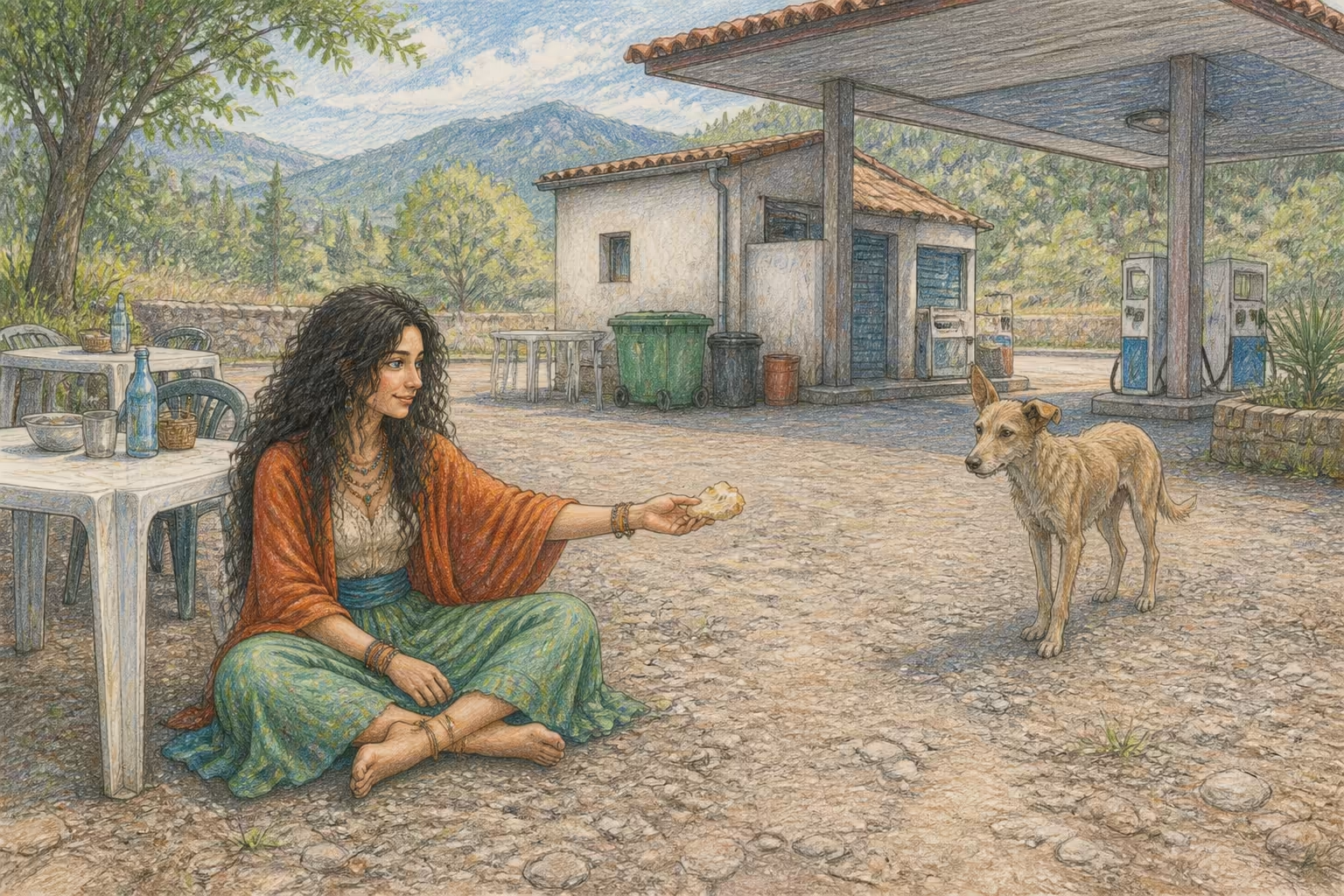
They stopped to eat at a picnic area next to a petrol station, an ugly spot with two plastic tables and a cigarette machine.
And that’s where she turned up.
She came out from behind the bins very slowly, with her head down, and the first thing Axel thought was that it was a wolf. It was a big dog, grey and white, with the mask on her face marked as though it had been painted on, her ears pricked and eyes of a blue that does not belong on a dog. And she was skin and bone: her coat was coming out in patches along her back, in the way it does on animals that have spent a long time being hot where they shouldn’t be. She had no collar.
She stopped five metres off and stood there, calculating.
“Oh dear,” said Hortensia.
“What is that?”
“That is a husky, my boy. One of the sledge ones.” She wiped her hands on her trousers. “Those are for places with snow, child. Who on earth tells anybody to buy themselves a wolf to keep in a flat?”
Fay, who was on the table, stretched, looked at her, decided it was none of his business and curled up again.
“Don’t give her anything,” said Hortensia. “Because if you give her something, she doesn’t leave.”
“Come on, look at her.”
“Yes, I can see. But then she follows you and what do you do? Do you take her? And how far? Look, in my village there was a woman who kept a dog like that and ended up with nine, and I don’t say nine loosely, nine. And she wasn’t a bad woman. It’s that she didn’t know how to say no the first time.”
Axel was left with half a sandwich in his hand, hesitating, which is exactly the worst thing you can do in front of a hungry dog.
And then Eva stood up.
She picked up her own sandwich, hers, without having taken a single bite, walked over unhurriedly and crouched four paces away.
“Come,” she said.
It was the first word that had come out of her body since the verge.
The dog didn’t move.
“Come on, girl. I’m not going to do anything to you.” She broke the sandwich in half and left a piece on the ground in front of her. “Here.”
The dog came at an angle, watching her out of the corner of her eye, ready to bolt. She took the piece and moved two metres away to eat it.
“See? There you go.” Eva sat down on the gravel, legs crossed. “Nobody’s going to take anything off you.”
She left the other piece a little closer. And then she started talking to her.
She talked quietly, in a voice Axel had never heard her use. She told her she was very thin. She told her Fay had eyes like that and asked whether they were cousins. She asked where she’d come from and answered herself that it was from round here.
And the dog answered her.
She didn’t bark. She lifted her muzzle, shut her eyes and let out a long “oww-woo-woo-woo”, very talkative, of an absolutely false sadness.
Eva froze for a second.
“Excuse me?”
“Oww-woo-woo!”
“Ah, so that’s how it is.”
She carried on, and the dog carried on answering, and that was a ten-minute conversation between a woman who talked very quietly and an animal that complained a very great deal. Hortensia was wiping her eyes on her sleeve from laughing. Axel stayed at the plastic table with the sandwich in his hand, not making a sound, and when Eva looked up and looked at him for a second and went back to what she was doing, he was hit by the strangest urge to cry, which passed straight away.
When they packed up, the dog was three metres away. When they got out onto the road, she was ten. Within half an hour she was out in front, with Fay, as though she had been doing this all her life.
“This one isn’t leaving now,” said Hortensia. “Well. We’d better call her something.”
“Kika,” said Eva.
The two of them looked at her.
“Kika?”
“Kika.”
“And why Kika?”
“Because she’s four kilos short.” She twisted her mouth. “And because it suits her.”
She carried on walking, and Axel stayed behind for a while turning something over, which was that this woman didn’t give her songs names and had named a dog in two seconds.
Hortensia looked at him with her eyebrows up, very dignified, like somebody who has just won an argument nobody had started.
That night they stopped in a pine wood, far from everything and with no signs. They ate badly, because there had been nowhere to buy anything and they had some biscuits and a tin left. Kika lay down at Eva’s feet without asking permission, and two minutes later she was asleep and snoring in a way that was not normal for an animal of that size.
And when Hortensia had already got into the tent and Axel was doing his last round to put the rucksack under a pine, Eva spoke.
“I was ten when I started hating her.”
Axel stopped.
“They’d taken us to a birthday party. And I started singing something I’d just made up, in front of everybody, standing on a chair, because I was ten and I didn’t care.” She was looking at the fire, which was only embers now. “And she stood up and said to my mother, in front of me and the other girls: ‘you tell her, she won’t listen to me.’ And my mother took me down off the chair. With a hand on my arm, without shouting, very nicely. And sat me down.”
She was quiet for a while.
“That’s all,” she said. “She didn’t hit me, she didn’t do anything to me, nobody behaved badly towards me. That. And I’ve spent fourteen years unable to sing anywhere she could walk in through the door.”
She got up, brushed off her trousers and got into the tent.
Axel stayed outside a while longer, looking at the embers, thinking that he had left his house over a piece of pizza and that maybe everybody leaves over something silly that isn’t.
Beside the pine, a little way off, somebody was sitting. He hadn’t seen him arrive.
Gorgorito was on a stone with his legs hanging, looking in the same direction as him.
Axel waited for the joke. The usual quip, the chocolate thing, something. It didn’t come. The little brownie sat there without a peep until Axel got into the tent.
And when he stuck his head out again, a minute later, he was gone.