
Identify Yourselves
A little notebook, a surname and a call Eva didn’t want to make
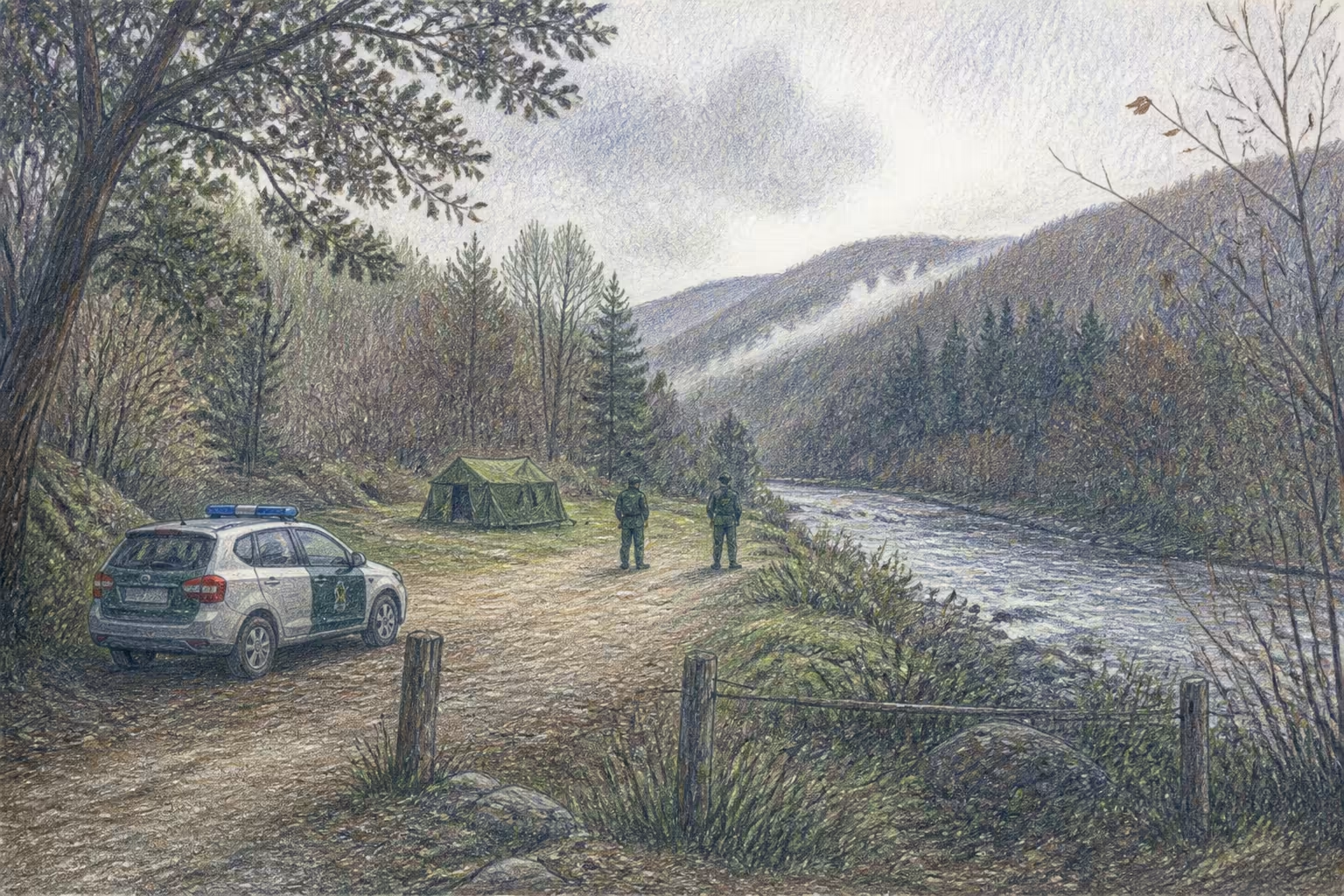
The first thing Axel heard was a car door.
The second was gravel.
He opened his eyes. Through the gap in the zip came a grey six-something-in-the-morning light and a small piece of green trousers.
“Morning. Anybody in there?”
He got out as best he could, barefoot and with his hair flat on one side. Outside there was a Guardia Civil car parked at the entrance to the clearing, lights off and engine off, and two officers: an older one with a moustache, who had stayed by the car looking at the river with his hands behind his back as though he were on holiday, and a young one with the face of somebody doing this for the first time in his life.
“Morning,” said Axel.
“Morning.” The young one pointed at the sign with his chin, almost apologetically. “It says there that you can’t.”
“I know. We saw it.”
“Right.”
The two of them stood looking at the sign for a moment, like a couple of blokes looking at building work.
“Well then,” said the officer, “you pack up and off you go and nothing has happened here. But I’ll need some identification, it’s the procedure.”
Hortensia was already out, combing her hair with her fingers and in an excellent mood.
“Morning, love! Do you want a coffee? I’ve got a pot, we’ll have it done in a minute.”
“No, madam, thank you very much.”
“It’s the good stuff, mind.”
“No, madam.”
She took her ID card out of a pocket with two fingers and handed it over like somebody dealing a card. Axel took his out of his trouser pocket. The officer glanced over them and wrote the numbers in a little notebook, slowly, in small, very careful handwriting. And he looked up towards the tent.
“And the third one?”
Eva came out slowly. She stood up on the grass, barefoot, with the new blue rucksack hanging from one hand.
“Morning,” said the officer. “May I see your documentation?”
“I haven’t got it.”
“You haven’t got it on you or you haven’t got one?”
“I haven’t got one.”
The officer blinked.
“All right. Fine. That’s not a problem at all.” He got the notebook out again. “Give me your name and surnames and that’s that.”
“Eva.”
He waited.
“Eva… and what else?”
Eva didn’t answer.
Axel looked at her. She was very still. Too still.
“It’s just that I need the surnames, miss.”
“Well, no.”
The young officer turned for a moment towards the car, looking for his colleague. The one with the moustache was still watching the river.
“Look,” he said, lowering his voice, and he genuinely said it meaning well. “This is nothing. It’s a formality. I identify you, we close the paperwork and off you go for your breakfast in peace.”
He took the little device off his belt and started typing.
And Axel, standing two metres away, saw the exact moment the lad’s face changed. It was very little. A second. He raised his eyes from the screen, looked at Eva, looked down again, looked up again.
“Excuse me. Are you Eva Moreno?”
He said it whole, both names together, in that way of saying names that people have when they’re reading them off a screen. And what struck Axel as strangest wasn’t the surname, which was one of those surnames there are two of in every class. It was hearing her named. As though up until that moment she had been a girl who sang in a market and suddenly she was a person with papers somewhere.
Eva didn’t move.
“You are registered as a missing person,” said the officer. “A report from…” he looked, “a year and four months ago. Filed by a direct family member.” Another look at the screen. “Irene Moreno.”
Axel watched her do something he didn’t understand. She put a hand to her chest, over her T-shirt, and closed her fist around something she was wearing underneath. One second. Then she lowered it.
Eva crouched, picked her rucksack up off the ground, slung it over her shoulder and started walking towards the road. Without looking at anybody. Walking.
“Hey! Miss!”
“Eva.” Axel went out after her. “Eva, stop.”
She didn’t stop. She crossed the gravel, left the clearing and carried on along the verge, barefoot, at a normal pace, neither fast nor slow, like somebody going somewhere.
Axel caught up and got in front of her.
And what he found wasn’t crying. It was a face he had never seen before, with nothing inside it, as though somebody had switched off her light and locked the door.
“Don’t you call her.”
“Eva…”
“Don’t you call her.” Now she did say it loudly, and her voice came out very flat. “I haven’t done anything. I haven’t stolen, I haven’t killed anybody, I don’t owe anybody money. I can be wherever I like.”
“Nobody’s saying…”
“A year and four months.” She laughed, and it was horrible. “A year and four months looking for me. Do you know what that is? That isn’t her missing me, Axel. That’s her not being able to stand that there’s something she isn’t in charge of.”
The young officer came up behind, not running, with his hands away from his body.
“Miss, you’re not going to walk off along the verge. Let’s talk about it.”
“I’m not going back.”
“Nobody has said you’re going back anywhere. You’re of age. You can be wherever you like and with whoever you like, and nobody can make you do anything. All right? That first.” He ran his tongue over his lips and carried on, and you could tell he was saying something he had read and that this was the first time he’d had to say it out loud. “The only thing is that there’s an open report, and if I’ve located you, the report closes. And if it closes, whoever filed it has to be told. That you’re alive and that you’re all right. That’s all. That isn’t a punishment, miss, that’s the opposite: that’s so they stop looking for you.”
“No.”
“That isn’t up to me. That’s how it is.”
“And where am I?”
“Sorry?”
“Are you going to tell her where I am?”
The officer shook his head.
“Not that. If you don’t want, not that. Only that you’re all right.”
Eva looked at the road for a long while. And then she pointed at the little notebook with her chin.
“That thing you’re writing in there. Where does it go?”
“This?” The lad looked down at his own small handwriting. “This goes into a report.”
“And who reads the report?”
“Well…” You could see nobody had ever asked him. “Whoever has to read it.”
“Right.”
She stayed looking at the verge a moment longer.
“Call her, then,” she said. “But I’m not taking that phone.”
They went back to the clearing. The officer moved off a few metres and stood with his back to them for a good while, talking to the control room, giving numbers, spelling things out. Eva sat on the stone table looking at the river, hands between her knees, and Axel sat down next to her and said nothing.
Hortensia, on the other hand, did not sit down. Hortensia stood next to the young officer with her arms folded, waiting, and when the lad lowered the phone and said “I’ve got her,” she put out her hand.
“Give me the phone.”
“Madam, I can’t…”
“Give it here, son, I’m not going to eat the thing.”
And the lad, who was twenty-three years old and had been in the service eight months, gave it to her.
Hortensia moved three steps away.
“Irene?” she said.
Pause.
“No, I’m not from the Guardia Civil. I’m a lady who is travelling with her.”
Pause. A long one. From where Axel was you could hear the voice on the other end. Not the words. The tone. Fast, loud, without drawing breath, like water when you open a tap that has been shut for years.
“Right. Right. Yes, love, I can hear you.” Hortensia shifted her weight. “No. I’m not going to tell you that. Nor that either.”
Another pause, and this time the voice on the other end went up so much that one word came through on its own: years.
“Look, love,” said Hortensia, and she said it perfectly calmly. “Your sister is all right. She’s living. Let her live.”
She hung up. She handed the phone back to the officer, who took it as though he were being handed back a grenade.
“There,” said Hortensia.
The officer with the moustache walked to the car without having said a single word all morning, and as he opened the door he turned round.
“Up there, past the bridge, there’s an area with a spring,” he said. “That one hasn’t got a sign.”
And he got into the car.
The young one was the last to go, with his hand on the back of his neck.
“Julián,” he said, suddenly.
Axel looked at him.
“My name’s Julián.” He went red. “Nothing, just… just have a good trip.”
He got into the car and they left.
They packed up. They folded the tent, put the embers out with water from the river, got the rucksack out from under the stone table. And Hortensia took out the coffee pot, filled it right there on the stone table, with Axel’s stove roaring like a small aeroplane, and didn’t ask anybody whether they wanted any.
It came out terrible. The first one always comes out terrible, because new aluminium tastes of new aluminium.
The three of them drank it standing up, burning their mouths, looking at the river.
Eva drank all of hers.
And she didn’t say thank you.