
The Habit
Three in a two-man tent and a sign that said no
It turned out Hortensia walked faster than the two of them put together.
They had been leaving the village since mid-afternoon along a back road, and the woman was out in front, setting the pace, telling them things. She told them well. That was the surprise.
“I fell in a horse trough with my communion dress on,” she said, without anybody asking. “The same day. Half past eleven in the morning, with the dress, the gloves, the little crown and all. And I didn’t fall, mind you, that’s what my mother said and it isn’t true. My brother Julio pushed me, God rest him, because I’d told him in front of three cousins that they’d made his crown out of butcher’s paper. Which was true.” She turned round for a second so they could see her face. “And they put me in a trough and they said nothing to him, because he was wearing short trousers and those dry. That was my first lesson in justice and I’m sixty-five years old and it still holds.”
Axel was laughing.
“And there were frogs in that trough, mind. Don’t go thinking it was clean water. Frogs and a bit of green slime. And I came out of there with the dress green at the bottom and they sat me on a bench to dry like a fish, and from that bench I watched everybody else’s whole communion.” She lifted one shoulder. “And I had a better time than they did.”
She went back to the river, which was where she always went back to.
“And barefoot all summer. All of it. From June until school started. My feet were like leather, I’d step on a bramble and not notice.”
“Lots of people say that and then they get a thorn in,” said Eva.
“And I got thorns in too, love. But I carried on.” She shifted the strap of her rucksack. “And I used to climb the poplars, the ones by the bank, because those are for climbing right to the top so they sway with you. Up there your stomach goes. My mother had to shout me down out of them and I’d come down laughing my head off and go back up the next day.”
“And then?”
“And then nothing. Then one day you stop climbing.” She lifted the shoulder again. “And it isn’t that you decide to stop. It’s that one year you don’t climb, and the next year you don’t either, because what’s the point.”
Eva turned slightly towards her.
“And why does anybody stop climbing?”
“Oh, love, over nonsense. Because somebody buys you a good pair of shoes.”
Fay came and went along the verges, appearing and disappearing in the long grass. The sun was starting to go down and the air already smelled of cool earth.
“We ought to be thinking about where we stop,” said Axel.
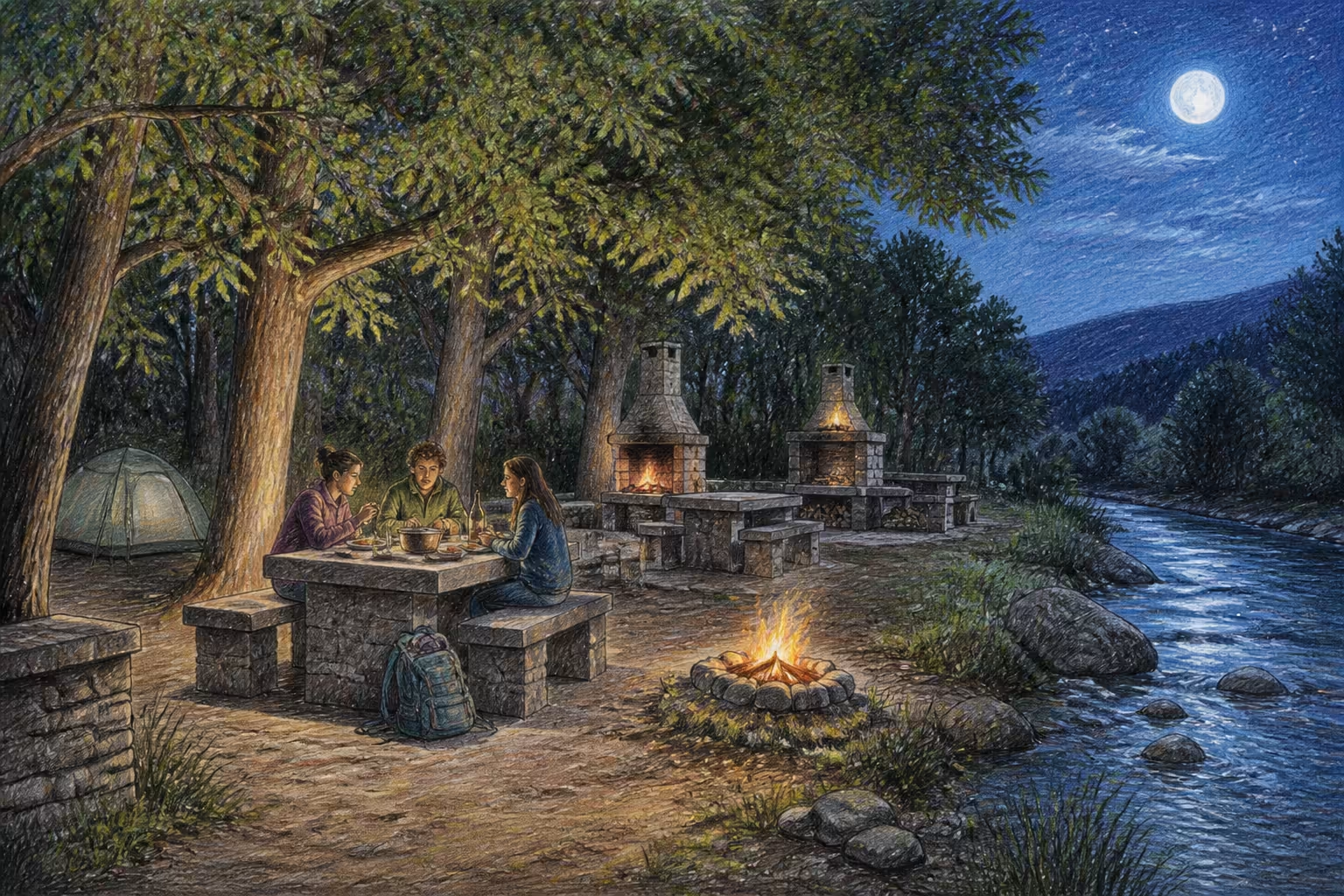
A bit further on there was a perfect spot: a flat clearing by the river with big trees, three stone tables and some built barbecues, the brick sort, black inside from a thousand meals.
And a sign.
NO CAMPING AND NO FIRES OUTSIDE THE DESIGNATED AREAS
Axel stopped to read it.
“Right,” he said. “Well, we’ll find something else.”
“Find what?” Hortensia was already walking in.
“It says you can’t.”
“It says you can’t camp. We’re not going to camp, love, we’re going to sleep.” She dropped her rucksack on a stone table. “And the barbecue is designated. It says so right there. Designated.”
Axel looked at Eva, and Eva had stayed at the edge, on the gravel, without stepping on the grass.
“I wouldn’t.”
“Why not, love?”
“Because no. Somebody comes along and that’s that.”
“Who’s going to come along?” Hortensia laughed, delighted with life. “Look, I grew up just over there. Nobody ever comes here, and the worst thing that can happen to you here is a wild boar turning up, and wild boar don’t care about the sign.”
Axel thought about it for two seconds.
Two seconds. Him, the bloke who got everywhere fifteen minutes early, who parked where you’re supposed to, who took library books back on the day they were due. And who had been sleeping wherever he liked for exactly one night. One. And already felt like a veteran.
“Go on, Eva, it’s fine,” he said, and walked into the clearing behind Hortensia.
Eva stayed on the gravel a moment longer. Then she came in.
Dinner was the best thing they had eaten in a long time, because Hortensia had been into the village shop and had bought without looking at the price: four fat steaks, that day’s bread, tomatoes, a head of garlic, oil and three different jars of sauce.
“Three?” Axel had said.
“Well, I didn’t know which one you liked.”
And a coffee pot. An aluminium stovetop pot, the three-cup size, the smallest one on the shelf, still with the price sticker on it.
“And this?”
“This is the first thing I picked up,” said Hortensia, very serious. “The rest we’ll see about, but without coffee I don’t leave my house to go anywhere.”
Axel turned the thing over in both hands, the way you examine a tool.
“This weighs something.”
“Then I’ll carry it.”
“No, no, I’ll carry it happily.” He was already putting it in the top pocket of the rucksack, the good one, the one for things you take out often. “I’m only saying it weighs something.”
Then he got the fire going, and it caught first time, and he was more pleased about that than he was prepared to admit. And then he started on the steaks and his head went off somewhere: he began breaking up the garlic and crushing it with the bottom of a glass because he had no mortar, he began toasting the bread on the grill next to the meat so it would catch the fat dripping down, he began asking Hortensia to pass him this and that.
“Here, you know what you’re doing with this,” she said.
“Not at all. I do this by ear.”
They ate with their hands, sitting at the stone table, with the river sounding away behind them and a great many stars coming on without permission. Fay polished off an entire steak on his own.
And at some point Eva forgot about the sign.
She started humming with her mouth full, quietly, one of hers, looking at the fire. Axel had his back turned, crouched at the barbecue, arguing with an ember.
Hortensia stopped chewing. She looked at Eva. Then she looked at Axel’s back. Then she looked at Eva again. And she went on chewing very slowly, with a small mouth, like a lady who has just found something out in church.
Putting up the tent was another story. The tent was a two-man: good, light, bought for one.
“I’ll sleep outside,” said Eva.
“Don’t you dare.”
“I’ve got plastic.”
“Nobody here is sleeping under a sheet of plastic when there’s a tent,” said Hortensia, and that was the end of the conversation.
“We’ll fit,” said Axel.
They didn’t fit. They fitted in one very specific way, the three of them on their sides like sardines, with Hortensia in the middle because she was the thinnest of the three and Fay on the legs of whoever he fancied.
“This is an indecency,” said Hortensia, delighted.
What didn’t fit was the rucksack. Axel shoved it, turned it, stood it up, laid it lengthways, and nothing.
“Leave it outside, man.”
“And if it rains?”
“Then it gets wet.” Hortensia was already getting into her sleeping bag. “Put it under the stone table and off we go.”
Axel went out, left the rucksack under the table, put his waterproof over it and came back in. Nothing was going to happen. They were in the middle of nowhere.
As he came in he saw something he didn’t understand and didn’t ask about. Eva had put her school rucksack inside the blue one, folded up, shoelace and all, and had closed the zip over the top of it.
And then, with the zip already closed and the three of them lying in the dark, the other thing happened.
“Sweet mother of mine,” said Hortensia. “What is that?”
“I don’t know what you’re talking about,” said Axel.
“It smells of dead cheese in here, son.”
“It’s his feet,” said Eva, with absolute calm, like somebody giving the weather. “They stink something horrible.”
“They do not stink.”
“They stink outrageously.”
“It’s the tent, because it’s shut.”
“The tent smells of tent. You smell of something else.”
“Of cheese,” said Hortensia.
“Not of cheese.”
“Of goat’s cheese,” said Eva. “The sort with that white rind.”
“It is not cheese!”
“Oh, child, there’s nothing wrong with it. My father had feet just the same and he was the best man in the world, they called him the Cured One in the army and he told the story with enormous pride.” Hortensia was laughing so much the whole tent was moving. “But open that zip, for the love of everything!”
Axel opened the zip a hand’s width, grumbling, and through the gap came the cold and the sound of the river.
They were quiet for a while.
“Eva?” said Hortensia.
“What.”
“Do you snore?”
“Horribly.”
“Ah, good.” She settled herself. “Then we’re even.”
Axel had trouble getting to sleep, and not because of the snoring, which started ten minutes later and was, indeed, spectacular. It was the sign. He lay there a while looking at the plastic roof, going round and round on whether somebody would come, on whether they fine you, on whether they fine you or all three of you. And then he thought about Eva’s face on the gravel, and about the fact that he had said “it’s fine” without knowing anything about anything, and that it’s very easy to say that when you’ve never had trouble with anybody.
And then he thought about the tent. That he had spent two nights in a hundred-and-twenty-euro tent chosen on the internet, and that he had put it up twice and both times badly, and that the woman sleeping on his left made do with a plastic sheet and five metres of rope.
He rolled over.
He fell asleep thinking about the garlic crushed with the bottom of a glass, which had come out beautifully.
Outside, under the stone table, the rucksack spent its first night in the open.