
What Does Not Fit
A huge house, a borrowed bathroom and a rucksack nobody wanted
On the way out of the café, Axel saw him again.
He was sitting on the step by the door with his little legs dangling, as though he had been there all morning waiting.
“You were…”
“Gorgorito.” The brownie folded his little arms, deeply offended. “I’m Gorgorito, man. What a memory you’ve got.”
Eva, beside him, hadn’t taken her eyes off the step either. Axel looked at her. She didn’t say yes and she didn’t say no.
“You wouldn’t have a bit of chocolate on you, would you?” said the little brownie, going straight for what mattered.
“No. I ate the lot.”
“Bah. Greedy pig.” He nodded towards the café, where the woman still hadn’t come out. “Anyway. What I came to say. Tell her to come with you.”
“Come with us where?”
“Wherever you’re going, sunshine. What does it matter?”
“But that woman has just…”
“That woman has just nothing. And you’re welcome, by the way.”
“Welcome for what?”
“You tell me.” He scratched an ear. “And tell her to take those shoes off, man, you can’t live in shoes like that.”
“Hang on, what do you know about her shoes?”
“That I’ve seen them.”
As if that explained everything perfectly, he turned round and went over to Fay, who was sitting there licking a paw with all the calm in the world.
He jumped up onto his back.
“Giddy up!”
Fay carried on licking his paw.
“I said giddy up.”
Fay finished the paw, stretched, and when he felt like it set off at a trot down the street with the brownie hanging on by fistfuls of fur and shouting things Axel didn’t catch.
Two strides and they were gone.
“What on earth are you two staring at?” The woman was coming out of the café. “You look like you’ve seen a ghost.”
He hadn’t seen anything. Of course not.
Axel and Eva glanced at each other for a second and started walking.
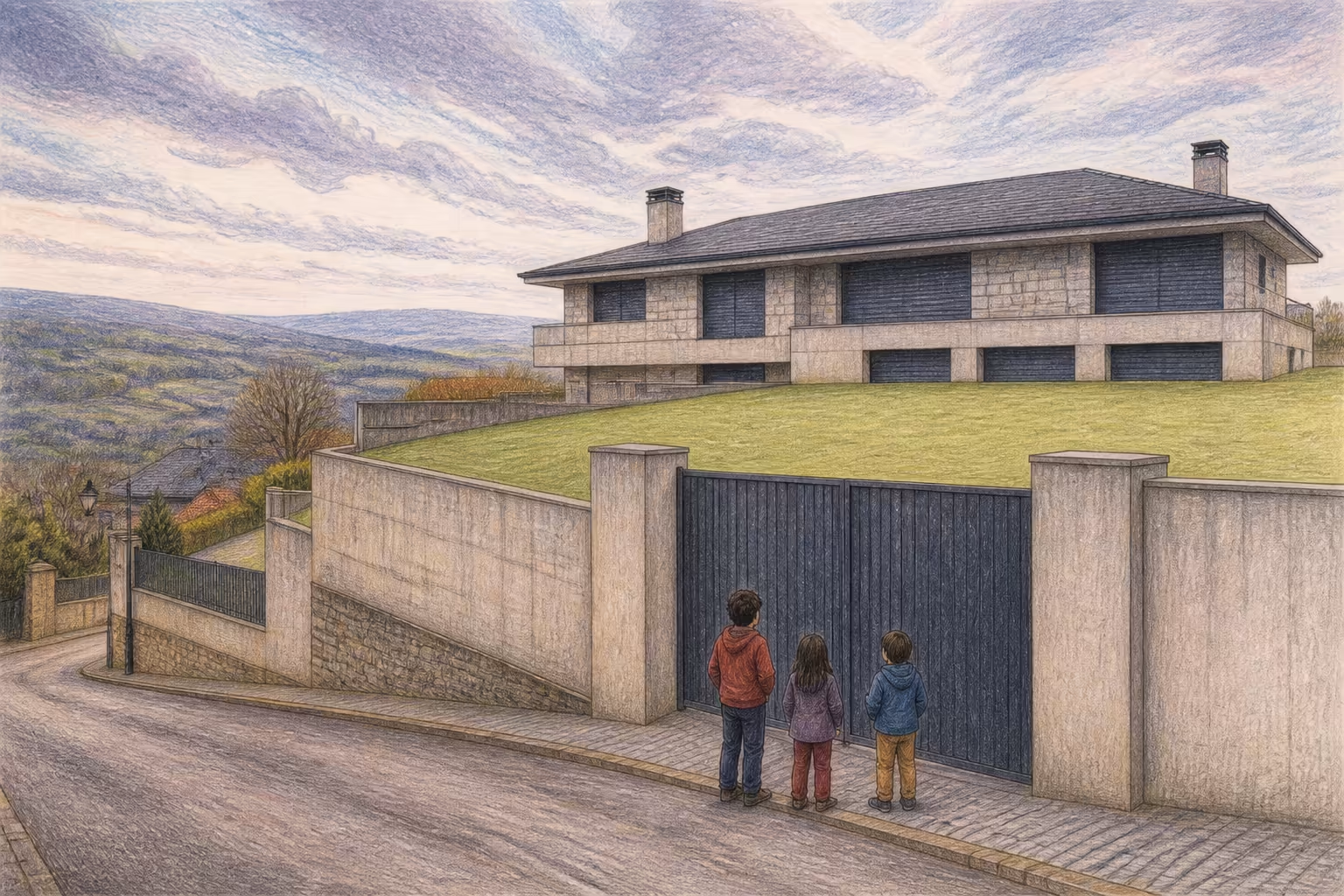
The woman lived “just here”, which turned out to be a good walk uphill, towards where the houses got big and the railings got high.
She talked all the way, as though the tap had been shut for years and had just come on full.
“I was an absolute terror as a girl, you know. Don’t you go thinking otherwise.”
“Were you?”
“A terror.” She was out in front, setting the pace, not puffing on the hill. “We used to go down to the river the minute we got out of school, and the river was three kilometres away. Three. On foot. And we came back after dark.”
“Who did?”
“My sister and me and whoever fancied it.” She laughed to herself. “There was a pool under a bridge with a spout coming down from above, and the game was to stand underneath and see who lasted longest. Freezing, it was, child. I’ve come out of that water with blue lips.”
“And barefoot all summer. All of it.” She glanced sideways at Eva’s feet and didn’t say what she was going to say. “I used to go to bed thinking that the minute I could I’d be off to see the world with what I had on and without telling anybody. That was crystal clear to me right up to the age of twenty.”
“And what happened at twenty?”
“I married a banker.”
She said it the way you confess to a crime.
“A good man, so everybody said. Very serious. Very much one for having everything in order. And without noticing, I started wanting the same: taking note of who was wearing what, minding what people would say more than anything else in the world.”
She lowered her voice.
“He was a man who never laughed. And who, little by little, takes away your own wanting to laugh as well. Like a leak. You don’t notice until one day you look and the house is under water.”
She looked at the people going past in the street.
“And I don’t know what’s the matter with the world lately. Everybody with that face on, as if somebody had switched something off inside them.” She shook her head. “And you, like a fool, let it catch. That’s what I was this morning: a bitter old woman having a go at a barefoot girl.” Her voice cracked a little, and then she snorted, cockier than anybody. “What a lot of nonsense my whole life has been.”
And they arrived.
The house was enormous, one of those with railings and an entryphone with a camera. Immaculate. And dead: blinds down, not a light, not a sound. And a garden that was nothing but lawn, cropped and green and perfect, without a single miserable plant. Not one flower.
The woman looked at it the way you look at somebody you’ve run out of things to say to.
“Well. This is it.” She took the keys out of her bag. “Come in, go on. There’s plenty of everything in here.”
She opened the gate.
“Listen,” said Axel, already crossing the lawn, “can I use the bathroom a minute? I need to do a little something.”
Eva didn’t lose half a second.
“A big little something or a small little something?”
Axel doubled over laughing right there, in the middle of the garden.
And the woman, two steps ahead with the key in her hand, let out one of those laughs that comes up from the stomach, one that had probably not come out of anywhere in years.
“Go on, give it a good kick!” she said, pointing him at the door with the key.
Eva’s smile stopped halfway.
Half a second. Nothing. Axel didn’t even notice.
Then it came all the way back.
Inside, the house smelled of clean and of nothing.
The bathroom was bigger than his old bedroom. Towels folded in three. A soap that smelled of a good hotel.
Axel washed his hands in hot water and then stood there for a while with his hands under the stream, doing nothing else.
Hot water. What a thing. What a thing a roof is, and a door that closes, and somewhere to leave your toothbrush.
And he thought it honestly, without cheating: that was good.
He turned off the tap before anything else occurred to him.
When he came out, Eva was standing in the hall with her hands behind her back, not touching anything, as though she’d been told not to touch anything.
The woman came down the corridor with a rucksack in her hand. Small, blue fabric, the straps still stiff from never having been used.
“Here you are, love.”
Eva looked at it. She didn’t take it.
“I’ve already got one.”
“That is not a rucksack, child, that’s a bag with straps.” Hortensia pointed at the zip tied shut with the shoelace. “It’s going to open up along the bottom one of these days and you’ll be picking your things up out of a ditch.”
“It hasn’t opened in a year and a half.”
“Well, exactly. It’s about due.”
She put it in her hands without asking.
“Stick your stuff in there and a couple of changes and whatever else you like, it’s going to be cold up there.”
Eva was left holding the rucksack by one hand, not quite knowing what one does with that.
And Axel realised that in the whole morning he hadn’t seen her uncomfortable once, not even with the old woman coming out with that in front of the entire bar, and that now she was, over a rucksack.
“Oh, and hang on,” said the woman, already turning, “let me give you some shoes. I’ve got loads. Size forty, but with two pairs of socks…”
“No.”
It came out sharp. Sharper than Eva wanted.
“Thank you,” she added, quieter. “But no.”
The woman looked at her feet, bare on that gleaming floor, and didn’t push.
The three of them ate in a kitchen where everything was on show and nothing was used, and Eva had a twenty-minute shower in hot water and came out with her hair dripping and without saying a word. And then they went back out into the garden. The sun was full on and the grass was so green it looked fake.
There Axel looked at the enormous house, looked at the woman, and it came out of him without much thinking.
“Listen. The house isn’t going anywhere, is it? Come with us.”
The woman stopped with the key halfway into her pocket.
“Sorry?”
“Come with us. We’re not going anywhere in particular,” Axel smiled, “but we’re going.”
Eva, who had been quiet until then, finally spoke. Softly.
“I went like that. With nothing.” She looked at her feet. “It’s the best thing I’ve ever done.”
The woman’s eyes filled again. But with something different from the café.
“But…” She looked at the house, the street, her hands full of rings. “At my age. I can’t just like that. Where to? With what?”
“With what you’ve got on,” said Axel. “Like when you used to go down to the river.”
There was a silence.
And in that silence something shifted under her face. As though from underneath a great many years of big house and high railings there were surfacing, very slowly, the girl with blue lips under the spout.
“Give me five minutes.”
“No rush, take your time.”
“Five minutes, I said!” But she said it with an enormous smile, already going up the steps with more spring than her age entitled her to.
She took a good deal more than five minutes, and when she came out again she was somebody else: comfortable trainers, a rucksack that was the twin of Eva’s, her hair tied up any old how and a twenty-year-old face inside her usual one.
“Right. Done.” She shut the door without so much as looking at it. “Oh, and look at this silly business.”
She took a leather purse out of her pocket.
“I’d lost it and I’ve been beside myself all morning. And do you know where it was? In the fridge.” She threw up her hands, surrendering to herself. “In the fridge! Between the cheese and the butter. I do believe I’m properly losing my mind, children.”
Axel and Eva looked at each other.
And they both held it together with admirable dignity.
“By the way,” said Axel, as they were heading down the hill, “we’ve been together half the morning and I don’t even know your name.”
“Hortensia Rebollo.” She made a face. “Hortensia like the flower and Rebollo like the oak tree. My father always said I came out of a nursery.”
She looked down the street, towards where she had never been.
“Right then. Which way to this adventure?”
And she set off downhill before either of them could answer, the new rucksack bouncing on her back, down a street she hadn’t walked down in forty years.
Fay came out of a corner with no brownie on board and a face that had never done anything odd in its life, and put himself in front.