
Clumsy Hands
A cold dinner, rain on the roof and forty-one years without going back
The stove had been working for eleven years.
Axel’s father had given it to him when he turned fifteen, and it was one of those ugly bits of kit that never break: a steel plate, three legs and a burner that roared like a small aeroplane. You screw one of the big blue bottles on underneath and it takes whatever you throw at it. The bad thing about the blue bottle is that it weighs, it costs, and one day it runs out.
“How much is left?” said Hortensia.
Axel unscrewed it and weighed it twice in his hand, moving it about the way you weigh a piece of fruit.
“Two days. Three if we have breakfast cold.”
“We are not having breakfast cold.”
“Two days then.”
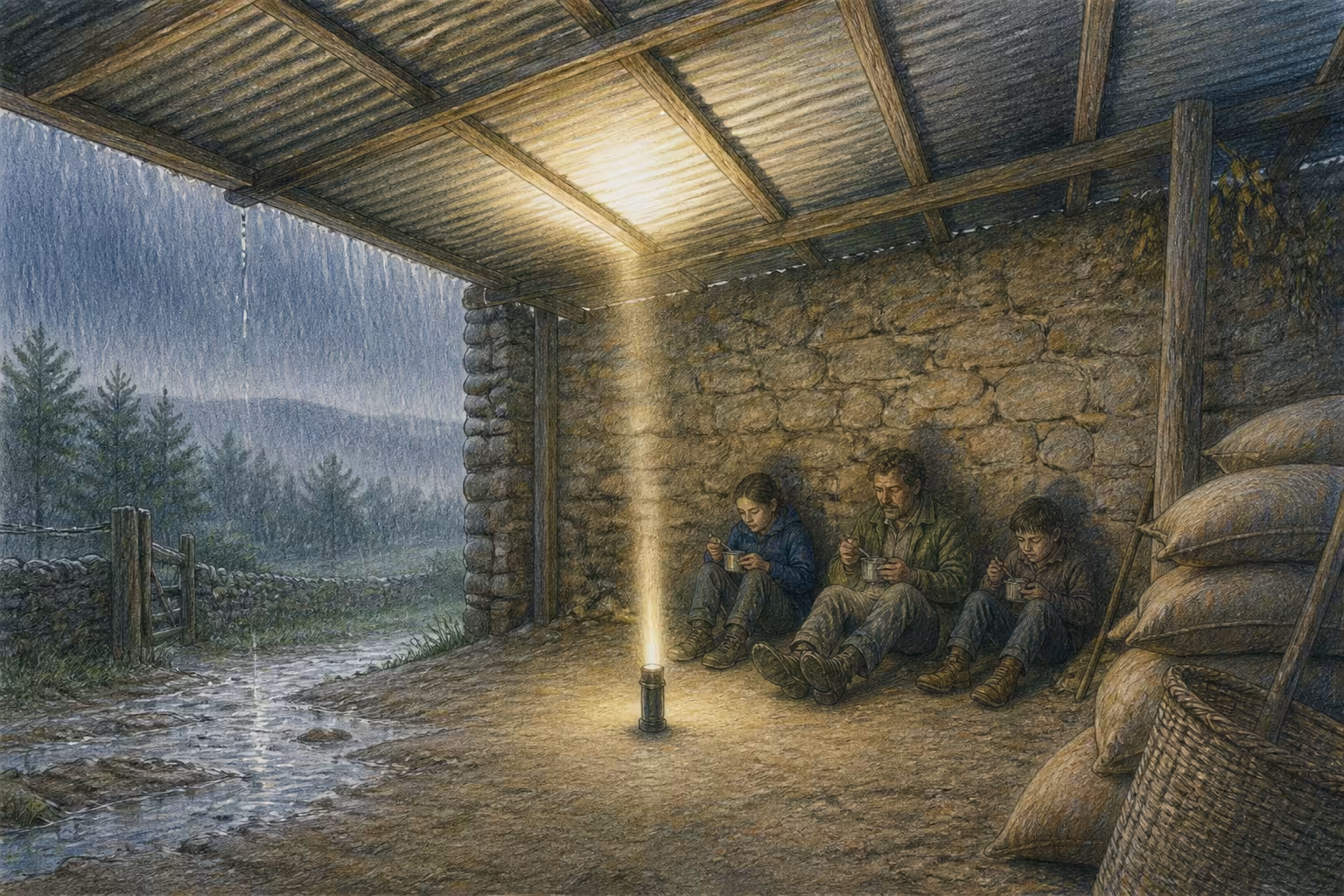
That afternoon it was raining, not hard but without stopping, that fine rain that soaks you in twenty minutes without your noticing. They had found a tool shed in the middle of a field, half open on one side, with a floor of hard-packed earth and a heap of empty sacks in a corner.
“Here,” said Hortensia. “Here and no more about it.”
Axel got out the pot, got out the stove, put it on the floor, screwed on the bottle, opened the gas and pressed the sparker.
Nothing.
He pressed again. Nothing.
“Give it here,” said Hortensia.
“No, no, this one always works.”
He pressed it eight or nine more times, doing exactly the same thing over and over to see if he’d get lucky, and on the tenth the sparker made a little noise and went loose in his hand, the little wheel spinning on nothing.
“Ah,” he said.
Then he saw him. He was sitting on top of the regulator, both hands resting on his knee and a face full of circumstances. He was a little bigger than Gorgorito, he had on a dungaree full of pockets and a pair of disproportionate great hands, the size of his own feet.
“It’s broken,” said the little creature, in a very deep voice.
“I can see that.”
“It’s that I was having a look inside it.”
“I can see that.”
“It’s that I open everything up.” He held both hands up and looked at them the way you look at a tool that is too big for you. “To see which way the thing goes. And then I close it up and it doesn’t go any more, and that’s the part I don’t understand, because I put everything back where it was.” He shrugged. “But I know the inside now. And that doesn’t go away.”
Axel closed his eyes for a second.
“And you are…?”
“Manazas.”
“Well, of course.”
“Tomorrow we’ll find an ironmonger’s,” said Axel. “With one of those flint stones it’s a two-minute job.”
“Or we make a fire.”
“Not with everything soaking.”
And Eva was already getting up.
She went out into the field with the torch and came back ten minutes later with an armful of thin sticks she had pulled out from under a gorse bush, from the inside part, from where the water doesn’t reach even if it rains for three days. She sat on the hard earth floor of the shed, took a fat stick and with Axel’s knife shaved curls off it until she had a little heap the size of an egg. She put the shavings underneath, the thin sticks crossed on top in two directions and the fat ones propped around without quite touching.
“Have you got a lighter?”
“I’ve got two.”
“Then that’s that.”
Four minutes later there was a fire inside a shed with the whole countryside streaming with water.
Axel sat looking at it.
“Where did you learn that?”
“Nowhere.”
“Eva.”
“Nowhere, I said.” She turned a stick over with her foot. “You learn it because otherwise you have your dinner cold.”
What Axel thought was not what he expected to think. He didn’t think he was a mug with a hundred-and-twenty-euro stove and a tent chosen on the internet. What he thought was: I want to know how to do that. And the force the thought came with left him a bit stupid, because it was the first thing he had wanted to learn since he got his driving licence.
They had dinner hot: bread, and a tin of tuna and a tin of tomato done in the pot with a splash of oil, in a shed, with the rain drumming on the corrugated roof and a light that moved. Kika settled herself in front of the embers with the face of an animal that has finally arrived somewhere.
And they sat quiet a while, chewing, listening to the water. Manazas had gone off to sit on the heap of sacks and was very still, hands tucked under his backside and his eyes fixed on the stove.
It was Eva who brought it up. She’d had it inside her all afternoon, you could tell.
“Hortensia.”
“Tell me, love.”
“The house thing.”
Hortensia stopped chewing. She picked up the water bottle, drank, wiped her mouth with the back of her hand and took her time getting started.
“It’s the house where I grew up,” she said, looking at the fire. “A village right up at the top, in the mountains, that doesn’t have a hundred neighbours. Stone house, with the byre below and the living quarters above, and a bread oven built onto the outside wall. My father was a blacksmith. My mother, everything else.”
“And how come…?”
“How come I’m not there?” She laughed down her nose. “Like everybody else, love. I came down to the city at nineteen to work in a shop and there I met a man with a tie. And my parents died two years apart, and as there were no brothers and sisters and there was nothing, the house was left in my name. I signed some papers at a solicitor’s with my coat still on and went back to the city that same afternoon. I had the dinner made, all right. I remember perfectly. I buried my mother in the morning, signed in the afternoon and in the evening I laid the table.”
“And you haven’t been back?”
She took another drink from the bottle.
“No.”
“Never?”
“Never. Forty-one years.”
Axel sat up a bit.
“Forty-one?”
“Forty-one. I was twenty-four when I signed and I’m sixty-five. You do the sum, because I get it wrong on purpose.” She sat turning the bottle round. “At first it was that I didn’t have the time, which is what one says. Then it was what for, since the place would be a ruin and it would only upset me. And then it was another thing. Then it was that I’d gone so long without going that going meant admitting how long I’d gone without going. Do you follow me? That the day you walk up that hill you have to look at the door and tell yourself how many years you’ve gone without opening it. And nobody does that for fun.”
“Yes,” said Eva.
She said it so fast that Axel turned to look at her.
“The thing is a cousin of mine went down a few years ago and sent me a photograph,” Hortensia went on. “And I didn’t open it.”
“What do you mean you didn’t open it?”
“That I didn’t open it, son. That I saw it on the phone, that it said ‘the house’, and I pressed back. And I still have it there.” She raised a shoulder. “It’s completely daft. I know that.”
There was a moment of nothing.
“Then let’s go,” said Axel.
“Oh yes, of course.”
“No, seriously. Let’s go.”
Hortensia looked up.
“You two? To a lost village in the mountains to look at a ruin?”
“We aren’t going anywhere in particular,” said Axel. “I already told you.”
Hortensia opened her mouth. She closed it. And she started clearing up the tins with tremendous vigour, talking about how you have to be careful with the edges, they cut.
When all three of them were lying down and Hortensia had been snoring for a while, Eva spoke in the dark.
“Axel.”
“What.”
“The house thing wasn’t said for the sake of saying it.”
“I know that.”
“No.” He heard her turn over in her sleeping bag. “She’s been thinking about it since the junction. Since you told her the north thing and she went quiet. She was already thinking about it then.”
Axel raised his eyes to the corrugated roof.
“And why do you notice things like that?”
“Because I’ve spent a year living off noticing things like that.”
She said no more. And Axel lay a while with that, with the rain hitting up above, thinking that this woman could tell him what an old lady was thinking three days before the old lady said it, and that he had spent a month unable to tell him what she was thinking.
After a while he remembered the stove. He went out with the torch to fetch it, because he’d left it lying next to the pot, and he crouched down to pick it up. He pressed the little wheel without thinking.
And the spark jumped.
He stayed there, still, with the stove in his hand, in the middle of the wet night. He tried it three more times. Spark, spark, spark. Just like always.
He looked around: the sacks, the rain, the corrugated roof.
“Come off it,” he said out loud.
And he didn’t light the dinner, because they’d already eaten, but he stayed crouched there a while longer pressing the little wheel, watching the spark jump over and over in the darkness, like an idiot, until the back of his neck got wet.