
Light
Two days unbearable and two hammocks on offer
He was unbearable for two days. He knew it and he couldn’t stop.
He got angry with a cash machine that wouldn’t let him withdraw without the physical card. He got angry with a sports shop that closed at midday. He got angry with a forty-euro sleeping bag that was rubbish and which he bought anyway because there wasn’t another one.
Both nights they slept under Eva’s plastic sheet, tied between whatever there was, and both nights he slept well, and that put him in an even worse mood.
Above all he got angry with himself, on a loop, with tremendous efficiency. That he’d left it outside. That Kika had made a noise at ten past four and he had looked at his phone, thought “nothing” and turned over. That Eva had told him people came through there.
That last one he said to himself about two hundred times.
Eva didn’t say it to him once.
On the second day, on a hill, he exploded over nothing.
“Can you stop looking at me?”
“I’m not looking at you.”
“You’ve spent two days looking at me as though somebody had died on me.”
Eva stopped.
“All right.”
And she carried on walking. And a hundred metres later Axel said “sorry” to her back, and she raised a hand without turning round, which meant “it’s fine”.
The tent business was on the third day, in a district town with two streets and a big supermarket. They went into one of those sports shops that smell of rubber, with the music on and a lad of twenty behind the counter, and Axel went straight to the back, to the tent aisle, and planted himself in front of one exactly like the one that had been stolen.
A hundred and twenty euros.
He picked it up, turned it over, read the weight on the label.
“Seventeen hundred grams,” he said.
“Uh-huh.”
“The other one weighed seventeen hundred.”
“What a coincidence.”
And he already had the box under his arm, on the way to the till, when Eva stopped in the middle of the aisle. She had stopped in front of a wire display with a hand-written sign.
HAMMOCKS. 19.90. CLEARANCE.
There were four of them, hanging from their hooks, in little bags the size of a fist. Parachute nylon, two carabiners, two tree straps.
“No,” said Axel.
“I haven’t said anything.”
“It’s written all over you.”
Eva took one down, weighed it in her hand, and gave the packet an attention Axel hadn’t seen her give anything in a month.
“Four hundred grams,” she said.
“I heard.”
“Four hundred.”
“Eva, you can’t sleep in a hammock.”
“Have you slept in one?”
“No.”
“Ah.”
And she stood there, turning the packet over.
“It’s just, if it rains…”
“It rains every afternoon for half an hour and stops.”
“It’s just, if it’s cold…”
“It’s June.”
“It’s just that in a hammock you can’t… I don’t know. Keep your things.”
Eva looked up and looked at him with infinite patience.
“Axel. What things?”
There Axel shut up. Because he didn’t have things. Because he had spent three days with what he had on, a bad sleeping bag and a speaker that was worth nothing second hand, and he was about to spend a hundred and twenty euros on having exactly the same bulk as before all over again.
The two of them stood in the aisle, with the shop music in the background.
“Two?” said Eva.
“Two.”
They came out with forty euros spent, four hundred grams each and the strangest feeling of having cheated.
The first night was a disaster. They found two chestnut trees at exactly the right distance and it took them forty minutes to put them up, because the straps go round the trunk in a way that isn’t the way it looks. Axel got into his, turned over and came out the side. He got in again and one foot stayed out. His neck bent. It crossed his mind that this was the most expensive mistake of his life at forty euros.
On the other side of the clearing, four metres away, Eva hadn’t made a sound for ten minutes.
“Are you all right?”
“I’m perfectly fine.”
“You’re not perfectly fine.”
“I’m a metre off the ground, looking at the treetops, with my backside in the air.” A pause. “I’m far better than perfectly fine.”
“You’d slept hanging off something before.”
“In a fishing net, one whole summer.” The hammock moved a little. “Go to sleep.”
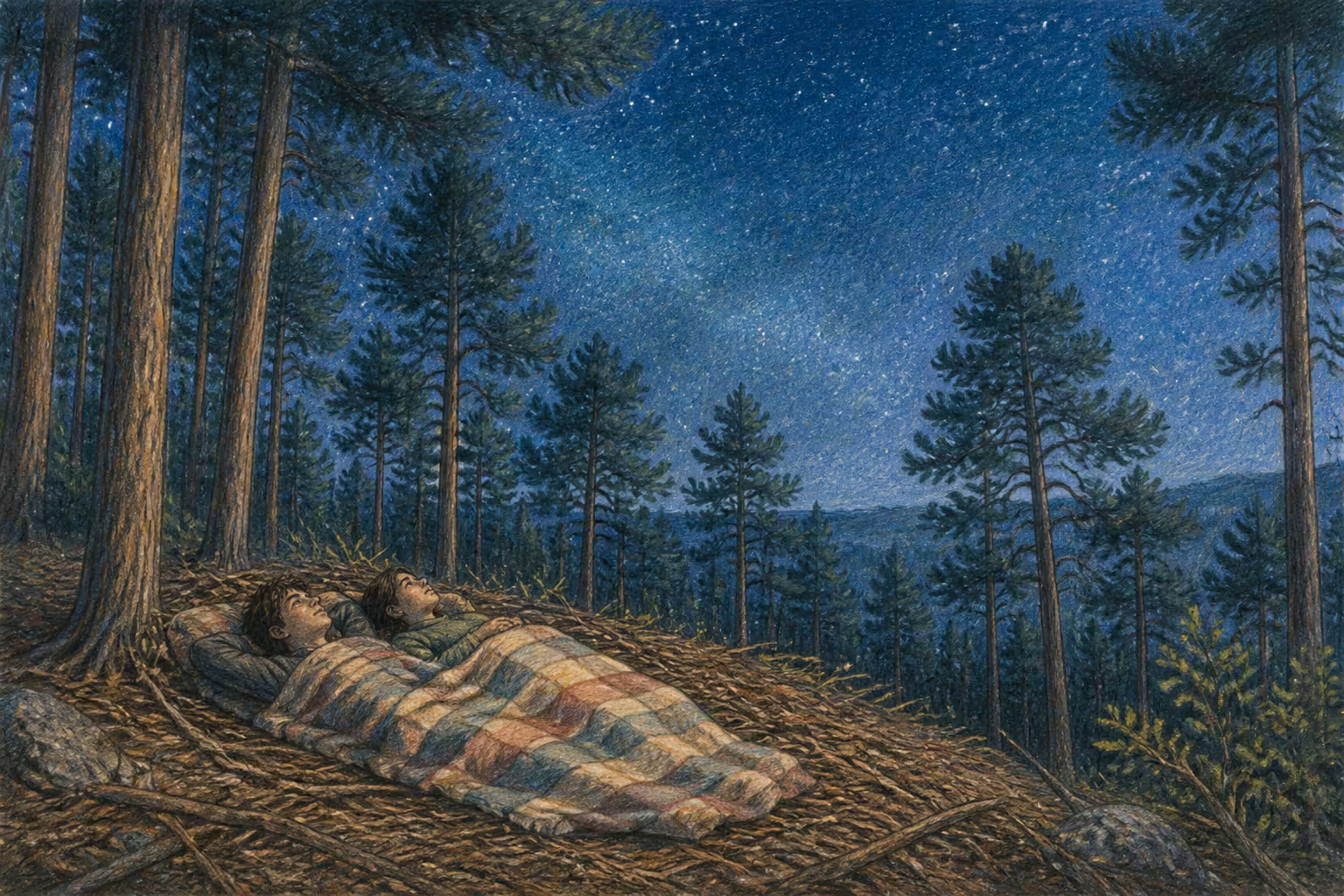
Half an hour later Axel found the position, which turns out to be diagonal, and lay looking upwards. You could see the stars between the crowns, it was cool but not cold, the hammock moved a little every time he breathed.
There was nothing underneath him. No groundsheet, no foam mat, no floor. Only air and, further down, the earth, and him hanging from two trees like a fruit.
It was the best he had slept in a month.
“Eva.”
“What.”
“The fishing net.”
The nylon creaked while she settled herself.
“A camp. On the beach, in August. There was an old net hung between two posts next to a fishing boat, and the moment I saw it I knew that was where you sleep. With sand even in your teeth.”
“What camp?”
And there Eva took her time.
“My grandfather’s,” she said.
“Your grandfather used to take you to camps?”
“My grandfather was in the neighbourhood mountain club.” She settled herself again. “A room with a stove, a map pinned to the wall and twelve men of sixty. And he took me along. From the age of six. Saturdays, and two camps a year.”
Axel kept very still, which in a hammock is the only thing you can do.
“That’s where I learnt fire,” she went on, in the tone you use for giving the weather forecast. “And knots. And to read the sky. And to put up a shelter with a plastic sheet and a bit of rope. And to walk ten kilometres without opening my mouth. And to have a shit in a hole. And that if you leave the matchbox outside the plastic you’re an idiot and that’s that, and nobody tells you twice.”
“And why did you tell me nowhere?”
“Because I don’t feel like talking about it.”
She said it without any harshness at all. The way you say you don’t like olives.
Axel didn’t ask any more. And two minutes later she carried on by herself, which is how she always carries on.
“I was good there.” A pause. “Not good as in somebody telling me. Actually good. At twelve I was running the fire and the pot for twelve adults, and those men asked me for things. And it was the only place in the world where nobody was watching the way I held my hands.”
“And what did your mother say?”
“My mother didn’t speak to her father.”
“What?”
“They didn’t speak. For years.” The hammock moved. “My mother came out of a neighbourhood and a house with a gas heater, and she married a man who had restaurants. And from then on her father was something that happened to her. A man with dirty boots who turned up on Saturdays at half past seven in the morning. He never came into my house, not once, all right? Not once. He waited for me in the doorway.”
“And she let me go. That’s the strange part, and it’s taken me years to understand it.” She stayed thinking. “I think it was this: that it suited her very well to have me out of sight on a Saturday, and that saying no to him would have meant having to talk to him.”
“And your father?”
“My father didn’t get involved. That wasn’t his family.” A sound of nylon. “I think he felt sorry for my grandfather. But sorry from a distance, which is the kind that’s no use for anything.”
“And then came the thing with the Monday.”
“What Monday?”
“I was thirteen.” She was speaking more slowly now. “An Easter camp, four days, in a refuge up the top. And on the last day it started raining in that way that isn’t raining any more, the track down turned into a mudbath and my grandfather said we weren’t going down. And we didn’t go down. The twelve of us slept up there one more night, with a wood stove and a pot of macaroni. Up until then it was the best night of my life, and I haven’t got a single photo of it.”
“And he brought me home on the Monday at midday instead of the Sunday afternoon.” A sound of shoulders. “And I missed one day of school.”
“One day,” she repeated, because Axel hadn’t said anything. “One Monday. At thirteen. At a school where I was doing well.”
“And that blew up. I was standing in the doorway with my rucksack in my hand and my boots caked in mud, and there was a row the whole street heard. And it wasn’t about school, all right? I know that now. The Monday was the excuse she’d been waiting for since I was six.”
“And then, in the lift, without shouting or anything, she told me that those weren’t people of my level.”
Axel’s hammock stopped moving.
“Of my level,” Eva repeated. “Talking about her own father.”
“The next Saturday I had English in the morning. And a piano recital once a month. And that was that. There was no row with me, there was nothing. It ended the way things end in my house, which is that one Saturday it isn’t there any more.”
Axel looked for something to say and couldn’t find anything that wasn’t stupid.
“And the worst part isn’t that,” said Eva. “The worst part is that I was thirteen and I didn’t say anything. Not once. Not ‘please’, not ‘I like it’, not ‘it’s the only thing I’ve got’. Nothing. I went up to my room and by the next Saturday I was conjugating irregular verbs.”
“And your grandfather?”
“He lived four more years and we never went up anywhere again.” She said it in one go, the way you say things you’ve said many times inside your own head. “We saw each other in the street. Literally in the street: he’d take two buses, wait for me on a bench next to my school and we’d have a sandwich. Half an hour. And neither of us brought it up, and I thought that was out of politeness. He died when I was seventeen.”
She said no more about that, and Axel understood that you didn’t go in that way.
“Seven years being very good at something that didn’t count,” she said after a while. “And ten being middling at the ones that did.” A shrug you don’t hear in a hammock but you notice. “And that gets rid of any silly ideas about saying out loud that you like something. In front of your own people, I mean. I’ll ask a stranger for a tomato and not blink. I never managed to say to my mother, ‘this is the only thing I’ve got’.”
Axel looked at the crowns of the trees.
“And why are you telling me now?”
“Because you asked me because of a fishing net.” The hammock moved. “If you ask me straight out I don’t tell you.”
“But you came back.”
“I haven’t come back to anywhere.” She turned over. “The only thing I’ve done is leave.”
“Right. But you carry a plastic sheet and five metres of rope.”
And Eva didn’t answer that. But she laughed, very quietly, in the dark, and it was the first time Axel had heard her laugh at something of his.
“His name was Rubén,” he said, on his back.
Eva didn’t move.
“The one in the photo with the hats.”
“Right.”
“Right.”
Axel was quiet a moment.
“What do you mean, right?”
“That I already knew.” Eva was still looking up. “Well, I didn’t know. But I knew.”
Axel laughed down his nose and stayed quiet for a while.
“We went everywhere together,” he said. “Everywhere. Since we were eleven. He was the one who said ‘let’s go’ and I was the one who looked up the timetables.”
“A good division of labour.”
“Excellent.” He smiled. “The Norway thing was his idea. I’d met a girl at the hotel and told him she was from Utrecht, and he said ‘right, let’s go to Norway’. Which has nothing to do with it, all right. And he didn’t care. What he wanted was to leave. And we went, at nineteen and without a penny, and slept two nights in a station.”
“And the girl?”
“The girl wasn’t interested.” He laughed. “But her parents invited us to eat salmon and then we walked round Oslo for twelve hours straight, and at two in the morning we sat on a bench at the harbour to eat a bun and he told me that had been the best day of his life. At nineteen. Sitting on a bench with a bun.”
He stopped.
“He died at twenty-three. Cancer. Nine months from when they told him.”
Eva stayed as she was.
“And that’s that.” Axel tried to shrug inside the hammock, which is a place where that gesture doesn’t work. “I didn’t fall apart or anything, all right. It wasn’t like that. I carried on. I finished my degree, worked, had a girlfriend, paid the rent.” He found a star and stayed there. “The thing is nobody said ‘let’s go’ any more. And I was looking up timetables for nothing.”
They were quiet for a good long while.
“That’s why I carried that photo,” he said in the end. “In case I forgot.”
“Forgot what?”
“I don’t know. Him.”
Eva turned onto her side, and the whole hammock moved.
“And have you forgotten?”
Axel really thought about it, not to look good. He remembered the face. He remembered the voice, or something like the voice. He remembered how he laughed without a sound, all shoulders. He remembered a great many things that weren’t in any photograph.
“No,” he said.
“Well then.”
And they stayed with that a while.
“Axel.”
“What.”
“The thing about Hortensia’s house, that was you, wasn’t it?” A silence. “Then let’s go. Nobody asked you to. You said it.”
Axel opened his eyes in the dark.
“I don’t know how to do anything,” he said.
“That’s learnt in an afternoon. I’ll teach you fire tomorrow if you like, and in three days you’ll do it with wet grass.” The hammock moved. “The other thing isn’t. The other thing was taken off me at thirteen and I’ve spent ten years looking for it under stones. And you’ve got it and you don’t even know.”
And she turned over and went to sleep, just like that, leaving that there for him.
Axel lay awake a while. He ran his hand over his neck and pulled his pendant out from inside his T-shirt: a little slice of branch, sanded by him at fifteen in his father’s workshop, hanging from a cord he had changed three times. They hadn’t taken it because he was wearing it.
He held it between his fingers a moment. Then he tucked it back under his T-shirt, settled himself properly on the diagonal and went to sleep a metre off the ground, with nothing underneath, lighter than he had ever been.