
Wamba
Three weeks saying hello to someone who never answered
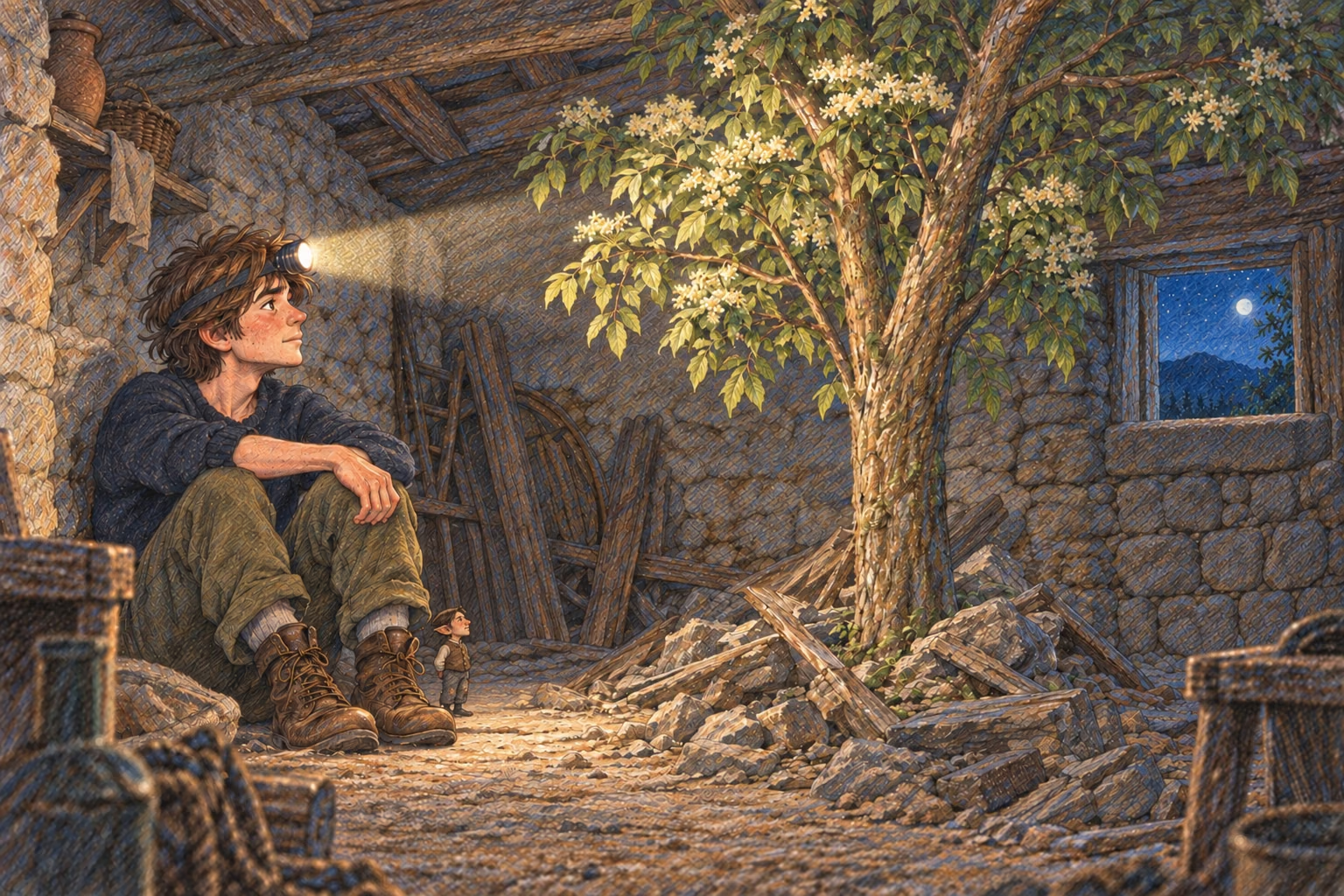
Axel said good morning to the one in the waistcoat twenty-one days in a row.
Always in the same spot. On the beam across the back bedroom, right above the elder tree, sitting dead straight with his hands on his knees, looking at the tree like someone keeping an eye on building work he hadn’t authorised.
“Morning.”
Nothing.
“We’re taking slate up today.”
Nothing.
One day Axel tried not saying anything, just to see. And the one in the waistcoat turned his head three centimetres, waited, and went back to looking at the tree.
“Oh, so now you’re interested? Well, good morning.”
Nothing.
Eva heard him talking to himself every morning from downstairs and never asked. What she did was leave the broom leaning against the door of the back bedroom. Every morning. Without saying who it was for.
Víctor had been there the same three weeks. He slept at the hotel, ate at the house and went down every day for ice and beer. “Put it on my tab, Trini.” Warm beer, he said, was for sad people.
He learned Sabino’s name in a day and Trini’s in two. He called Kika “the dog”, because he never asked. And Axel he called “Concierge”. At first it was funny. Then it stopped being funny, and by then there was no way to tell him his name was Axel without it sounding like a complaint.
Fay, who in four months had climbed on everything that stayed still, a rucksack, a bale of straw, Sabino’s belly, never once got on Víctor’s car.
Víctor did help, mind. He carried slate up. Badly, but he carried it. And he finished Axel’s sentences for him, and a lot of the time he was right, and by the second week Axel didn’t even start them.
He did something worse to Úrsula, and with the best will in the world. Over lunch she told them how in her third winter in the village her water froze for eleven days.
“Yeah, but that’s because you wanted to, isn’t it?” said Víctor with his mouth full. “You could’ve left. I mean, if you stayed it’s because it was worth it to you.”
Úrsula put her fork down. She looked at him for a moment.
“Of course,” she said.
She carried on eating. And Axel spent the rest of lunch not knowing where to put his eyes.
The folder guy came up on a Thursday in July, mid-morning.
A white four-by-four on the bend, so clean it looked like it had come straight off the forecourt. A navy quilted gilet zipped up to the neck. White trainers without a speck on them, tiptoeing over the loose stones. A leather folder under his arm. And an advert smile he’d had on since the bottom of the street.
“Morning, guys! I’m not bothering you, am I? You carry on, I’m just taking a few measurements.”
They were taking slate up. Eva down below, filling the bucket. Axel up top, on the ridge, hauling on the rope.
He took a little gadget out of his gilet that put out a red dot and started measuring the front of the house. One corner. The other one. The eaves, whistling.
Kika left two muddy paw prints on his trainers. Fay, from the wall, didn’t even bother.
“Is that a laser?” Víctor was already on his way down off the roof. “That’s sick. How far does it go?”
“As far as you want.”
Ten minutes later the two of them were standing in the middle of the street with their arms folded, looking up at the house the way you look at a car in a showroom.
“The light you get in here at seven, man.”
“Insane.”
“That’s content.”
“That’s content,” said Víctor.
“And how much does the spring up top give in August?” asked the folder guy, very nicely, of nobody.
Eva sent Axel up another bucket.
“Eva, mate,” Víctor shouted down. “They’ll buy it off you. With that you could get yourselves a proper house, with heating and everything.”
“This is a proper house.”
“One that doesn’t leak, I mean.” He looked at his can, which had gone warm. “I’m going down for ice.”
He went off down the street whistling.
And the minute he’d gone round the bend, the folder guy’s laser went wonky.
“That’s weird.” He looked at the little screen. “Four kilometres.”
He pointed it at the corner again.
“Twelve centimetres.”
Again.
“Four kilometres.” He laughed to himself. “Well, with four kilometres of frontage the spa’s going to be Olympic-sized.”
Axel saw it from the ridge. In the empty window frame, right where the red dot landed, a hand the size of a walnut was holding a little bit of slate in front of it and taking it away. Holding it there. Taking it away. With enormous patience.
Sabino was on the wall opposite with his face to the sun, his eyes shut and his cap pushed back.
“Sorry, excuse me.” The folder guy showed him the gadget with a little laugh. “Does this happen to other people round here?”
Sabino didn’t open his eyes.
“That’s the damp.”
The sun was hot enough to crack the stones.
The folder guy laughed, to be polite. He went to get his folder, which he’d left on the step.
The folder wasn’t there.
He looked on the step, on the wall, under the four-by-four, on all fours in his gilet. Eva didn’t look.
She was the one who found it, ten minutes later, without looking for it, in a manger in the byre. Open, with the sheets taken out and laid in the bottom from biggest to smallest.
The folder guy picked them up one by one, very slowly, with the smile still on. It took some doing.
“Everything’s so authentic here, isn’t it?” he said in the end. “Even the mangers.”
He gave Eva a card, because she was the closest.
“In case you want to talk numbers in September, guys. Because at the end of the day, the numbers are the numbers.”
Eva looked at the front of the card. She looked at the back.
“Thanks.”
The folder guy tiptoed off down the street. On the bend he ran into Víctor coming up with the ice, and the two of them stood there for twenty minutes talking by the four-by-four.
“What’s it say?” said Axel from the ridge.
“‘Head of Rural Experiences.’”
“And what’s that when it’s at home?”
“Head of Bathrobes.”
That night the kitchen table stopped wobbling. It had been wobbling since day one. Eva had folded the card in four and wedged it under the leg.
A couple of nights around then, in the hammock, Axel got the thing in the pit of his stomach. He put it down to the beer.
The thing with the ladder was on a Wednesday.
Úrsula’s ladder, leaning against the back wall and tied at the top to a batten, the way she’d shown him. A ladder that’s tied properly doesn’t fall, not even in the wind.
At two in the afternoon it fell.
Axel was inside. He heard the crash, which in an empty stone house sounds like the end of the world, and ran out.
The ladder was on the ground in the garden, in the brambles, with the top rung bent and two rungs out.
If he’d been up it, he’d have come down with it.
And on the top rung, hanging on at either end, there were two of them.
Two Axel had never seen before. Short, wide, with hats that had once been the same colour. They were hanging off the bent aluminium like two shipwrecked sailors off a plank. And just as Axel came out, one of them was shoving the other in the chest.
The three of them stared at each other.
“It was him,” said one.
“It was him,” said the other.
They let go at the same time and vanished into the brambles.
Víctor was coming up the street with the ice, and he stopped at the garden wall to watch.
Úrsula came up at seven. Axel was waiting at the door, having spent since two rehearsing a sentence that didn’t exist.
“Úrsula, the ladder.”
“What about it?”
“It fell down.”
Úrsula looked at the bent rung. The rungs. The rope, which was still tied to the batten, hanging there in one piece. And then she looked at the rope again, more slowly.
“It was tied,” said Axel.
“I can see that.”
“Tied like you told me, I swear on my mother’s life.”
“I can see that, Axel.”
And she waited.
Axel had two options, and one of them was to make up a wind that hadn’t blown.
“I don’t know what happened. I was inside, I heard the crash and it was like this.”
Úrsula crouched down, ran her thumb over the stone at the foot of the ladder and it came away wet.
“Aluminium slips on wet stone. The foot slips, the rope lets it go down and the ladder sits down. I’ve seen it sit down twice.”
“And the rung?”
“It bends if it sits down hard enough.”
She said it wiping her thumb on her overalls, without looking at him, the way you’d lend somebody an umbrella.
“Two hundred and ten euros,” she said.
“I’ll pay you for it.”
“You haven’t got two hundred and ten euros.”
“I’ll pay you in October.”
“You won’t have two hundred and ten euros in October either.” She moved the rung. The aluminium made a nasty noise. “That’s not going to straighten.”
Víctor was still at the garden wall, with a beer already open.
“On Saturday I’m going to Vegadeo for supplies,” said Úrsula, getting up. “You come along, you do the loading and we bring it back between us. And you pay me for the new one when you can, and don’t you mention it to me again.” She gave the bent one a gentle kick. “This one’s for the henhouse.”
She went off down the street stamping her heels. Halfway down the hill she stopped without turning round.
“Nine weeks you’ve got left on that order. And today you’ve lost an afternoon.”
Víctor peeled himself off the wall and gave Axel two pats on the shoulder.
“Nice woman.”
That night Axel went up to the back bedroom with his head torch on. The one in the waistcoat was on his beam.
“It was your lot,” said Axel.
And the one in the waistcoat stood up.
First time in three weeks. He did his waistcoat up to the top, button by button, and got down to the floor by a way Axel never got to see.
From the floor, next to his boot, he said:
“The ones downstairs are idiots.”
“I’d worked that out.”
“One hangs on and the other one shoves. Always the same. Forty years the same.” He put both hands up. “I did not authorise this.”
“I want that on record.”
“It’s very much on record.”
“And the laser business?” said Axel.
“That one can’t measure.”
And that was all.
Axel didn’t ask him what he was, or how, or since when. He asked him what you ask someone you’re going to share a house with.
“And what’s your name?”
He thought about it. As if he hadn’t needed it for a long time.
“Wamba.”
“Wamba?”
“Because of this.” He tugged the lapel of his waistcoat. “It was one of Gran’s rags.”
“Whose gran?”
“Gran’s.”
Axel sat down on the floor with his back against the wall and the two of them sat for a while looking at the elder tree.
He looked at his feet. Bare. Black with soot up to the ankles, toes spread on the flagstones.
He went down to the kitchen. Eva was scrubbing the pan in the washing-up bowl, barefoot, and didn’t look up.
“Done?” she said.
“Done.”
“And what’s he called?”
Axel stopped dead in the middle of the kitchen, head torch still on. In four months that girl hadn’t asked a single thing about them in the present tense.
“Wamba.”
“Wamba.” She turned the pan over. “Wamba it is, then. Class.”
She carried on scrubbing, with her back to him.
“The one at the pelota court sat down next to me. That afternoon in the storm. He tucked himself right up against my foot and stayed there about an hour.” She lifted the pan and looked at it against the light. “I thought you hadn’t seen him.”
“Eva.”
“And the one in the café wasn’t a rat either.”
She didn’t turn round. Nothing in her shook.
“Since when?”
“Since I was six.”
She hung the pan on its hook.
“And why didn’t you…?”
“Because I said it once.” She wrung out the cloth. “When I was nine. I told my sister in the car, coming back from a camp. My sister got this look on her face. She told my mum. And my mum took me to see a man with a very nice consulting room who asked me if I was sleeping well.”
Axel leaned against the wall.
“And nothing happened to me, you know. I went three times and that was it. Nobody punished me.” She hung the cloth on its nail. “But I learned. There’s things you say and things you don’t.”
“And the windowsill one. The ‘now or never’ one.”
“That one talked to me.”
“You told me you’d been wondering ever since if you’d made it up.”
“And I do.” She dried her hands on her trousers and finally turned round, with the most normal face in the world. “But I’m the one who opened the door.”
Axel didn’t say anything. He took off his head torch, which was still on, and put it on the table, which didn’t wobble any more, pointing at the wall.
“Go on, take the bucket up,” said Eva. “There’s slate tomorrow.”