
The Address
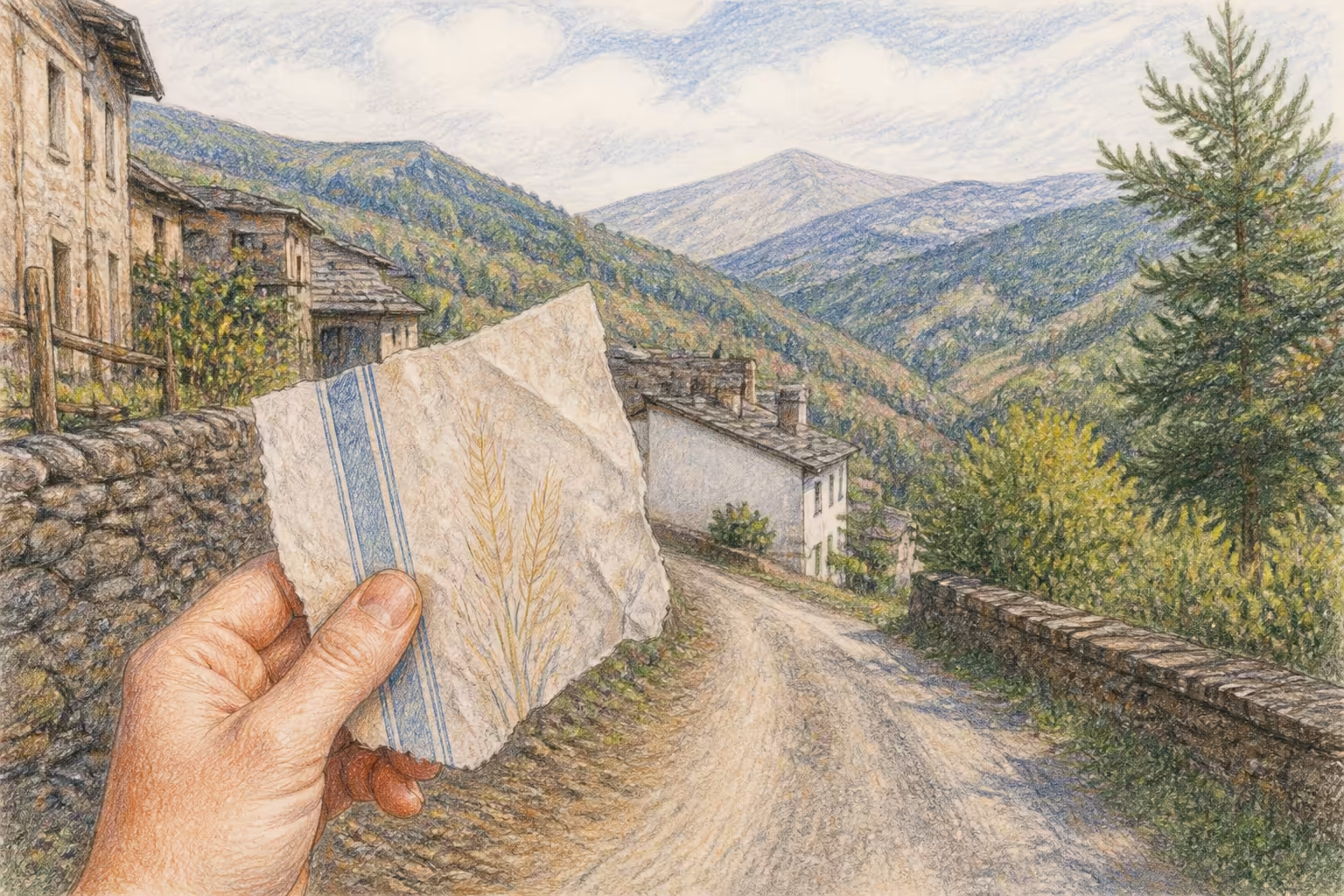
A piece of a flour bag with the name of a village in biro
She said it over the third breakfast in the back room of a bakery, and she said it the way you say things that have been decided for two nights already.
“I’m staying.”
Axel put his cup down.
“What do you mean, you’re staying?”
“I mean I’m staying here a few days.” She was buttering a piece of toast and didn’t look up. “Or a few weeks. Or whatever.”
The oven could be heard.
“Hortensia…”
“Don’t give me that face, my boy, I’m not dying.”
“No, it’s just that…”
“It’s just nothing.” Now she did look up, and she was perfectly calm. “I’ve spent two weeks getting up at five in the morning to watch a man put loaves in an oven and I’m having the time of my life in a way I haven’t since I was seventeen. And that’s that.” She took a bite of the toast, chewed, wiped her mouth. “And I’m going to tell you one thing more and then I won’t say it again.”
“Go on.”
“I left my house two months ago thinking I’d walk for four days and turn back.” She looked at her cup. “And I’ve walked two months. And every morning, when I woke up, the first thing I thought was ‘today I’m going back’. Every one. The river one, the pelota court one, the reservoir one. I’d wake up, my hip would hurt and I’d think: today I’ll ask the boy to walk me to the station.”
“You never said anything.”
“Well of course I didn’t.” She shrugged one shoulder. “And two weeks ago I got up at five in a bed that isn’t mine, in a village whose name I don’t even know, to watch a man take bread out of an oven. And I didn’t think it. Not when I got up and not all morning.”
She picked up the cup and drank it down in one.
“I don’t know whether this is love and I don’t care,” she said. “What I know is that I’ve spent two weeks not wanting to go back. And at my age you take notice of that the first time.”
Axel spent the morning with an odd thing in his stomach, and the odd part was that he had got used to it: that he had spent two months walking behind a sixty-five-year-old woman who told stories about sleeping priests and who decided where they slept, and that now he had to go back to deciding himself. Which, if he stopped to think about it, was exactly what he had left his house to find.
It struck him as funny and it didn’t strike him as funny.
Eva took it worse and didn’t say so. She spent all morning in the bakehouse, sitting on a sack of flour, watching Paco work without speaking, and at lunchtime she wasn’t hungry.
And in mid-afternoon, when Hortensia came out onto the street to look for her, she found her on the step. She sat down beside her with a groan, holding her knee.
“Oh. My hip.”
Eva went on looking at the street.
“Right then,” said Hortensia. “Out with it.”
“Nothing’s the matter.”
“Of course something’s the matter. Out with it.”
Eva didn’t take her eyes off the street.
“That people stay,” she said.
“What?”
“Nothing.”
Hortensia waited.
“That you start being comfortable with somebody and then people stay somewhere, and that’s that.” She shrugged. “And nothing happens. It’s normal. I’ve been like this all my life.”
Then Eva did something she had never done.
“Come with us.”
She said it looking at the street, very fast, the way you throw a stone down a well so as not to hear it land.
“Oh, love.”
“That you come.” Now she did turn round. “You walk fine. Axel won’t mind. I’ll carry your bag.”
Hortensia took as long as three seconds take when they get long.
“No.”
And she didn’t dress it up, which was her way.
Eva nodded once, turned back to the street and didn’t say anything else.
Hortensia nodded very slowly. And then she took her face in both hands, just like that, without warning, and turned it so she’d look at her.
“Listen to me carefully, because I’m saying this once.”
Eva didn’t move a muscle.
“You don’t owe anybody anything,” said Hortensia. “Do you hear me? Nobody. Not me, not your sister, not whoever comes next. I’m staying because I feel like it, not because you’ve done anything wrong, and if tomorrow I feel like leaving I’ll leave and that won’t be anybody’s fault either. Because people stay and people go, and they do both things for their own reasons. And anybody who makes you feel you owe them something, that one doesn’t love you. That one wants to order you about.”
She let go of her face.
“There. Done.”
She got up to have a wee, because she said her hip and her bladder had come to an agreement.
Eva stayed alone on the step for a good long while. And when Axel came out to look for her, half an hour later, she was still there, chin on her knees, looking at the empty street the way you look at a road.
“Shall we?” he said.
“Let’s go.”
And she never told him what she’d been told, not then and not ever.
The goodbye was in the morning, early, with the shop still closed and the street smelling of bread.
Paco gave them an enormous paper bag.
“This won’t go off in three days,” he said. “And if it does, dip it in something.”
Hortensia took a piece of paper out of her tracksuit pocket: a piece of a flour bag, torn off, with something written on one side in biro.
“Here.”
Axel took it. At the top, in capitals, a name: TARAMUNDI. And underneath, in smaller letters: the last one on the upper street, the one with the oven built onto the wall.
“It’s a month’s walk,” said Hortensia. “A month and a half if you dawdle, which you will.”
“Hortensia…”
“I said go.” She folded her arms. “I’m not going to go. I’ve thought about it and I’m not going to go, and don’t ask me why because I’ll tell you a lie. But I’ll rest easier knowing somebody has gone to see whether it’s still standing.”
“And if it isn’t?”
“Then you phone me and you tell me.” She pointed a finger at him. “And you tell me exactly as it is, all right. No dressing it up. I have heard a great many dressed-up things in my life and every one was worse inside.”
She put her hand in the other pocket and got out her phone.
“Give me your number, go on.”
And Axel gave it to her.
Before they left, Paco brought out from under the counter a road atlas with the covers falling off and a printed year that was earlier than Axel.
“Here, look at this, you can’t see anything on the phone.”
They opened it on the counter, among the flour, and the four of them spent a while with their heads in a thirty-year-old map.
“It isn’t on here,” said Paco.
“What do you mean, it isn’t?”
“It isn’t, man. It’s so small they didn’t put it in.” He tapped a green patch with nothing in it. “It’s round about here, in this blob. But I can’t tell you.”
“Well, that’s marvellous.”
“Anyway.” Paco closed the atlas and patted the cover twice. “It would be worse if it were.”
The three of them hugged in the middle of the street, and it was one of those clumsy three-person hugs where somebody always ends up with an arm dangling. Hortensia held onto Eva a second longer than she needed to. Then she pushed them both away.
“Right, off you go! You’re losing the morning!”
And she went into the bakery without looking back.
They walked a while without talking. Kika went in front, Fay came and went along the verges, the bag of bread weighed a fortune and still smelled.
And at some point during that while he realised something he didn’t like. That the last creature he had seen had been at a pelota court, in the storm, and it was the one that cried. And that since then nothing: no red hat, no small laugh, no stone out of place. And that the only thing that had pointed him anywhere in the whole trip was a woman in a tracksuit and a torn-off piece of a flour bag.
At the edge of the village, Axel stopped and looked at the paper again.
“Taramundi,” he said out loud, to hear how it sounded.
It sounded like nothing. It sounded like a village.
“Is it far?” said Eva.
Axel looked it up on the map on his phone. It took a while to load. It was a dot in the middle of a green patch, very high up, with a single road that reached it and did not go on.
“It’s in the middle of nowhere.”
“Good.”
“Good?”
“Good,” said Eva, and slung her rucksack onto her shoulder, as always. “Because if it were close, somebody would already have gone.”