
Slow Heat
They arrived at a funeral and ended up cooking for ninety
They had gone four days without anything happening. Four days of road, pines, uphill, downhill, one village, another village, bread, tins, sleep.
And it wasn’t bad. But it was the same.
“I’m bored,” said Eva on the Thursday, lying flat on her back in the grass.
“Me too.”
“Thank goodness.”
The two of them lay looking at the sky for a while.
“We need to do something,” she said.
“Do what?”
“I don’t know. Something.”
There the conversation ended, because neither of them could think of anything, which is how almost every conversation of that kind ends.
In the middle of the afternoon on that Thursday, lying in some grass six hundred kilometres from his home, with the sun coming in sideways and nothing to do until dinner time, Axel realised something that went down very badly.
That he was just the same as at his own kitchen table.
Exactly the same. The same feeling in the same place, two fingers below the breastbone, the one of looking at the ceiling on a Sunday at six in the afternoon and thinking “well”. He had given away his things, he had left a job, he had slept in a shed and in a square and in a pine wood, and he had been carrying the same hole around for four days.
The same one. And with fifteen kilos on his back into the bargain.
It wasn’t a stray night any more. It had happened to him in the tent, with the rain and the photographs, and it had happened twice more since. It came and went. It left him alone for whole days and then came back, and it always came back the same: in the same place and with the same face on it.
And he thought something else, and he didn’t say that either: that in his flat, in his life before, he had never been bored. Not one day. He had things for never being bored, hundreds, on a screen the size of his hand. And that this boredom, the boredom of lying in some grass with nothing to do, was the first time in years that something had itched inside him and asked him for something. And it occurred to him that maybe that was a good thing and he didn’t know how to say it without sounding like an idiot, so he kept quiet.
The next village was shut. It was twelve o’clock on a Saturday morning and everything was shut: the bar, the shop, the bakery. The shutters down and the street empty.
“What’s all this?”
They saw the cars as they turned the corner. They were double-parked all the way along the church street, thirty or forty of them, many with plates from elsewhere. And people were coming out of the church: a lot of people, in dark coats, in little knots, talking quietly in the square.
“A funeral,” said Eva.
They stayed on the corner, not knowing whether to walk past or turn back. And a woman who came out last, clutching her handbag with both hands, saw them standing there and came over.
“Are you from the ones outside?”
“No, madam. We’re just passing through.”
“Ah.” She paused a moment. “I’m sorry.”
And she started crying right there, in the middle of the street, in front of two strangers. Eva put a hand on her arm, and the woman pulled herself together straight away, with that embarrassment older people have when they’re caught feeling something.
“It’s that everybody has come,” she said. “Everybody. And there’s nothing. He died suddenly, on Thursday night, and there’s been no time for anything, and around here there’s nobody who can feed ninety people on a Saturday. They’ve come from the other end of the country, and from France even, a nephew who works there and took the car at four in the morning. And now they’re going to leave like this, each to his own car, on an empty stomach and without having said anything to each other.” She blew her nose. “And my brother wouldn’t have liked that. What my brother liked was people eating.”
What happened next was quick and it got out of Axel’s hands in a marvellous way.
He asked the woman if there was a key to the bar. The woman said her nephew had the key to the bar and he was right there. The nephew, whose name was something Axel didn’t retain, said yes without asking too much, because he was in that state where you say yes to everything just so you don’t have to think.
And by half past twelve Axel was inside the village bar, with the lights on and somebody else’s apron on, looking into a cold store.
“How many people are there?”
The nephew looked out of the door and counted.
“Eighty. Ninety.”
Axel went very still for a second.
“All right,” he said.
What there was was this: two boxes of tomatoes, three kilos of onion, an enormous bag of loose rice, four chorizos, a piece of bacon fat and, in the freezer, five kilos of chopped pork ribs. And garlic. Masses of garlic.
“That won’t do for ninety,” said the nephew.
“That will do for a hundred and twenty.”
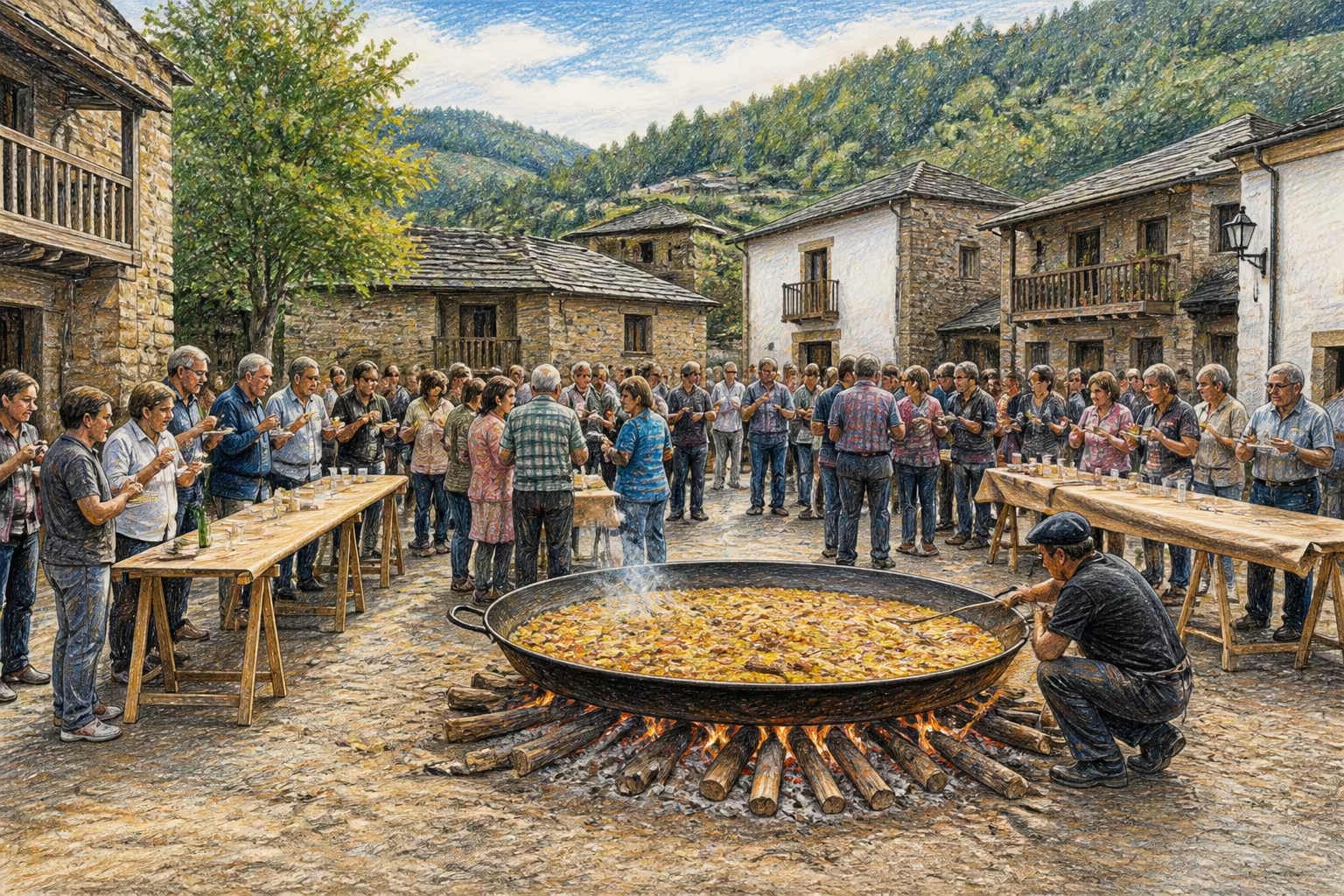
They brought the bar’s big paella pan out into the square, the fiesta one, which had spent two years up in a loft.
Somebody brought firewood.
Somebody else brought trestles and a board.
At half past twelve the car turned up.
It came down the street with his elbow out, parked where you can’t park, and he planted himself in the square with his sunglasses up in his hair, looking at the paella pan like somebody arriving at a fair.
“What the hell is this?”
“A funeral.”
“Bloody hell.”
He had written to Axel on the Tuesday, at eleven at night, asking whereabouts they were, and Axel had answered with the name of the village because he couldn’t think of a single reason not to. That was two hours of driving. He found out about the two hours from him, who said it three times.
He didn’t pitch in. It wasn’t that he refused: it never crossed his mind, and nobody asked him because a man who arrives talking looks like he is already doing something. He spent an hour and a half standing next to the fire telling an endless story about a festival in Croatia while Axel turned three kilos of onion with a wooden paddle.
And when they sat down to eat, he ate.
He ate the way somebody eats who hasn’t cooked: he went back twice, took out half the dish of ribs the woman from the house next door had brought, and served himself the last piece of omelette without looking to see whether anybody was still without.
Nobody said anything. In a village like that you feed the outsider and that’s that.
Axel saw it and it didn’t bother him. It even struck him as a bit sad.
At five, with the square cleared up, Eva was sitting on the kerb and he crouched down in front of her with his phone in his hand.
“Sing that again.”
“Which one?”
“The river one. I’m recording it.”
Eva laughed and said no. Then she said all right. And she sang it through, sitting on a kerb, with a bloke squatting and holding a phone thirty centimetres from her mouth and the whole village stacking chairs around them.
When she finished he stood looking at the screen the way you look at a sum that comes out right.
“Whoever I say is going to hear this.”
And at quarter to one, in the square of a village where they knew nobody, Axel was kneeling in front of a fire blowing underneath a metre-wide paella pan, with Eva chopping onion beside him on an upturned fruit crate.
“Do you know how to do this?”
“No.”
“All right.”
“Well, yes.” He stirred. “It’s the same as in the pot, but bigger.”
“That’s a lie.”
“Yes.”
It took him two and a half hours. And in those two and a half hours what always happens happened: people gathered round.
First the children gathered, because children gather round a fire. Then an older man who started telling Axel that the rice needed more stock, and then another who said no, less, and within five minutes there were four men arguing about the stock with their hands behind their backs, very serious, and Axel in among them stirring.
Somebody turned up with four cases of wine.
Somebody put a speaker in a window.
Two women set up the boards and covered them with paper.
A woman who hadn’t spoken to anybody all morning started cutting bread into slices at a frightening speed.
At some point, between people’s legs, Axel saw the red hat go past. It was going fast, crouched, both little hands occupied carrying something you couldn’t see, and it went under the board and didn’t come out. Axel went back to the rice. He had ninety people waiting and it wasn’t the moment.
By the time the rice was done, the whole square was laid out.
Ninety-odd people ate standing up and sitting on the kerb, with plastic plates, in the square of a village, on a Saturday at half past three in the afternoon. It was good. Not restaurant good: properly good, which is a different thing.
Axel ate last and standing up, with the plate in his hand, leaning on the church wall, watching ninety people eat something he had made.
It came to him, without warning and out of nowhere, a half-eaten slice of pizza on a kitchen floor.
He shook it off straight away. He still had the rice from the bottom of the pan, which is the good part.
Twenty minutes later, somebody told a story about the dead man and half the square laughed. And a quarter of an hour after that they were all laughing. And by five, a cousin from out of town was doing an impression of how the dead man used to dance at weddings, and there were people crying with laughter and people crying about the other thing, and both at the same time, which is how it should be.
The woman from the beginning came over to Axel with a plate in her hand.
“How did you know my brother?”
“I didn’t. I was passing through.”
She nodded slowly, as though that were perfectly normal.
“Well, thank you, son.”
And she went off to dance.
They left at seven, when the thing was still going and they weren’t needed. And as they left the square, between people’s legs, Axel saw the red hat again: it was up on the back of a chair, holding an olive in both hands, turning it over like somebody inspecting a melon.
He gave him a nod. A small one, towards the square. Meaning “not bad”.
Axel, who hadn’t told anybody where the idea had come from, realised the idea hadn’t come from anywhere: it had come from lying in some grass, bored, and from one of the two people lying in that grass happening to say so out loud.
And he remembered something that had been said to him on a dirt track the first night and that he hadn’t thought about since.
I go where things happen.
The nephew put four things in their rucksack and gave them money, and Axel said no and the nephew told him to shut up.
They left the village by the road, with the noise of the square behind them getting smaller. Kika was full up to her ears and was walking oddly.
“Listen,” said Axel after a while.
“What.”
“I’m not bored any more.”
Eva laughed.
“Mmh. Nor am I.”
“Listen.”
“What.”
“You said it.”
“I didn’t say anything. I said we needed to do something.”
“Well, exactly.”
Eva walked a few metres looking at the ground.
“Give me a break,” she said.
And they didn’t talk about it again, but they both went to bed that night with the silly feeling of having discovered a machine.