
Seeing Things
Half an hour that was nowhere at all
That week it was hotter than it should have been for the date. They walked from six to eleven and from five to nine, and in between they looked for shade and lay about doing nothing, sweating, waiting for it to drop.
Axel was sleeping badly. He had been sleeping badly since the robbery, and worse with the heat: he woke at three or four with his heart going for no reason, and then there was no way back.
On the Tuesday the car came for her.
They had fixed it on the Sunday, writing to each other on Axel’s phone, and Eva came out with it on the Monday night in the way people say things they have already decided not to consult anybody about.
“Tomorrow I’m not walking.”
“All right.”
“There’s a place in the city with a proper booth and he wants somebody to hear me. He’s picking me up at nine.”
“All right.”
“It’s four hours of driving.” She sat looking at the fire. “Four there and four back.”
She didn’t say it showing off. She said it in wonder, which is worse.
Axel said all right for the third time, got into the hammock and spent an hour looking at the canvas.
On the Tuesday he walked nine hours alone.
Kika went with him for the first three and then went back to the shade of a transformer and there was no shifting her. Fay didn’t even appear. He walked along a B-road with no verge, with the lorries going past a hand’s width away, and he ate standing up leaning on a wall, and at five in the afternoon he realised he had not said a word out loud since the morning.
And nothing happened to him all day. Not a stone moving on its own, not a red hat behind a gorse bush, not a laugh. Nothing.
They got back at half past eleven. He watched the headlights come up the dirt track from inside the tent, and he stayed still, and he didn’t come out.
Eva came in bent over, got into her sleeping bag with her clothes on and stayed quiet a while.
“It went well,” she said in the end.
“I’m glad.”
And that was that. He asked nothing else, and it wasn’t out of politeness: it was that he had been carrying Eva’s sister’s number for two days in the same phone the two of them had used to arrange it.
On the Thursday he forgot to eat. He didn’t decide to: he simply had breakfast at six and then they walked, and then they stopped, and then they carried on, and by the time he thought about it it was seven in the evening and he had eaten nothing but a handful of almonds.
They were coming into a village. He had a vague memory of seeing the sign.
He remembered the sign.
The next thing he remembered was being sat down.
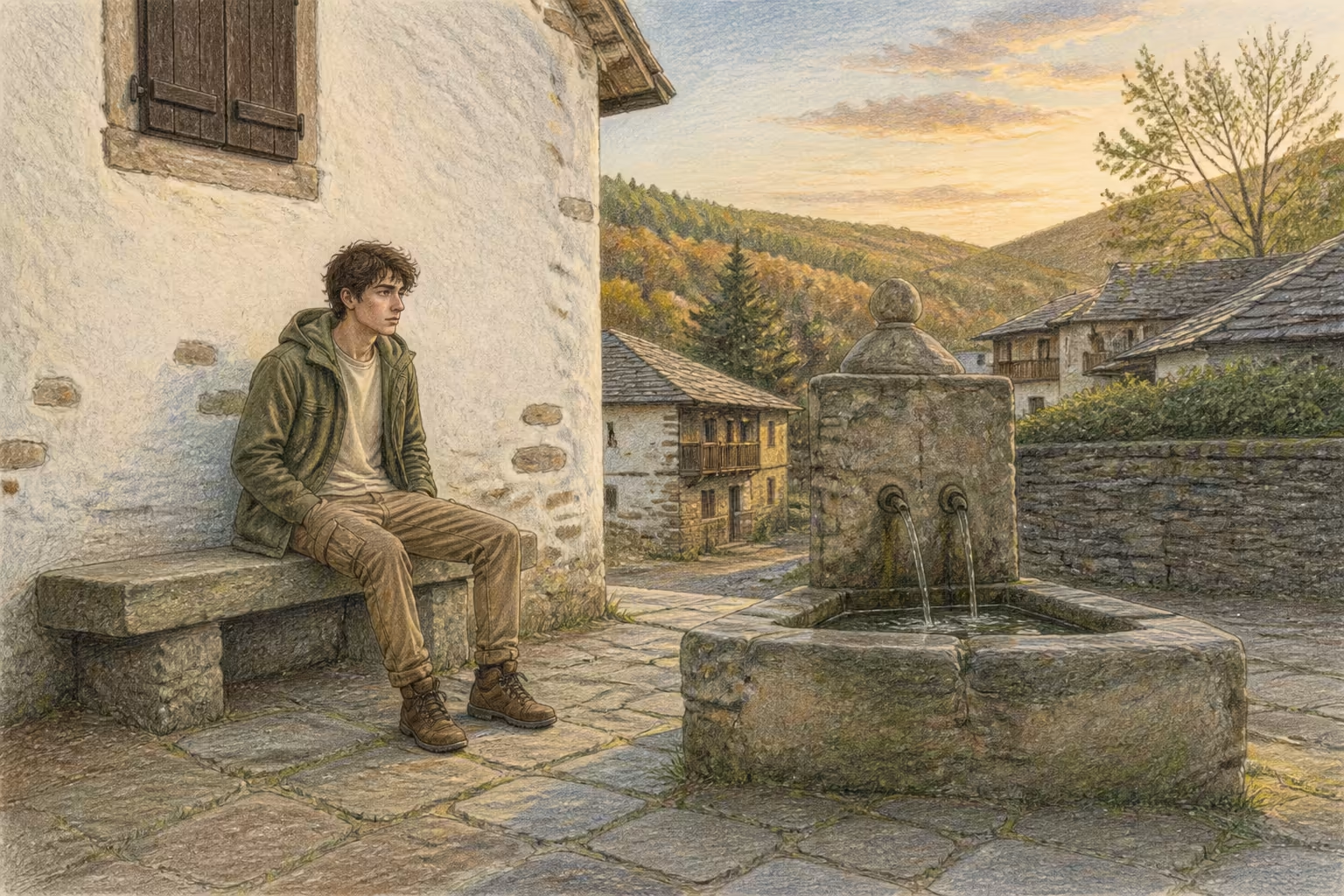
He was sitting on a stone bench, in the shade, leaning against a white wall. In front of him there was a fountain with two spouts.
He didn’t know how he had got there.
It wasn’t that he vaguely remembered. It was that there was nothing. There was the village sign, on a hill, with the sun to one side, and then he was sitting on a bench.
He looked at his phone.
Quarter to eight.
Thirty-five minutes.
He stood up and sat straight back down because his head went. He looked around. The street was a street. There was a woman sweeping a doorway twenty metres away. There was a car parked with a dog inside.
Everything perfectly fine and him not knowing where he had been for half an hour.
And there the fear got in.
It wasn’t an idea. It was in the body. A cold from his kidneys to the back of his neck. His hands strange. An absurd urge to touch his own face. To check he had one. He had one.
Because the seeing-things had its place. The seeing-things had been his since he was eight and he had learned to carry it the way you carry a limp, without looking at it much. This was different. This was a piece of him missing. A piece of him. Half an hour of his own in which he had walked, and talked, and been somewhere, and it wasn’t there.
And a whole scene presented itself to him, with a clarity that was sickening: him in a consulting room, with his parents either side, on two chairs, and a man in a white coat explaining something to them very delicately. His mother with her handbag on her knees. His father with his hands between his legs, looking at the floor, not asking anything.
His father not asking anything.
That was what he couldn’t bear.
“Eva?”
There was nobody beside him. He stood up again, more slowly, and set off up the street calling her, and a voice came out that wasn’t his.
He found her in a shop doorway, with the bag, talking to the owner.
“Hey!” She turned round. “Oh, you’re back. Was it open?”
“Was what open?”
“The chemist. You went to see if it was open.”
Axel stopped dead on the pavement.
“Mmh,” he said.
“Was it?”
“No.”
“Shame.”
And she carried on talking to the woman in the shop.
Axel stood there in the middle of the street, with the eight o’clock sun on one side of his face.
He did not remember saying anything about a chemist. He did not remember talking to Eva in that village.
He told her that night. They were lying on some waste ground behind the cemetery, which was the only flat spot, and they had been quiet for twenty minutes.
“Eva.”
“Mm.”
“I think I’m ill.”
She sat up.
“What’s wrong?”
“I don’t know.” He looked up. “Today I lost half an hour.”
“What do you mean, you lost it?”
“That I don’t know where I was. That I remember the village sign and then I remember sitting on a bench, and in between there’s nothing. And you told me I’d gone to the chemist and I didn’t go to any chemist. Or I did. I don’t know. That’s the worst of it, that maybe I did.”
Eva didn’t answer that.
“And it isn’t only that.” Now it all came out at once. “It’s that I’ve been like this since I was eight. I see things. Things nobody else sees. All my life.”
“I know.”
“No, you don’t know.” He sat up. “It isn’t funny, Eva. It’s that sometimes my head goes off, it goes racing, it fills up with things and I can’t stop it. And I’ve always told myself ‘that’s it, I’m tired, I overthink things’. I’ve said that to myself a thousand times. In those words. And today I lost half an hour.”
He put his hands over his face and left them there a moment.
“And what I’ve been thinking since eight o’clock is that maybe this is what happens to people before. Before.” He moved a hand, like somebody pointing at a place that doesn’t exist. “And that I’ve had it since I was eight and I’ve spent my life telling myself I’m tired.”
He didn’t finish.
Eva was quiet a long time. And then she did what she did, which struck Axel at that moment as absolutely insufficient: she got up, went to the rucksack, took out a tin of sardines, a piece of bread and the bottle, and put it all in front of him.
“Eat.”
“Eva, it isn’t that.”
“Eat anyway.”
“I’m telling you something serious.”
“I heard you.” She sat down opposite. “Eat.”
And he ate, with enormous anger, because he wanted something else. He wanted her to tell him he wasn’t mad. He wanted her to tell him she saw the brownies too. He wanted her to tell him something.
He ate the whole tin and half a loaf. And fifteen minutes later he felt better. Physically better. Noticeably better. And that made him angrier still, because it didn’t fix anything.
“Tomorrow, in the first place with a doctor, you go,” said Eva.
“Mmh.”
“Not ‘mmh’. You go.”
“I will.”
“And ask the chemist about the head thing too, if you want. I’ll come with you.”
Axel nodded. And then said, very quietly:
“And if they tell me something?”
Eva thought about it.
“Then they tell both of us,” she said.
They fell asleep without talking about it again. And before getting into the hammock, Axel checked the knots on both straps. He checked them without thinking, the way you check the door is shut, and then he stood there a moment with the cord in his hand realising he had checked them.
That night, on that waste ground behind the cemetery, absolutely nobody appeared. Not one red hat. Not one small laugh. Not one stone that moved on its own.
Nothing.
Axel lay awake until very late, looking into the darkness, waiting.
And nobody came.
And at three in the morning, with his eyes open, he went back over the whole day looking for what had happened. He had got up. He had walked six hours in the sun. He had lost half an hour. He had eaten a tin of sardines with a great deal of rage.
Nothing had happened.