
Manazas
A stove that wouldn’t spark and forty-one years of not going back
The stove was eleven years old.
Axel’s dad gave it to him when he turned fifteen. It was one of those ugly things that never break: a steel plate, three legs and a burner that roared like a small plane.
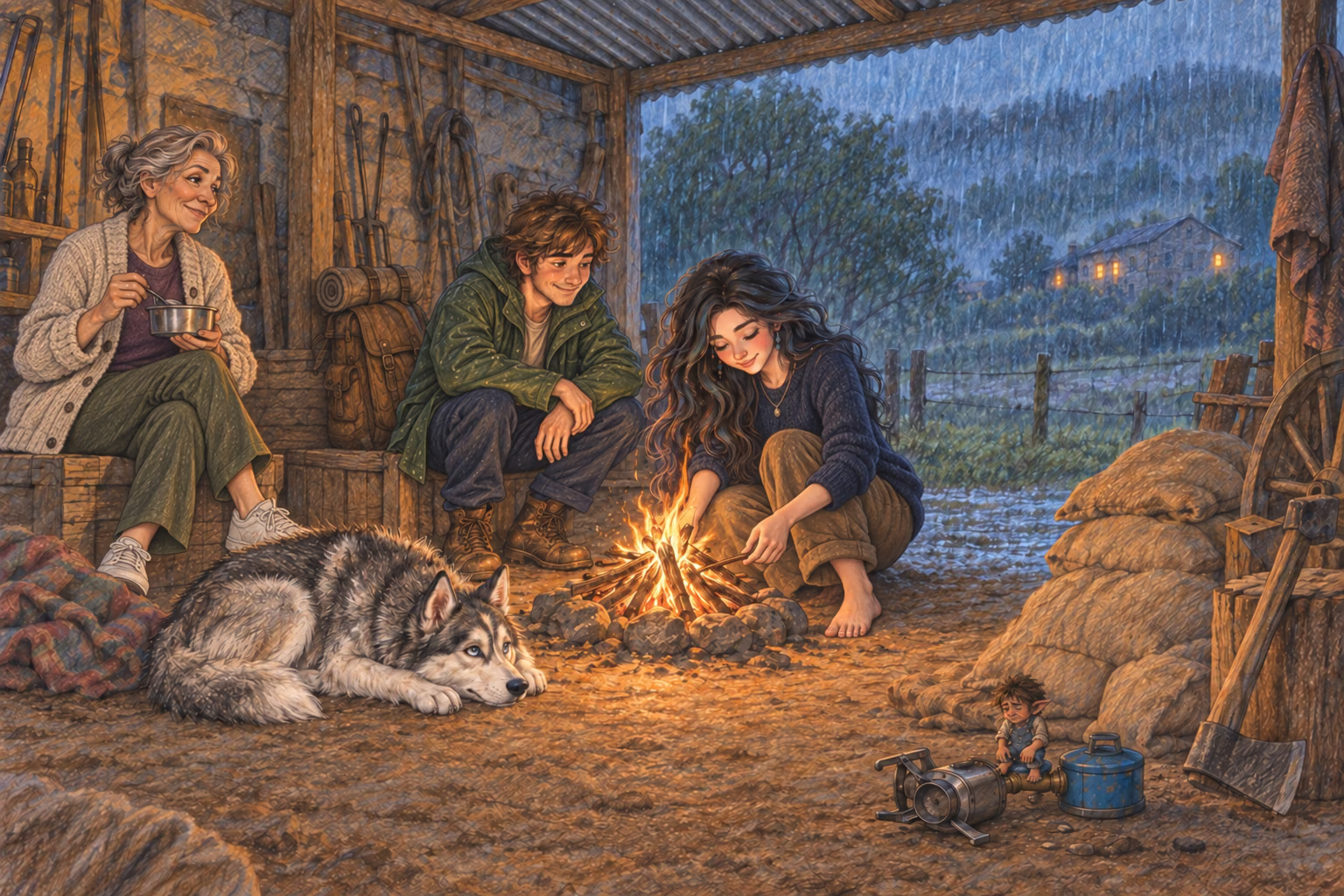
That afternoon it rained half-heartedly and without stopping, that fine rain that soaks you through in twenty minutes before you’ve even noticed it’s started. They found a tool shed in the middle of a field, open on one side, with a hard dirt floor and a pile of empty sacks in a corner.
“Here,” said Hortensia. “And that’s final.”
Axel got the pan out, set up the stove, opened the gas and hit the spark.
Nothing.
Again. Nothing.
“Give it here,” said Hortensia.
“No, no, this one always works.”
He hit it nine or ten more times, same again, hoping for a fluke. On the tenth the little wheel went click, went slack and started spinning in thin air.
“Oh.”
And then he saw him.
Sitting on top of the regulator, hands on his knees, looking suitably sorry. A bit bigger than Gorgorito, in dungarees covered in pockets, with enormous hands, the size of his own feet.
“It’s broken,” he said, in a very deep voice.
“I can see that.”
“I was having a look inside it.”
“I can see that.”
“I open everything up, see.” He looked down at his great big hands. “To see how it all goes. And then I close it up, and it doesn’t go any more.” He thought about it. “But I know the inside by heart now. And that I don’t forget.”
“And who are you?”
“Manazas.”
“Well, obviously,” said Axel, looking at the hands.
Axel looked at the two of them. Hortensia was wringing out her cardigan. Eva was watching the rain. Neither of them was looking at the stove.
“We’ll find a hardware shop tomorrow,” he said, louder than he needed to. “With a new flint it’s a two-minute job.”
“Or we make a fire,” said Eva.
“With everything soaking? Not a hope, sunshine.”
Eva was already getting up.
She went out into the field and came back ten minutes later with an armful of twigs she’d pulled from under a gorse bush, from the inside, where the rain doesn’t get in even if it chucks it down for three days. She took a thick stick and with Axel’s penknife shaved curls off it until she had a little pile the size of an egg. On top, the thin ones, crossed. Round the outside, the thick ones, not touching.
“Got a lighter?”
“I’ve got two.”
“There you go, then.”
Four minutes later there was a fire going inside a shed, with the whole field dripping all around it.
“Where did you learn that?”
“Nowhere.”
“Eva.”
“Nowhere, I said. You learn it or you eat cold.”
Axel didn’t think he was a muppet with a hundred-and-twenty-euro tent. He thought: I want to be able to do that. And he felt a bit daft, because it was the first thing he’d wanted to learn since his driving test.
They had a hot dinner. A tin of tuna and a tin of tomatoes in the pan, with a splash of oil, and bread dipped in the sauce. The rain drummed on the corrugated roof. Kika lay down in front of the embers with the face of someone who’d finally got somewhere.
Manazas had gone over to the pile of sacks. He was sitting on his own hands, like a kid who’s been told off, with his eyes glued to the stove.
It was Eva who brought up the other thing. She’d been carrying it around all afternoon.
“Hortensia. That thing about your mother’s house.”
Hortensia stopped with her bread halfway to her mouth. She drank from the water bottle. She wiped her mouth with the back of her hand.
“It’s the house I grew up in,” she said, looking at the fire. “Right up at the top, in the mountains. Stone, the animals downstairs, the living upstairs, and a bread oven built onto the outside wall. My father was a blacksmith. My mother was everything else.”
“So why aren’t you there?”
“Because at nineteen I came down to the city to work behind a shop counter and I met a gentleman in a tie.” She laughed through her nose. “Then my parents died, two years apart. My brother was in Germany and didn’t want to hear about stones, and my sister sold me her share for what the notary cost. I buried my mother in the morning, signed in the afternoon and by the evening I was laying the table in the city.”
“And you’ve not been back?”
“No.”
“Never?”
“Forty-one years.”
Axel sat up.
“Forty-one?”
“At first I didn’t have the time, which is what everybody says. Then it was, what for, it’ll be a ruin by now.”
There she stopped. She put her hand to her cardigan pocket, to the thing that went clink, and left it there for a second.
“A ruin,” she said again, like it was a word she’d read somewhere. “And then it was something else. I’d gone so long without going that going meant admitting it. Walking up the hill, standing in front of the door and counting the years.”
“Yeah,” said Eva.
She said it so fast that Axel turned round.
“A cousin of mine went up a few years ago and sent me a photo,” Hortensia went on. “And I never opened it. It’s on my phone, it says ‘the house’, and there it sits.” She lifted a shoulder. “It’s silly. I know it is.”
“Let’s go, then,” said Axel.
“Oh yes, of course. And you can do my windows while you’re at it.”
“I mean it. Let’s go.”
“You two? To some village in the back of beyond to look at a ruin?”
“We’re not going anywhere in particular. I told you. So, there.”
Hortensia opened her mouth. Shut it. And started clearing up the tins with tremendous energy, going on about how the edges are sharp and a cousin of hers who got a seven-stitch gash that way.
Later, lying down, with Hortensia snoring, Eva spoke in the dark.
“Axel.”
“What?”
“That thing about the house. She didn’t just say it.”
“I’d spotted that myself, clever clogs.”
“No. I mean she’s been thinking about it since the reservoir. Since the shoe.”
“How do you notice stuff like that?”
“By looking, clever clogs. Go to sleep.”
She didn’t say anything else. Axel lay staring at the corrugated roof. That girl could tell him what a woman was thinking three days before the woman said it. And he’d been walking next to her for ten days without a clue what she was thinking.
Then he remembered the stove.
He went out with the head torch, picked it up off the ground and flicked the little wheel without thinking.
Spark.
He froze. Spark, spark, spark. Same as ever.
He looked at the sacks. They were empty.
“Eva,” he said quietly. “It’s sparking.”
“The flint must’ve dried out,” she said, without opening her eyes. And she rolled over very fast so she could be asleep.
“Well, bugger me,” said Axel, out loud.
From somewhere in the pile of sacks, very quietly, came a laugh.