
Like a Whistle
The last slate and five people in a car
The last slate was laid by Eva.
It was twelve days after she came back, a Thursday, at twenty past seven in the evening, with the light already coming in sideways and the whole village smelling of rain that never quite fell. They had spent those twelve days carrying slate up by hand, bucket by bucket, with the rope, and there was one row left.
When there was one row left, Axel stopped on the ridge, took the hammer out of his belt and went down two rungs.
“You go up.”
“Me?”
“You.”
Eva climbed the new ladder without saying anything else. She sat astride the ridge, laid the last one, gave it two taps with the hammer and then a third that wasn’t needed at all.
And the two of them stayed up there, on a roof that no longer had a single hole in it, looking at the village from the only height from which you can see all of it: nine slate roofs, a fountain, a wash-house with the roof caved in and the road going into the bend and disappearing.
They said nothing for a good while.
“It’s done,” said Axel.
“It’s done.”
Eva stretched her legs down the slope, her bare feet resting on the slate, which at that hour still held the whole day’s sun, and leaned back until she was lying flat on the pitch with her hands behind her head.
Axel stayed sitting up. It went through his head to lie down beside her. He worked out how many centimetres there were, which were not many, and didn’t move.
By the time they came down it was dark and Úrsula was in the street below with her hands in the pockets of her overalls, looking up.
“Right,” she said.
And she said nothing else, and that, in Úrsula, was a party.
There were two weeks left until October.
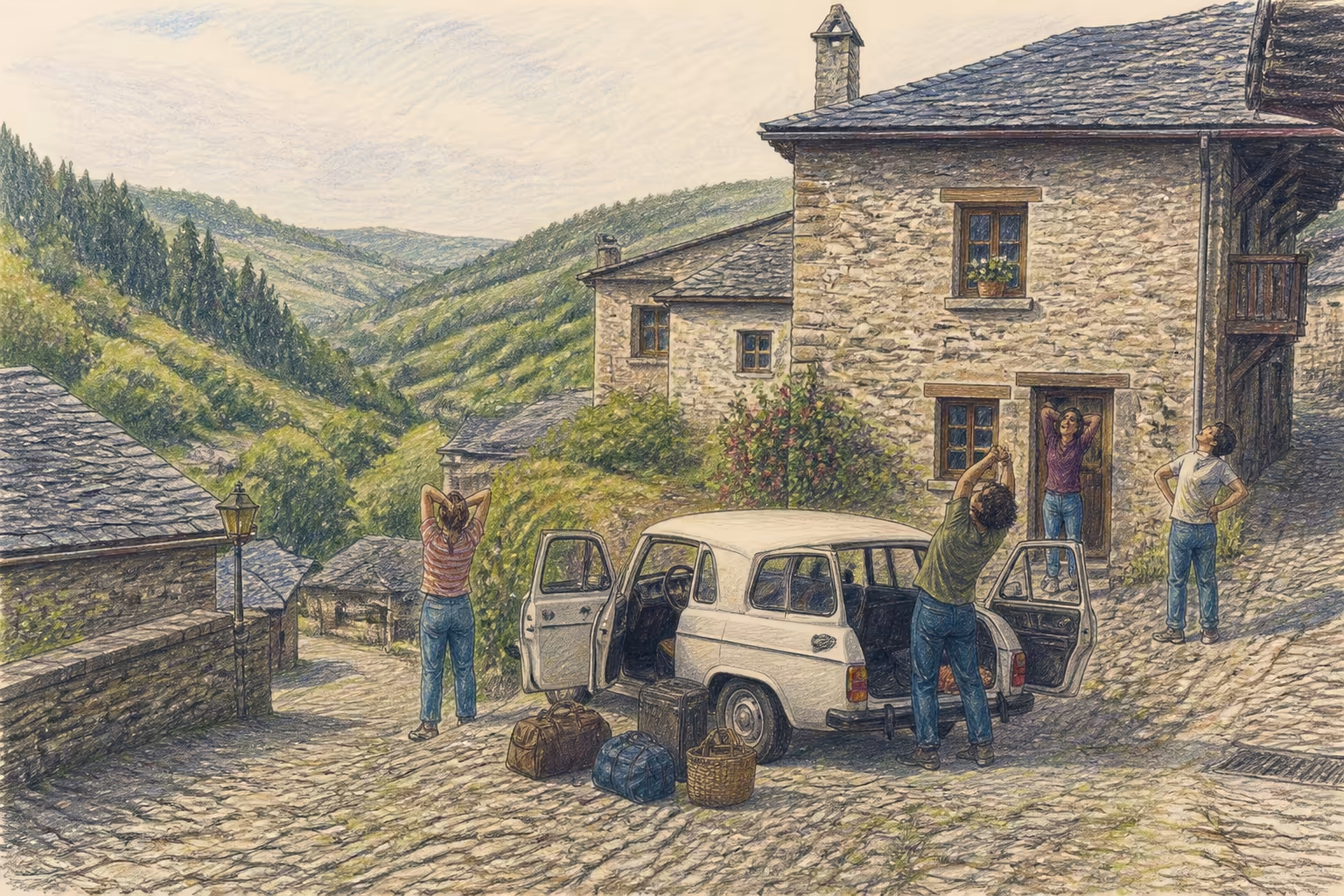
The car arrived the following Saturday, at twenty past seven in the evening, and could be heard from three bends away.
It was Paco’s white car, the old boxy one. It came up the cobbled street with the engine complaining, stopped in front of the house and stayed there a moment in silence, with all five inside, as though nobody dared open a door.
Then all four doors opened at once.
They had set off at seven in the morning. Twelve hours and twenty minutes. Paco driving, Axel’s father riding shotgun because he was the only one who didn’t fit in the back, and in the back seat, three: his mother, Hortensia and a woman Axel had never seen before.
They came out of the car the way the snakes come out of one of those joke tins.
“Bloody hell!” said his father, stretching. “My back!”
“Twelve hours,” said Hortensia, hanging on to the door. “Twelve hours with this man putting the radio on.”
“The radio is there to be put on!”
“The radio is there to be put on, not to be sung along to!”
His mother got out the other side, stretched, looked at the house and put a hand on her chest.
“Oh.”
Because the house wasn’t the house any more. In two and a half months they had done this: the whole roof, the window with glass in it, the balcony with new boards, the water reaching the kitchen again through a new hose from the spring, the byre emptied and swept and free of rats, the slope at the back cleared of forty years of tins, the vegetable patch clear of brambles and with three beds dug, the kitchen whitewashed and the hearth working. There was still no electricity, and on the table there were three candles and a head torch. And the elder tree was still inside, in the back room, with a new skylight put in around it by Úrsula, who had said it was a daft idea and had done it anyway.
“Good God, son,” said his father, walking towards the front wall with his head up. “Good God.”
He knocked the wall with his knuckles, which was the closest thing to a hug that man did in front of people.
The woman had stayed by the car. She hadn’t moved. She’d be thirty-odd, hair tied back, a jacket far too good for that street and a pair of shoes that weren’t going to last two days.
She was white.
Eva came down the three steps from the door and stopped four metres away.
The two of them stood there, and nobody opened their mouth. His father stopped knocking on the wall. Paco stayed with the boot half open.
“Hello,” said Irene.
“Hello.”
And the silence again.
Irene opened her mouth. And Axel, from the balcony, watched her go straight for the first thing she shouldn’t say.
“You’re very thin.”
Eva went still. Axel shut his eyes.
And then Eva said:
“And your shoes are terrible for this street.”
Irene looked down at her own feet. She stood there looking at them.
She burst out laughing. She burst out laughing with a hand over her mouth, half crying, with that horrible laugh that comes out when you’ve spent twelve hours in a car and a year and seven months waiting.
“I know,” she said. “I know. The lady told me at kilometre forty.”
“And she didn’t listen to me,” said Hortensia.
They didn’t embrace. They stayed four metres apart, laughing about the shoes, and then Eva said “come on in, then” and they went in.
Axel cooked for nine. Nine, because at eight Úrsula turned up with a bottle and at half past eight Sabino came up with the walking stick he didn’t use, and behind Sabino, without anybody having asked them, the lad with the frying pans and his mother.
He made that stew, the one he had learned in a battered pot they didn’t have any more, the one from the house of the woman who had died in January. Ribs, potatoes, paprika, and the rice at the end. He made it in the hearth, with the fire low, crouched down, stirring with a stick, exactly like the first time.
And it came out well.
They ate in the kitchen, eleven people squeezed round a table for six, with two benches, a chair fetched from Úrsula’s house and the lad with the frying pans sitting on a fruit crate.
His father sat next to Paco and they discovered within ten minutes that they had both owned the same four-wheel drive, same year and same colour, and after that there was no getting them off it. Queta looked at Irene’s feet before her face, the way she did with everybody, said her size out loud and got it right, and then started talking about skirting boards with Úrsula. Hortensia and Sabino spent half the dinner arguing about a donkey from sixty-five years ago.
Eva and her sister were at one corner of the table, talking quietly, for two and a half hours.
Axel heard nothing of that conversation and didn’t want to hear it. All he saw, from the other side of the table, was three things.
He saw that Irene cried twice and that Eva didn’t comfort her either time, and that it was right.
He saw that at one point Eva got up, went to the back room and came back five minutes later with her face washed, and sat down again.
And he saw, well into the small hours, that Irene took something out of her bag.
And that one he saw from close up, because right then he was putting the pudding dish down on that corner of the table and there was no longer any way of leaving without it showing.
It was small and it was wrapped in a paper tissue. Irene put it in front of Eva and drew her hand back.
Eva didn’t touch it.
“You open it,” she said.
“It’s yours.”
“You open it.”
And Irene opened it, with a lawyer’s hands that had never pulled up a weed in their life and had spent three days pulling them up. Inside there was a bamboo cane, split down the middle, with six holes burned into it.
Eva sat looking at it on the table. She didn’t pick it up.
“You threw it away,” she said.
“No.”
“I saw you throw it in the bin.”
“And I saw you look in the bin,” said Irene.
There they both went quiet, and Axel, standing with an empty dish in his hands, understood that the two of them had spent nine years with half that scene each.
“I got it out that night, once you were asleep,” said Irene. “And I never told you.”
“Why?”
“Because if I told you, you’d have had to thank me again.”
Eva let the air out through her nose.
Then she reached out, took the two halves, one in each hand, put them together where they had broken and sat looking at how they matched.
Nine years in a drawer in the house where the two of them grew up.
“It sounded terrible, eh?” said Eva.
“Sounded?”
“Like a whistle.”
And Irene’s whole face crumpled and she started laughing with her mouth shut, and that time Eva didn’t comfort her either.
But she stayed.
Axel took the dish to the kitchen and spent a bit longer than he needed to in there.
Irene stayed three days. She bought a pair of boots at Trini’s shop, which turned out to sell boots, and spent the three days doing things that were strange for her: carrying a bucket up, pulling out weeds, learning to light the hearth without smoking out the whole kitchen.
And she spoke to Axel about it only once, the last day, in the doorway, while she waited for the others to come down.
“Listen,” she said.
“Go on.”
“Thank you for calling me.”
Axel shook his head.
“Don’t thank me for that.”
“Why not?”
“Because I did it badly.” He leaned against the frame. “I did it behind her back for four months. And it nearly cost me everything.”
Irene said nothing.
“She’s already told me,” she said. “She told me that if I ring you before I ring her again, I don’t come up this street again.”
Axel laughed.
“That sounds like her.”
“Yes.” Irene looked at the house. “It sounds a lot like her.” And she stood thinking for a moment. “I don’t know how to do this either, you know? I’ve always been the one who knows what has to be done. And now it turns out I don’t.”
She looked at the cobbled street with her new boots from Trini’s shop.
“Listen, one thing. I’ve had this here for three days.” She turned a little. “The two of you left.”
“Go on.”
“She left. And you left. And I understand you, all right? Let it be clear that I understand you.” She said it fast, the way people say things they have rehearsed. “But the thing is that in my house two people died on a motorway on a Thursday, with the two of us in the back seat, and on the Friday somebody had to ring a funeral parlour, and a solicitor, and the woman from the insurance, and my mother’s eighty-four cousins. And I did that. At twenty-two. On my own.”
She put her hands in the pockets of the good jacket.
“And then a wardrobe had to be emptied. And then somebody had to decide what to do with a flat. And sign. And pay the service charge every month, because the service charge doesn’t stop just because you’ve gone off to find your own life.”
She looked Axel in the face.
“I’m not saying she did wrong. I’m saying somebody has to stay behind to turn the light off. And whoever stays behind to turn the light off doesn’t come out well in the photo.”
Axel looked for something to answer to that and found nothing, because it was true.
“There,” said Irene. “I’ve said it now.”
And she settled her bag on her shoulder.
“And don’t tell her, because I know her and she’ll tell me I chose to stay. And she’ll be right.” She laughed without meaning it. “That’s the worst thing about my sister. That she’s nearly always right, and barefoot on top of it.”
Axel gave the street a while.
Then it struck him that he had spent six months learning to keep quiet and that this was the first day it had been any use.