Kika
A dog who complained like mad and a village under the water
Eva didn’t speak all day.
It wasn’t a slammed-door kind of sulk. It was worse. It was a polite silence. She walked with them, stopped when they stopped, and when Hortensia gave her a bit of bread she said “thanks” and ate it looking at the bread.
Axel had three goes.
The first with a joke.
“What did the fish say when it swam into a wall?”
Eva kept walking.
“Dam,” said Axel. “That’s what it said. Dam.”
Hortensia had to stop on the verge, bent double.
“Oh, son, that’s terrible.”
Eva, nothing. Like the wall.
The second with a question about the route, so she’d have to answer.
“Do we hit a village before lunch?”
“I don’t know.”
Three words.
The third was the bad one.
“Here, if you want we can talk about this morning.”
“I don’t.”
“Yeah, but sometimes it helps…”
“Axel.”
And he shut up. Because he was a fixer. Someone broke something and there he was with the screwdriver before they’d even asked.
Hortensia, on the other hand, talked enough for three. About a priest who used to fall asleep standing up during Mass. About mushrooms. About why people don’t sit out on their doorsteps any more.
She didn’t ask Eva a thing. Not once in five hours. And it wasn’t by accident.
They stopped for lunch at a picnic spot next to a petrol station. An ugly place. Two plastic tables and a cigarette machine.
And that’s where she came out.
She came out from behind the bins with her head down. Axel thought it was a wolf. It was a big dog, grey and white, with her face marked like a mask, pointy ears and blue eyes that didn’t look right on a dog at all. She was skin and bone. Her fur was coming out in clumps. No collar.
She stopped five metres off, weighing things up.
“Ooh,” said Hortensia. “That’s a husky. The sledge-pulling sort. Who in their right mind buys a wolf to keep in a flat?”
Fay, up on the table, looked at her, decided it was none of his business and curled up.
“Don’t give her anything,” said Hortensia. “If you feed her she won’t go. And then what, you’re taking her with you?”
Axel froze with half a sandwich in the air. The dog didn’t take her eyes off him.
And Eva got up.
She picked up her whole sandwich, which she hadn’t taken a single bite of, and crouched down four steps from the dog.
“Come here.”
It was the first thing she’d said since the hard shoulder without anyone asking her anything.
The dog didn’t move.
“Come here, I said, you daft thing.” She broke the sandwich in half and put one half on the ground. “Here.”
The dog came in sideways, ready to bolt. She grabbed the piece and moved two metres off to eat it.
Eva sat down cross-legged on the gravel and started talking to her quietly. That she was very skinny. Where had she come from, then. That she had eyes like Fay’s and maybe they were cousins.
And the dog answered her.
She didn’t bark. She lifted her nose, shut her eyes and let out a very long “awooo-wo-wo-wo”, full of completely fake sorrow.
“Excuse me?”
“Awooo-wo-wo!”
“Oh, so it’s like that, is it.”
They kept it up for ten minutes, a girl talking quietly and an animal moaning about her entire life. Hortensia was crying with laughter into her sleeve.
When they packed up, the dog was three metres away. When they got back on the road, ten. Half an hour later she was out in front with Fay, like she’d been on the team her whole life.
“That one’s not going anywhere now,” said Hortensia. “We’ll have to call her something.”
“Kika,” said Eva.
“Kika? Why Kika?”
“Because she’s four kilos short. And because it suits her.”
That girl didn’t give her songs names, and she’d named a dog in two seconds.
The next day they came to a junction with two arrows. One said “Gijón 480”. The other just said “Caminomorisco” and headed uphill, towards some mountains that were blue in the distance.
Axel stopped in front of the Gijón one. He’d had the cliffs stuck in his head for months.
Fay crossed without looking at anyone, took the top road, sat down twenty metres along and settled in to wait. Kika behind him, like a trailer.
“That way,” said Eva.
“But there’s no sea that way,” Axel told the cat.
The cat didn’t answer.
“Uh-huh,” said Eva.
“Right. Up we go, then.”
And it wasn’t as hard as he’d expected.
“Let me get this straight,” said Hortensia, setting the pace. “You pack everything in and go and you don’t know where.”
“North. To the sea, to the cliffs.”
“Do you surf?”
“No.”
“Oh. So why did you go, then?”
“Because of a slice of pizza,” said Eva.
Hortensia stopped dead in the middle of the road.
“You what?”
“Eva.”
“He choked on a slice of pizza and it changed his life.”
“It wasn’t like that.”
“It was exactly like that.”
“It wasn’t exactly like that.” Axel walked faster, very dignified. “It was a big slice.”
“Of frozen pizza,” Eva went on, loving it. “Microwaved.”
“Part-baked.”
“What’s that when it’s at home?”
“Something else.”
“And he chucked himself belly first at the worktop like a wild boar and the pizza went flying.”
“Like an animal, I said! I never said boar!”
Hortensia was looking from one to the other with her mouth open.
“And you thought you were dying?”
“I thought I was dying. And I thought: fucking hell, what a stupid life.”
Hortensia went quiet for three steps. And then she let out a cackle that scared Kika.
“A pizza! Oh my Lord, a pizza!” She wiped an eye with her wrist. “For me it took a man dying. You got off lightly with a pizza.”
She stayed two steps ahead, like she’d just said it looked like rain.
Eva elbowed Axel, without looking at him. The first one in two days.
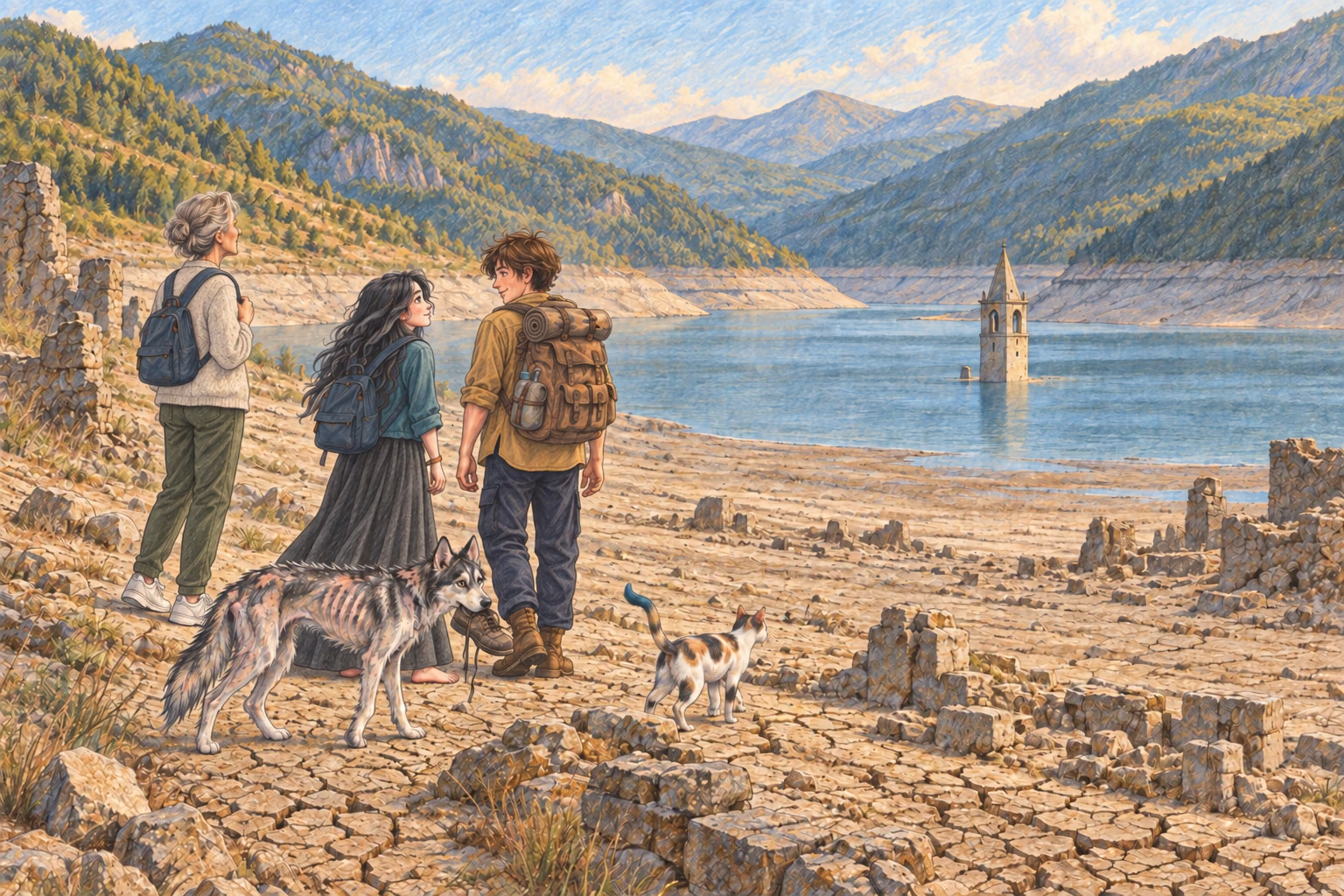
Two hours later the valley opened out and there was the water.
A huge reservoir, dark green, tucked in between the mountains. The banks were dry, cracked mud, with a white line way above the water showing how high it had once come.
And in the middle of the water, two hundred metres from the shore, there was a tower.
A square stone tower, with two windows at the top and a gap where there’d once been a bell. It came up out of the water on its own. Like a finger.
“A bell tower,” said Hortensia. “There was a village down there. They flooded it to make the reservoir. People got a piece of paper and a deadline, and the deadline was short. The dead they took with them. For the living they built a new village up there, with straight streets.”
She put her hands in her cardigan pockets.
“And the houses down below were left standing. With their doors shut.”
They went down to the shore because Eva had got it into her head.
Up close it was worse. In the mud there was a bit of wall with its corner still on. Half a staircase going up to nowhere. Kika found a leather shoe turned to stone and brought it to Hortensia’s feet, dead proud of herself.
“Drop that, you mucky thing,” said Hortensia.
And she stood looking at the tower. Too long.
“These houses were like my mother’s,” she said.
“Where was that?” said Axel.
“Up there. In the mountains.” She pointed at it with a flick of her chin, very quickly, the way you point at something you don’t want to point at.
“Is it still standing?”
“And let’s see if you two know what this bit of iron is!” said Hortensia, bending down for a lump of scrap. “Because I haven’t a clue.”
She started going on about mushrooms, very loud and very fast, and didn’t let go of them all afternoon.
Axel looked at Eva. Eva raised her eyebrows half a millimetre.