
A Bit of a Do
An empty square, a song and a van full of poles in the morning
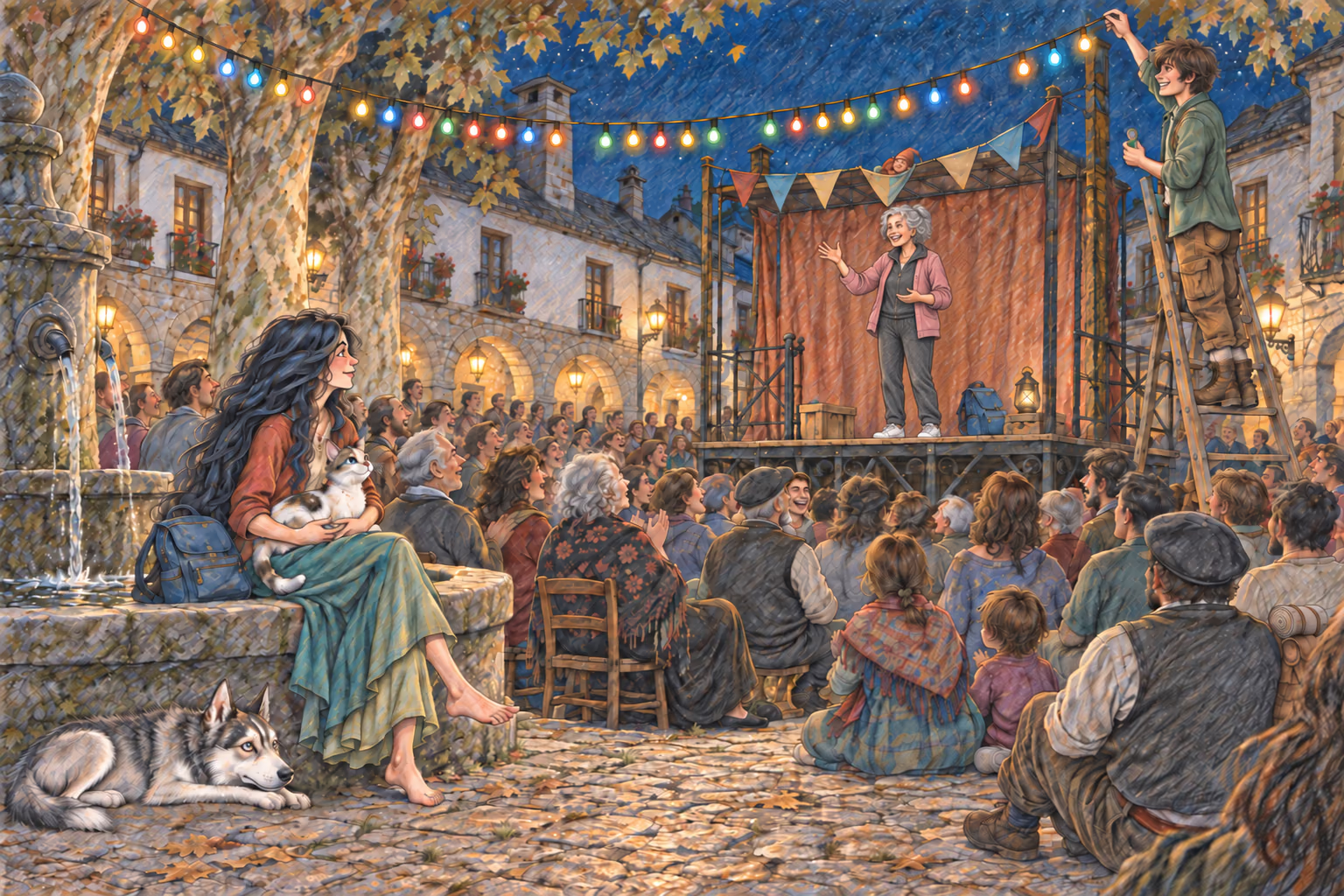
Four days later they got to Villafeliz de la Sierra, which means something like Happytown and was happy in name only. And it had a square that was sad to look at.
It wasn’t that it was empty. There was a bar open, a man watering his plant pots, two little girls going round the fountain on their bikes. But the whole thing was half a note flat.
The square was big, with arcades down two sides and huge plane trees in the middle. The kind of square you do things in.
And nothing got done.
“What a lovely square,” said Hortensia.
The man with the plant pots looked up.
“It was.”
And went back to his watering.
They had dinner in the bar. Packet soup, tortilla and a rough red that Hortensia said was delicious out of politeness. The bar owner didn’t say much, but when Hortensia asked him about the square he leaned on the counter with both hands.
“There used to be a fiesta here you wouldn’t believe. Three days. They’d put up a stage out of planks and anyone who wanted could get up. My uncle kept a list in a notebook and he’d put you down: you at nine, you at twenty past nine. The lad from the garage used to get up with his accordion. The sewing ladies used to get up and do this thing with aprons that’d have you in bits.”
“And what happened?”
“Nothing. My uncle died and that year it didn’t happen, out of respect. And the next year it didn’t either, because if not last year then why bother.” He picked up a glass and started drying it. “And that’s twenty now. There was no row, you know. Nobody said ‘that’s it’. It just got left, bit by bit.”
He let them put the tent up under the arcades, in a corner.
And that night, sitting on the edge of the fountain, Eva started to sing.
Quietly at first, one of hers. Only arcades have this thing: they give you your voice back. Eva’s voice went out, hung up there for a moment and came back a tiny bit late, like someone singing to her from the far end.
She stopped for a second, laughed and carried on louder.
A light came on on a balcony.
Then another.
A shutter opened on a second floor and stayed open.
Nobody came out. Nobody clapped. When Eva stopped, the square went so quiet you could hear the fountain.
“Right,” said Hortensia, pulling her cardigan straight. “Bed, we’ve got walking to do tomorrow.”
At twenty to eight Axel was woken up by a clanking of metal.
In the middle of the square there was a van with its doors open and three men unloading long poles, the paint flaking off them and thick with years of dust.
The scaffolding for a stage.
The bar owner was standing in his doorway with his coffee in his hand.
“What’s all this?” said Axel.
“They were in my uncle’s hayloft. The poles, the bulbs, the planks and two boxes of bunting. And the list, in a shoebox.” He took a sip of his coffee. “Twenty years in there. And this morning my cousin turns up at half seven and says ‘let’s get the poles down’. And I said fine.”
“And why this morning?”
The man looked at him very calmly.
“That’s what I’m asking myself.”
And he went inside.
On top of the heap of poles, sitting on the highest one with his hands on his hips, was Gorgorito. Running the job.
“That one in from the left, you numpty!” he was shouting at a man who weighed a hundred and twenty kilos. “From the left, it won’t go in like that, you melon!”
The man, who couldn’t hear him, banged it in from the right. It went in first time.
“That’s it!” shouted Gorgorito, delighted. “That’s what I was telling you, big lad!”
Axel rubbed his eyes. When he opened them the top pole was empty, and one of the men was saying that was odd, he could’ve sworn he’d left the spanner up there.
They packed the tent away with the van unloading ten metres off. A woman came out with a box of coloured bulbs. A lad came out with a ladder. Someone opened the bar early and put the radio on. Nobody explained anything to anybody. People just came out and picked things up.
“Shall we stay?” said Axel.
Hortensia looked at Eva, who was standing in the square with the cat in her arms, watching the woman with the bulbs.
“No,” said Hortensia. “It’s theirs.”
And she didn’t move.
Five minutes later she put her rucksack down to tell two men the plank was on upside down. And she was right.
They stayed the whole day.
Axel ended up on the lad’s ladder hanging bulbs, because he was the tallest.
“This one won’t come on, mate!”
“Well, stick another one in, there’s a whole box!”
Hortensia went into a kitchen at eleven and came out at two with a dish of tortilla and everybody’s name off by heart.
“And whose tortilla is that?” said Axel from the ladder.
“Mine, now.”
Eva didn’t do anything. She sat on the kerb with Kika and spent the morning watching, which was what she was best at.
By eight in the evening the stage was up next to the plane trees, and thirty-one coloured bulbs were hanging from the string, because the others didn’t come on.
Nothing was planned. No band, no poster, no start time.
The bar owner got up on the stage with the shoebox. It creaked. He took out a notebook with its covers gone soft from the damp.
“This is my uncle’s list. From the last year.”
He opened it and read it out. A name and a time.
“The lad from the garage, at nine. He died eight years ago.”
Nobody said anything.
“The sewing ladies, at twenty past nine. There’s two of you left, and one’s in the armchair.”
A very old woman, sitting in a chair someone had brought out to her doorway, put her hand up and laughed.
“The girl who used to do recitations. She lives away and she’s got three kids.”
Nearly all of them were dead or far away. And at every name someone said something from down below: that one got married, that one still plays but can’t manage stairs any more. And the square kept filling up and nobody left.
The bar owner shut the notebook.
“So there you go. The list’s empty. Anyone who wants to can get up.”
And nobody got up.
Thirty-one bulbs, an empty stage and eighty people looking at their shoes.
Axel looked at Eva. Eva had Fay on her lap and the face of someone who’d bolted the door from the inside.
And then Hortensia put the dish of tortilla down on the ground.
“Oh, I’ll get up myself, I can’t watch this.”
She went up the three steps holding onto the rail, in her cardigan and tracksuit bottoms, stood in the middle and looked at the square like you’d look at the queue at the doctor’s.
“I’m not from round here. I’m a lady who was passing through, and I’ve gatecrashed more weddings than any of you, so I know how this goes.” She cleared her throat. “I’m going to tell you how I fell into a horse trough on the day of my first communion.”
And she told it. With the gloves, the butcher’s-paper crown, the brother shoving. She told it better than she had on the road.
“And there were frogs!” She held one hand up high, fingers spread, like it was still dripping. “And slime. And the priest sprinkling holy water on everyone except me, because I’d already had mine.”
Halfway through they were laughing. At the end, when she said “and I had a better time than any of them”, the old woman in the armchair banged her stick twice and the whole square clapped.
Axel, sitting halfway up the ladder, clapped too, with a dead bulb in his hand.
Hortensia came down as red as a girl and with her chin right up.
After her the lad with the ladder got up, who knew a trick with a hanky. Then two women who knew bits of a song. And by eleven the accordion man was playing sitting at the foot of the stage, and the square was singing something Axel didn’t know.
Eva didn’t get up. But Axel saw her feet moving to the music, bare on the stones of the square, with Fay next to her on the kerb.
And up on the string of bunting, right above the stage, Axel spotted Gorgorito curled up inside a blue one, snoring.
They left at first light, with the square full of glasses and the bulbs still on.
They walked a kilometre and Axel couldn’t keep it in.
“We could’ve stayed for the whole fiesta, you know. It’s three days.”
“No,” said Hortensia, without turning round. “We’ve put the bulb in. The three days are theirs.”
And after a while, to nobody:
“Twenty years in a hayloft.”
And she walked faster.