
Hortensia
A huge house, a borrowed bathroom and a rucksack nobody wanted
On the café doorstep, where Fay had been sitting, now it was him.
Axel went outside to wait and found him sat there with his little legs dangling, like he’d been waiting for him all morning.
“You were…”
“Gorgorito.” He folded his little arms, offended right up to the ears. “It’s Gorgorito, for crying out loud. Memory like a goldfish, you.”
“Got any chocolate left?”
“You ate it all.”
“Pfff. Tightwad.” He jerked his head towards the inside of the café, where the woman was still blowing her nose. “And what about her? You just going to leave her there?”
“And what do you want me to do about it, mate?”
“Get her to come.”
“Come where?”
“Wherever you’re going, sunshine. What’s the difference?”
“But that woman’s just slagged her off.”
“That’s why she’s short a purse.” He looked over at the counter and scratched an ear. “And you’re welcome, by the way. Nobody says thank you round here. And tell her to get those shoes off, you can’t live in shoes like that.”
“What do you know about her shoes?”
“I’ve seen them.”
As if that explained everything, he went over to Fay, who was on the pavement licking a paw, and jumped up onto his back.
“Giddy up!”
Fay carried on with his paw.
“I said giddy up!”
Fay finished his paw, had a good long stretch, and when he felt like it trotted off down the street with the brownie hanging on to two fistfuls of fur, shouting things.
Two seconds later they were gone.
The woman came out of the café with red eyes and her handbag clutched to her chest. Eva came behind her, having scooped the mess back into the bag with a napkin, false teeth and all.
“What are you looking at?” said the woman. “You look like you’ve seen a ghost.”
“Nothing.”
“Where’s Fay?” said Eva.
“He went off down there.”
Eva looked down the street for a second.
“He’ll be back. He’s a law unto himself.”
“Just round the corner” turned out to be a twenty-minute hill, up to where the houses got big and the gates got tall. The woman walked in front setting the pace, not even out of breath, and talking like someone had pulled a plug out.
“I was a right little tearaway as a girl, you know. Don’t you go thinking otherwise.”
“Were you?”
“A tearaway. We’d go down to the river the minute school was out. Three kilometres on foot. And there was a pool under a bridge with a waterfall coming down from above, freezing, and the game was to stand under it and see who could last longest. I’d come out with blue lips.”
She laughed to herself.
“And on Tuesdays, which was baking day, my mother would leave a little plate of something sweet on the bakehouse windowsill, and in the morning it was gone. I’d ask who’d taken it and my mother would say: ‘the ones upstairs’. And if I kept on, that they had a mouth on them, that they wouldn’t sugar the pill even if they saw you crying, that they were always up for a laugh, and that if they needled you it was to wake you up. And that was the end of it.” She lifted one shoulder. “Village stuff.”
“So what happened?” said Eva.
“I married a banker.”
She said it with her voice dropped, like at a wake.
“A very serious man. The kind who has everything. Never laughed, you know. Never. And little by little he takes away your wanting to laugh too. Like a leak in the roof.” She shook her head. “What a stupid way to live.”
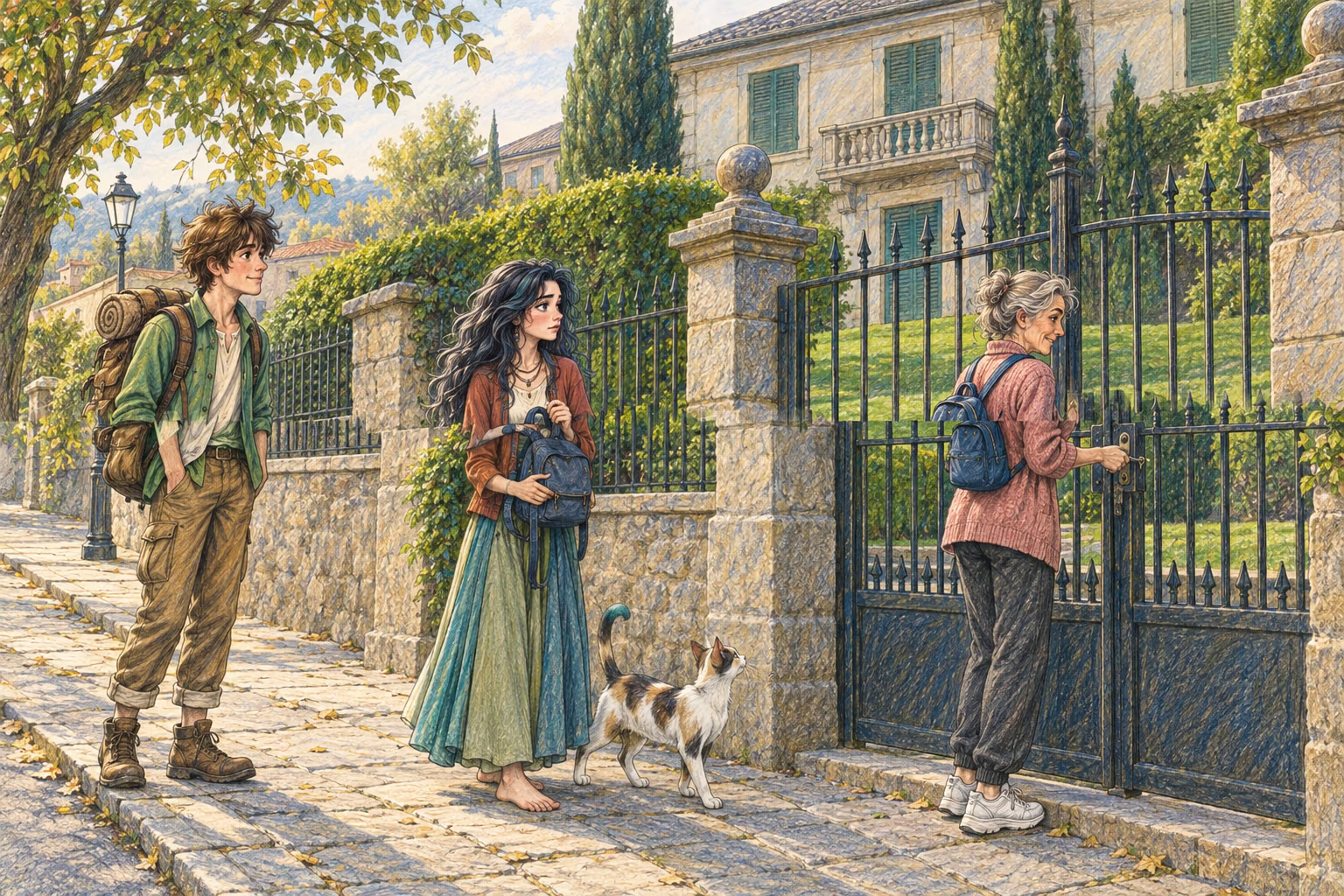
And they were there.
The house was enormous, the kind with a gate and a buzzer with a camera. Spotless. And dead: blinds down, not a light, not a sound. And a garden that was all lawn, short and green and perfect, without a single flower.
“Well, this is it.” She got her keys out. “In you come, there’s more than enough of everything here.”
“Here,” said Axel, already crossing the lawn. “Can I use your loo? I need to do a little something.”
Eva didn’t wait half a second.
“Number one or number two?”
Axel doubled up laughing in the middle of the garden.
The woman, key in hand, let out a belly laugh. One that probably hadn’t come out of anywhere in years.
“Go on, give it some welly!” she told Axel, pointing him to the door.
Eva’s smile stopped halfway. Just for a second. Then it came back, all of it.
The bathroom was bigger than Axel’s flat. Towels folded in three. A soap that smelled like an expensive hotel. Axel washed his hands and kept them under the tap until they burned.
When he came out, Eva was standing in the hall with her hands behind her back, not touching anything.
The woman was coming down the corridor with a rucksack in her hand. Small, blue, canvas, the straps stiff from never having been used.
“Here you are, love.”
“I’ve already got one.”
“That’s not a rucksack, sweetheart. That’s a bag with straps on.” She pointed at the zip tied with the shoelace. “One of these days it’ll split at the bottom and you’ll be picking your things up out of a ditch.”
“It hasn’t split in a year and a half.”
“Well, exactly. It’s due.”
She put it in her hands and turned round.
Eva stood there holding the blue rucksack between two fingers, well away from her body, as if it were hot.
“And hang on, I’ll bring you some shoes. I’ve got loads. They’re a forty, but with two pairs of socks…”
“No.”
It came out sharp. Sharper than she meant.
“Thanks. But no.”
The woman looked at the bare feet on that shiny floor and didn’t push it.
The three of them had lunch in a kitchen where everything was on show and nothing got used.
“The plates were my mother-in-law’s,” said the woman, dishing up. “The whole set. I’ve spent half my life eating off a dead woman’s china.”
Eva showered for twenty minutes and came out with her hair dripping and without saying a word. Then they went out into the garden, into the sun, onto the fake-looking lawn.
And it came out of Axel without thinking.
“Here. The house isn’t going anywhere, is it? Why don’t you come with us?”
The woman stopped with her key halfway into her handbag.
“Sorry?”
“Come with us. We’re not going anywhere in particular. But we’re going.”
“That’s how I left,” said Eva, quietly, looking at her feet. “With nothing. Best thing I’ve ever done.”
“But… at my age. Where to? With what?”
“With what you’re stood up in,” said Axel. “Like when you went down to the river.”
It went quiet.
The woman looked at Axel. Then she looked down at her shoes. Patent leather, a little heel, the kind you don’t walk on the grass in.
“Give me five minutes.”
“Take your time, there’s no rush.”
“I said give me five minutes!”
And she went up the steps with more bounce than her age had any right to.
She took forty. She came out in trainers, with a rucksack that matched Eva’s, her hair shoved up any old how and a twenty-year-old’s face tucked inside her own. Something heavy in her cardigan pocket went clink when she walked, and the corner of a brown envelope was poking out of the top. She didn’t say what it was.
She shut the gate. Stood for a second with her hand on the iron. Let go.
“Right, that’s that. Oh, and look at this, silly me.”
She took out a leather purse.
“I’d lost it and I’d been in a right state all morning. And do you know where it was? In the fridge! Between the cheese and the butter. I’m losing my marbles, my loves.”
Axel and Eva looked at each other.
And held it together. With tremendous dignity.
“By the way,” said Axel, on the way down the hill, “we’ve spent half the morning together and I don’t even know your name.”
“Hortensia Rebollo.” She pulled a face. “Hortensia like the hydrangea and Rebollo like the oak. My father used to say I came out of a garden centre.”
She looked down the street, towards where she’d never been.
“Well, then? Which way to this adventure?”
She set off before anyone could answer, the new rucksack bouncing on her back.
Fay came out from round a corner with no brownie on board, looking like he’d never done anything in his life, and planted himself in front of her.