
Concierge
Two water bottles in the sun, a little notebook and a wire fence
Without Hortensia, the cows went uncommented.
They’d see a cow and nobody would say anything. And the cow would just stay there.
Axel caught himself talking too much to cover the gap. He told her about the hotel. And he came out with a theory of his about churches.
“They put them right up at the top because everybody goes along the bottom. Only the ones who really believe it climb up. It’s a filter. Priests back then were dead clever, you know. Way cleverer than…”
And there he shut up, because he was making Hortensia’s noise and it wasn’t coming out right.
They walked for an hour without opening their mouths. And it was fine.
He carried Hortensia’s things in his trouser pocket. The key, cold against his thigh, and the two sheets folded inside the bit of flour sack.
The first night, with Eva already snoring, he got it all out and looked at it with the head torch turned right down. Even like that the brochure shone. The one with the stamp had a date on it.
He counted on his fingers. May, June, July, August, September.
One hand.
It seemed like loads of time. He put it away again with the key, and he didn’t use that pocket for anything else.
On the second night, once Eva had gone into the tent, Gorgorito turned up sitting on the rucksack.
“Where’s the old girl?”
“She stayed with a baker.”
“You sold her?”
“She stayed, I said.”
“For how much?”
“For nothing.”
“Then you got ripped off.” He scratched his belly. “Chocolate?”
“Haven’t got any.”
“What a rubbish trip.”
And he went.
On the third day Axel’s phone buzzed in his pocket. A message from nine digits with no name.
Where are you lot, Concierge?
Axel replied with the name of the village they were heading for. He couldn’t think of any reason not to.
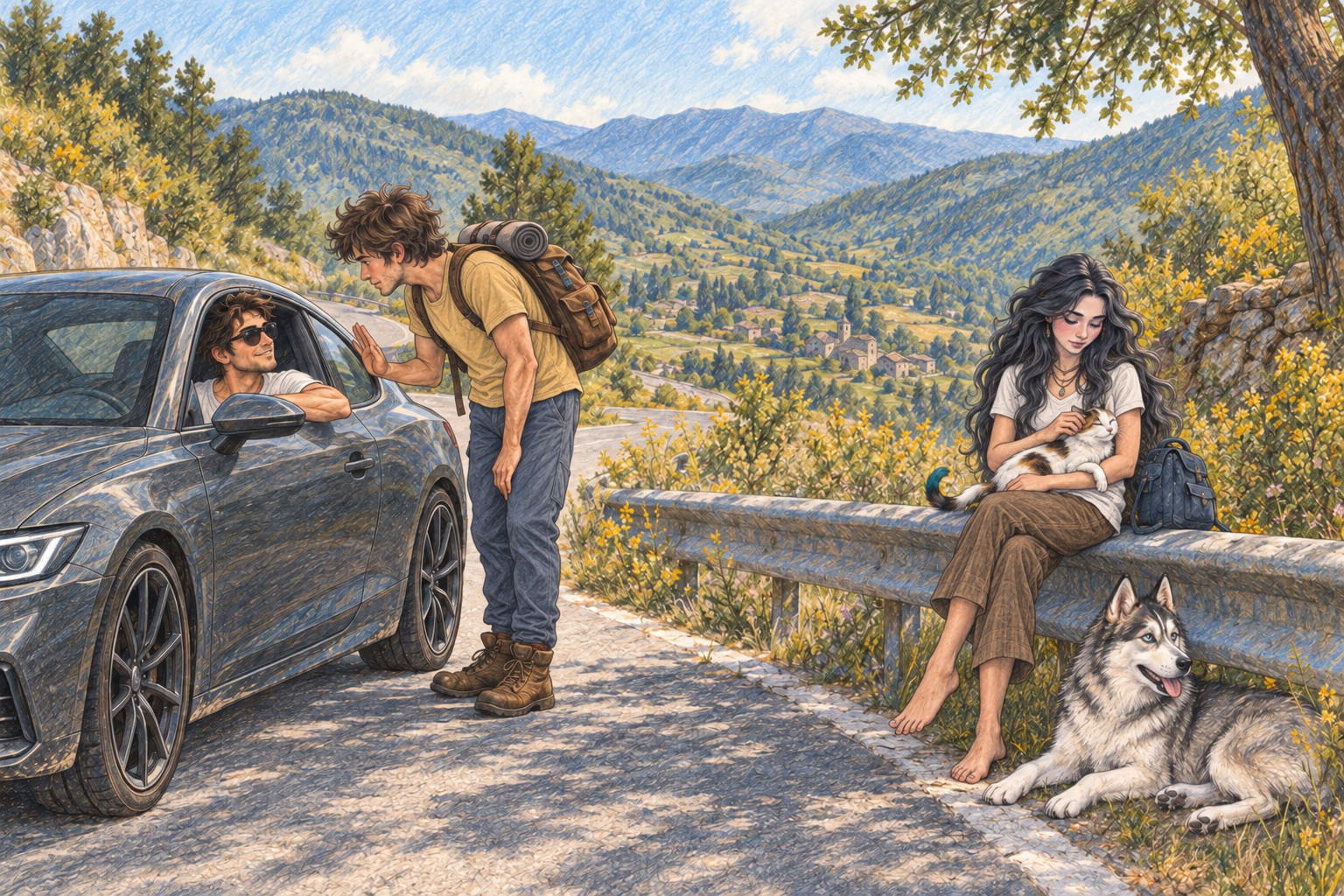
At eleven in the morning, on a back road where nobody ever went, they heard a car. Low, grey, scraping the tarmac at every pothole. It pulled up alongside them and the window came down.
“Concierge!”
Elbow out, and a pair of sunglasses that cost more than the tent.
“I was passing. Well, an hour from here.” He laughed to himself. “I’m from this province, down that way. Hop in, go on, I’ll have you in the village in ten minutes.”
Eva had sat down on the crash barrier with Fay in her lap. She didn’t look at the car. Kika lay down in the shade of the door, because shade is shade.
Axel crouched at the window and heard himself say no.
“What do you mean, no?”
“We’re walking.”
“Yeah, but it’s fourteen kilometres.”
“That’s the point.”
The lad in the car looked at the two of them, waiting for the joke. It didn’t come.
“You’re a pair of dickheads,” he said, delighted.
He parked on the hard shoulder with his hazards on and walked with them for a kilometre and a bit, talking non-stop.
“A mate of mine’s got a twelve-metre sailing boat and he gets seasick in the shower. In the shower, man.”
Then he went back for the car, because he got worried about whether people nicked things round there.
Before he left he stopped in front of Eva, who was still on the crash barrier scratching the cat behind the ear.
“That thing the other night. I’ve been thinking about it. Nobody does that off the cuff like that.”
“Okay.”
“Not okay. Okay’s what people say when they’re not going to do anything.”
And he went.
They walked the fourteen kilometres. They stopped for three hours at a river, because nobody walks in the three o’clock sun, and got there at half seven, knackered, with a new blister each. Quintanilla del Polvo, which comes out as something like Dustville, was hideous and had nothing in it. Not even dust.
That night Axel didn’t get the thing in the pit of his stomach.
He put it down to being tired.
The next day was the kind of hot you don’t forget, and they’d gone four days without a shower. It wasn’t that they smelled bad. They smelled of something. Of smoke, of sun cream, of rucksack.
At a petrol station Axel came out of the shop with two eight-litre bottles of water, one in each hand, and the face of someone who’d had an idea.
“Not a chance,” said Eva.
“I haven’t said anything.”
“It’s written all over you.”
If you leave the bottles in the sun all morning, by three in the afternoon the water’s hot. And eight litres is eight litres.
He tied them to the sides of his rucksack, one on each side, to balance it.
Sixteen kilos. Four hours.
“Give me one,” said Eva after an hour.
“No.”
“Give me one.”
“No.”
In the second hour she stopped in the middle of the road, untied one without asking and kept walking with the bottle hanging off her shoulder like a handbag. They didn’t mention it again.
At three they found the spot. A flat bit of ground behind some hazel trees, away from the road, with a big flat rock.
The water was hot. Bath hot.
“Ooh,” said Eva, putting her hand in the neck of the bottle.
“Eh? Eh?”
“Okay. Fine. It was a good idea,” she said, very fast, looking away. “Now go over there somewhere.”
Axel went over there somewhere. Fifty metres, behind the hazels. From there you couldn’t see anything and you could hear everything.
A little trickle. A strangled yelp. Silence. Another little trickle.
And then Eva’s voice, very loud and very outraged.
“THIS ISN’T A SHOWER!”
“It’s hot water!”
“IT’S A GLASS OF HOT WATER, AXEL!”
“You’ve got to ration it!”
“THIS ISN’T RATIONING!”
Two minutes later, in a different voice, almost to herself:
“Oh my God.”
“What?”
“I’ve had sand down my neck for four days.”
And Axel, on the other side of the hazels, with the bottle held up and the water running down his back, felt like the cleverest bloke in the world.
They had bread and tomato on the rock, with wet hair.
“Here,” said Eva, looking at her hands. “You paid for the bottles.”
Axel was going to say “don’t worry about it”, which was what he always said. Something else came out.
“Four sixty.”
Eva looked up.
“What?”
“They cost four sixty. Both of them. If you want to write it down.”
Eva went very still. Then she took out of her pocket a little notebook she’d bought at the tobacconist’s in Hermisende, licked her finger, found the last page and wrote.
“What are you putting?”
“Four sixty.”
“Don’t actually write it down.”
“It’s written.”
The row was about the route.
The fifth day, five in the afternoon, thirty degrees and a hill. Axel had had his phone in his hand for half an hour.
“This way we save six kilometres.”
“There’s no path that way.”
“There is. Look, there’s the line.”
“That line’s twenty years old.”
“It’s a map, Eva.”
“It’s a map made by somebody who’s never been here.”
And she kept going along the road.
“It’s six kilometres, kiddo!”
“Then go and get them, kiddo!”
And he did. He went down the path on his own, very dignified. Kika went with Eva, which he took as a betrayal, pure and simple.
The path was fine for four hundred metres. Then it got narrow. Then it filled with brambles up to his waist. And then it ended, in front of a brand-new wire fence with a hunting-ground sign on it.
Axel stood looking at the fence for a good while. The fence stood looking at him too.
It took him fifty minutes to get back, with his arms covered in scratches.
Eva was sitting on the crash barrier, in the shade, with the cat and the dog. She’d been there fifty minutes. She could have kept going. She hadn’t.
She didn’t say “told you”. She passed him the bottle.
“Six kilometres,” he said.
“And a fence.”
“Brand new, mind. Just put up. They put that one up this morning, specially for me.”
Eva kicked a stone, so she wouldn’t laugh.
Axel drank, looking at the mouth of the path he’d marched into so full of himself. The grass at the entrance was all standing up. All of it. The only bent bit was where he’d trodden.
“Not a soul goes down there,” he said. “Look at the grass. And the stuff on the verge, flattened in patches. That doesn’t come on the map.”
Eva gave him a sideways look.
“Ooh, look at Mr Clever.”
And they carried on along the road, which was longer and got there.