In the world of handmade figures, there's an invisible but crucial line: with molds or without molds.
Both can call themselves "handmade". But the process, the result, and the value are completely different.
We Magikitos are born without molds, so we know a thing or two about this. We'll tell you what changes when each figure is shaped from scratch, and how to recognize it when you have one in front of you.
The key difference
Figures with molds
Process: A master mold is created (sometimes just once). Then the material (resin, liquid clay, plaster) is poured into the mold. You wait for it to dry. You take it out. You paint it. Done.
Result: Many identical pieces. From the same design, ten, fifty, or a hundred copies can come out.
Time per piece: Little, once the mold exists.
Figures without molds (hand-modeled)
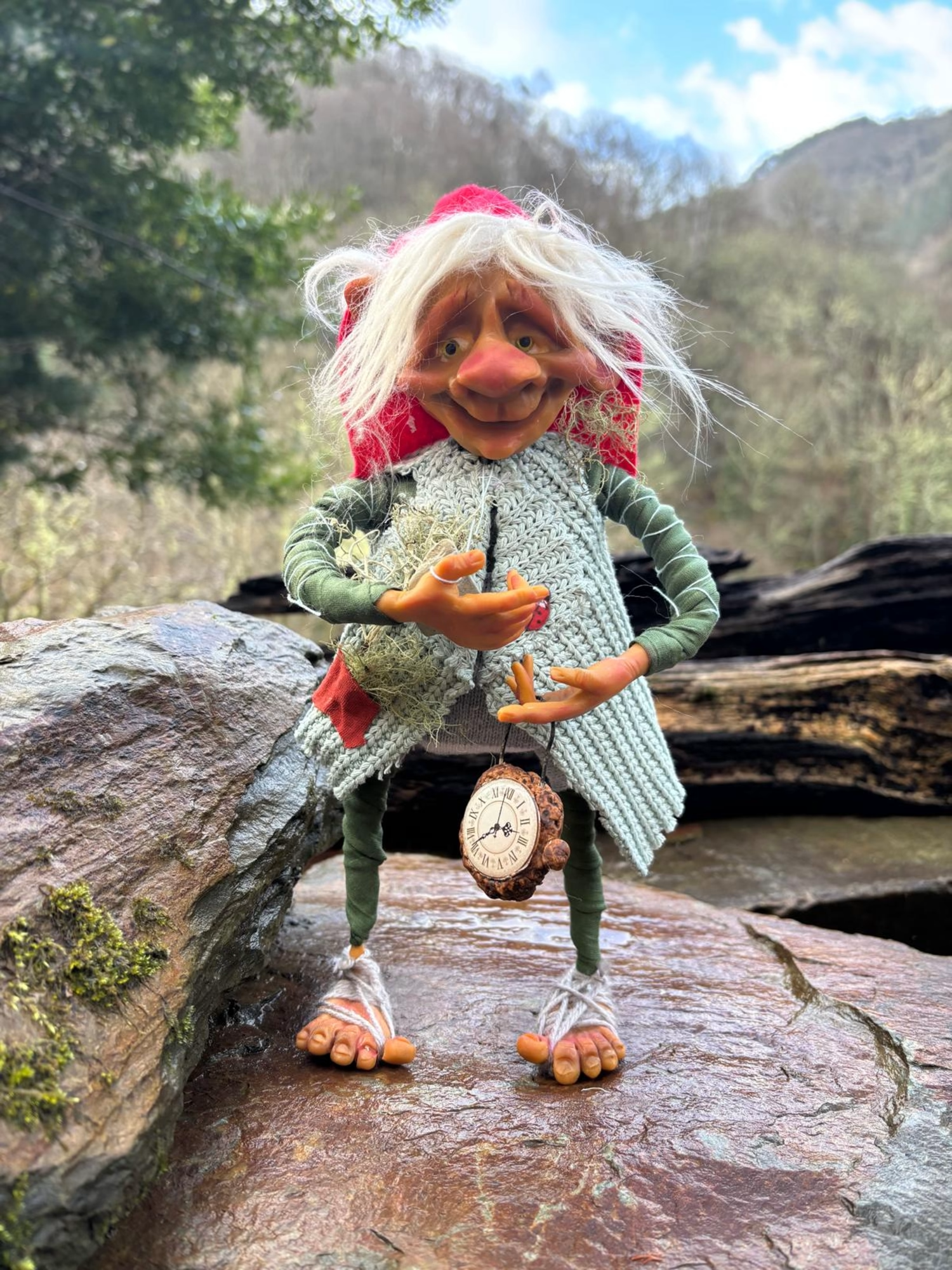
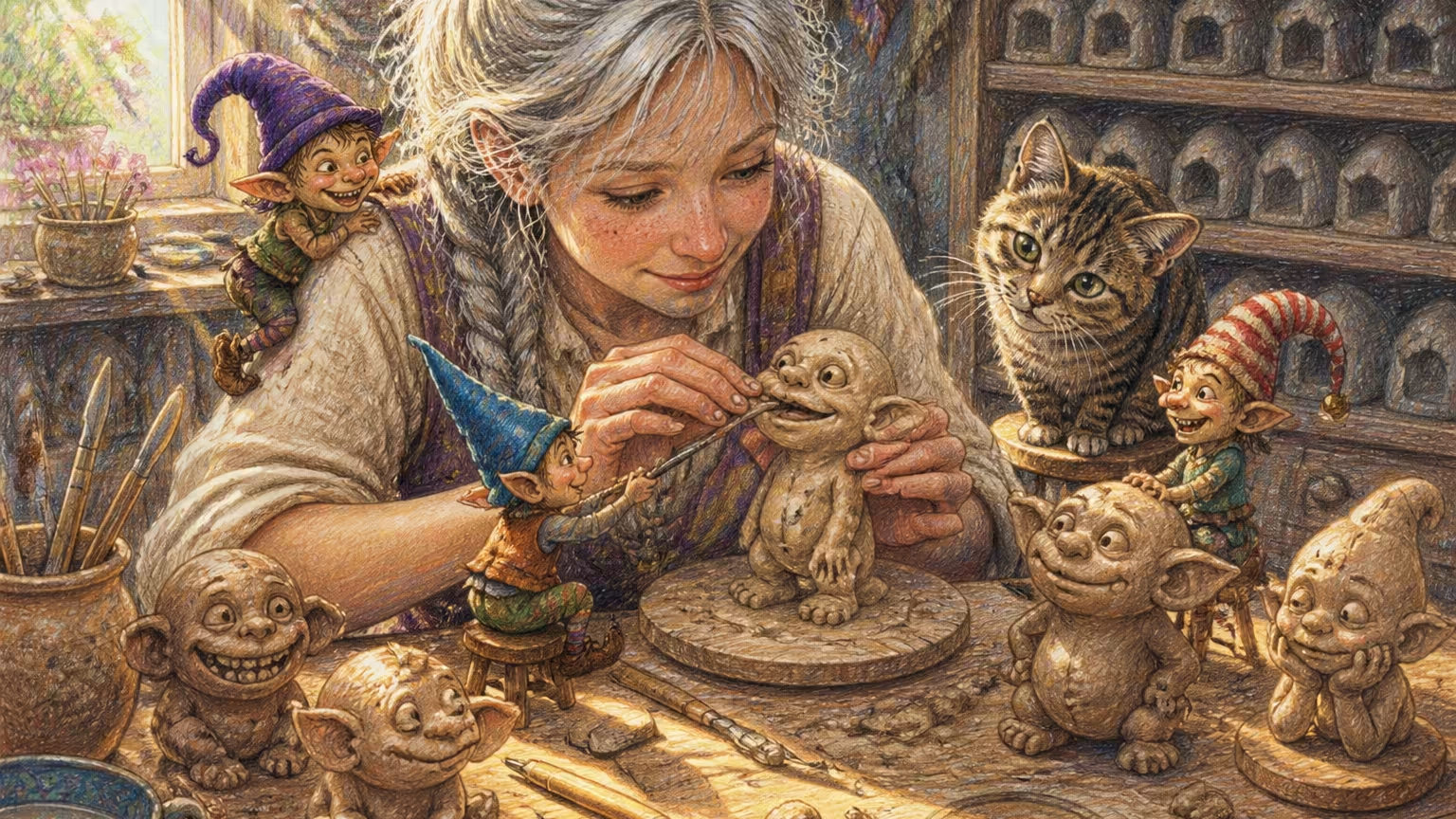
Process: Each piece is shaped from scratch. With your hands. Without physical guides. Every time from the beginning.
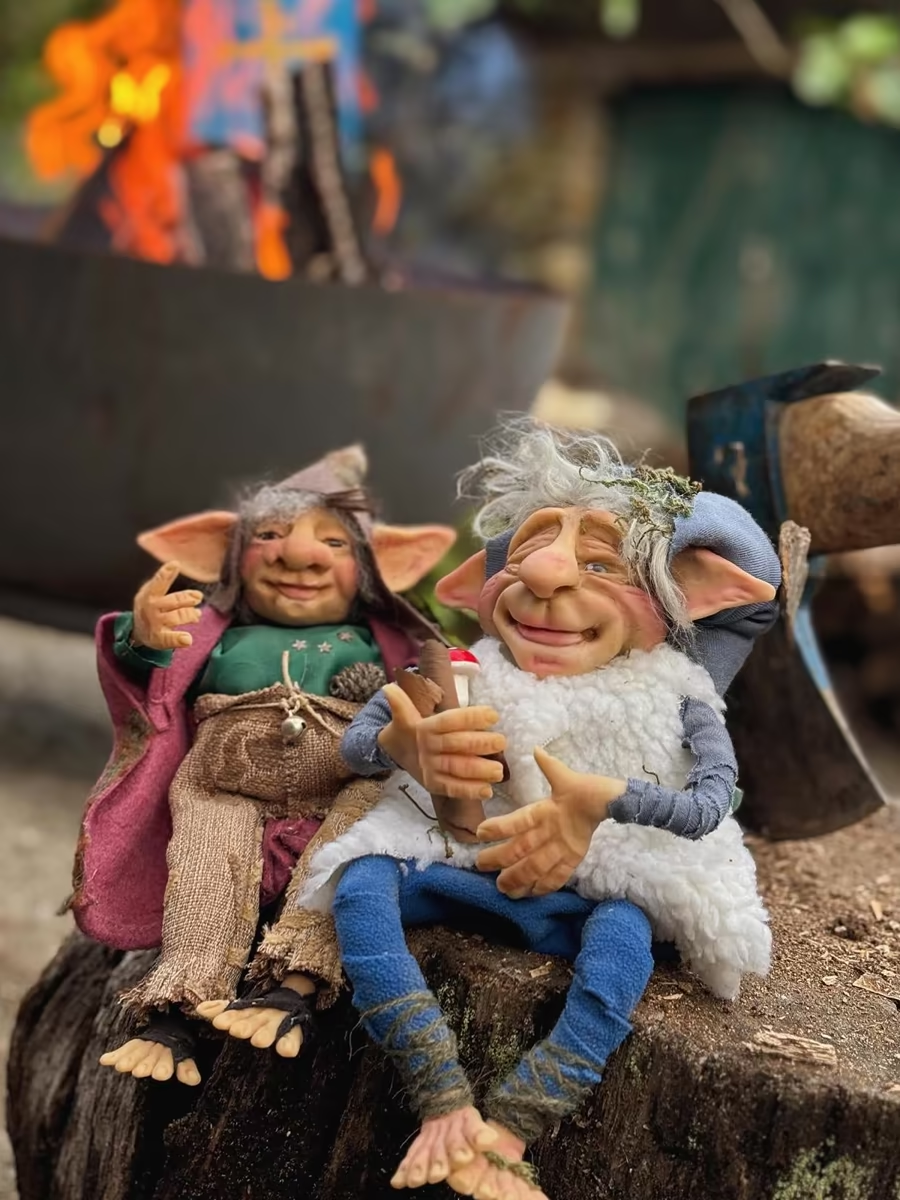
Result: Each piece is different. Even if you try to make "the same one", it never turns out exactly the same. The human hand doesn't repeat itself exactly.
Time per piece: Hours for each one, because each one starts from scratch.
What's so special about making them without molds?
1. Each piece is the original
A figure made with a mold is a copy. The original (the master mold) exists somewhere, and each figure is a replica.
A figure without a mold is the original. There is no copy. There is no matrix. That piece is born unique and stays unique.
In our case: Each Brownie figure is shaped by hand from scratch. No mold in between. Each one is THE original piece, not a copy of anything.
2. Their own personality
Molded figures have identical expressions. Two from the same model have the same face, the same posture, the same smile.
Figures without molds have their own personality. A Brownie might have one eye a tiny bit bigger. Another, a cheekier smile. Another, a more relaxed posture.
They're not "flaws". They're unique traits that only appear when hands create without guides.
In our case: Two Magikitos with the same Chispa are never the same. Each one has their own expression, their own character, their own vibe. If you want to check, look at the Brownie family and compare faces.
3. Each piece is a complete creative act
In art, an original painting is not the same as a print. A handmade instrument is not the same as a mass-produced one.
The same goes for figures:
- With mold: It's designed once and then reproduced.
- Without mold: It's created anew each time. Each piece is a complete creative act.
It's not that molded figures have no value. They do, and there are people with a lot of talent behind a good mold. But a hand-shaped piece carries something inside that can't be reproduced: that specific moment from those specific hands.
4. A deeper connection
When you know a figure is one of many copies, it's nice, but it's interchangeable.
When you know a figure is unique in the world, things change. There is no other like it. There never will be.
That difference matters more than it seems. What we know is unrepeatable, we look at with different eyes and care for with different hands.
5. Imperfections that are a signature
Molded figures have manufacturing "imperfections" (air bubbles, seam lines, burrs). They try to hide them.
Figures without molds have hand imperfections: subtle asymmetries, organic textures, natural variations. They are celebrated.
The difference: a factory imperfection is a flaw. A hand imperfection is a signature.
In our case: The wabi-sabi philosophy celebrates exactly that. They're not mistakes. They're proof that something was made by hands with intention.
What it costs to shape without molds
Making figures without molds is slower and harder, and it shows in everything:
Time per piece
With mold: The heavy lifting is done once, in the mold.
Without mold: The heavy lifting is done every time, in each piece.
Skill
With mold: You need to know how to work the mold, paint, and finish.
Without mold: You need to master form, proportions, and texture without any guide.
Pace
With mold: You can make many pieces in a short time.
Without mold: Few come out, and each at its own pace.
Risk
With mold: If a piece goes wrong, the material is lost.
Without mold: If a piece goes wrong after hours of work, those hours are lost.
That's why, when someone sells hand-shaped figures, it makes sense that they cost more than molded ones. And that's why we're a bit suspicious when a complex "handmade" figure costs the same as a bazaar one.
How to tell if a figure is made without molds?
Some people say "handmade" and use molds. Here's how to spot it:
Signs that there ARE molds:
- Identical pieces in photos: If you see several figures with exactly the same expression and posture, there's a mold.
- Visible seam lines: Where the mold closes, it sometimes leaves subtle lines.
- Piles of identical pieces: If someone has dozens of the same model waiting, they use molds.
- Very low prices for something complex: The math for a detailed hand-shaped figure doesn't work out to bazaar prices.
- Immediate restocking: If there's always more of the same, it's being reproduced.
Signs that there are NO molds:
- Each piece is different: Varied expressions, unique postures, slightly different proportions.
- Few pieces and each with its own name: Indicates handwork.
- Long timelines: What's made from scratch doesn't appear overnight.
- The maker says it clearly: "Each piece is shaped by hand without molds" is a statement that matters, and usually comes with process photos.
In our case: Look at the profiles of the handmade Brownies. You'll see that no Magikito is the same as another. That's the immediate visual proof.
Detailed comparison
| Aspect | Without molds | With molds |
|---|---|---|
| Uniqueness | Each piece unique, unrepeatable | Multiple identical copies |
| Creation time | Hours in each piece | Little per piece, once the mold is made |
| Skill | Modeling without guides, years of practice | Reproducible technique |
| Personality | Each with its own expression | All with the same expression |
| Nature | Original | Copy of a master mold |
| Imperfections | From the hand, celebrated | Manufacturing, hidden |
| Pace | Few pieces, each in its own time | Many pieces in a short time |
When a molded figure makes sense
Let's be fair. Molded figures have their place and are great if:
- The budget is tight: A well-made molded figure can be gorgeous.
- You need identical pieces: For some project that requires uniformity.
- You're just looking for something pretty to decorate: No further ambition, and that's perfect.
- It's for little ones who play rough: Something sturdy and replaceable is better.
When it's worth seeking one without molds
Hand-shaped figures without molds are for you if:
- You value real uniqueness: You want something nobody else has.
- You appreciate artisan work: You understand and respect the hours behind each piece.
- You're looking for connection: You want an object that tells you something every time you look at it.
- You gift with intention: You're looking for something meaningful, not generic.
- You love small art: For you, this is art, not shelf filler.
What only a figure without molds gives
- Absolute uniqueness (no two are alike)
- Being the original, not a copy
- Its own personality in each piece
- Imperfections celebrated, not hidden
- The mark of specific hands
Why we keep shaping by hand
We'll tell you straight, that's how we like it: Magikitos are not for sale. Our figures are made out of love for the art, one by one and without molds, and here we show ourselves so you can get to know us. Nothing is rushed, and it shows in every little face.
In a world that's increasingly automated and full of copies, pieces created by hand without molds are one of the few things left that can't be repeated. They're proof that hands, with patience and desire, make things no mold can replicate: personality, soul, true uniqueness.
And if one day you come across such a figure at a fair, a flea market, or someone's workshop, look at it slowly. That piece only exists once.