Did you know mushrooms have their own internet underground? Wild, right?
But hang on, it goes way deeper than that. The link between mushrooms and Brownies isn’t some cute aesthetic choice. It’s not just because they look great in photos, and it’s not because someone randomly decided it “felt magical” one day. This pairing shows up in cultures all over Europe, has thousands of years of story behind it, and modern science is backing it up in ways that honestly make your jaw drop.
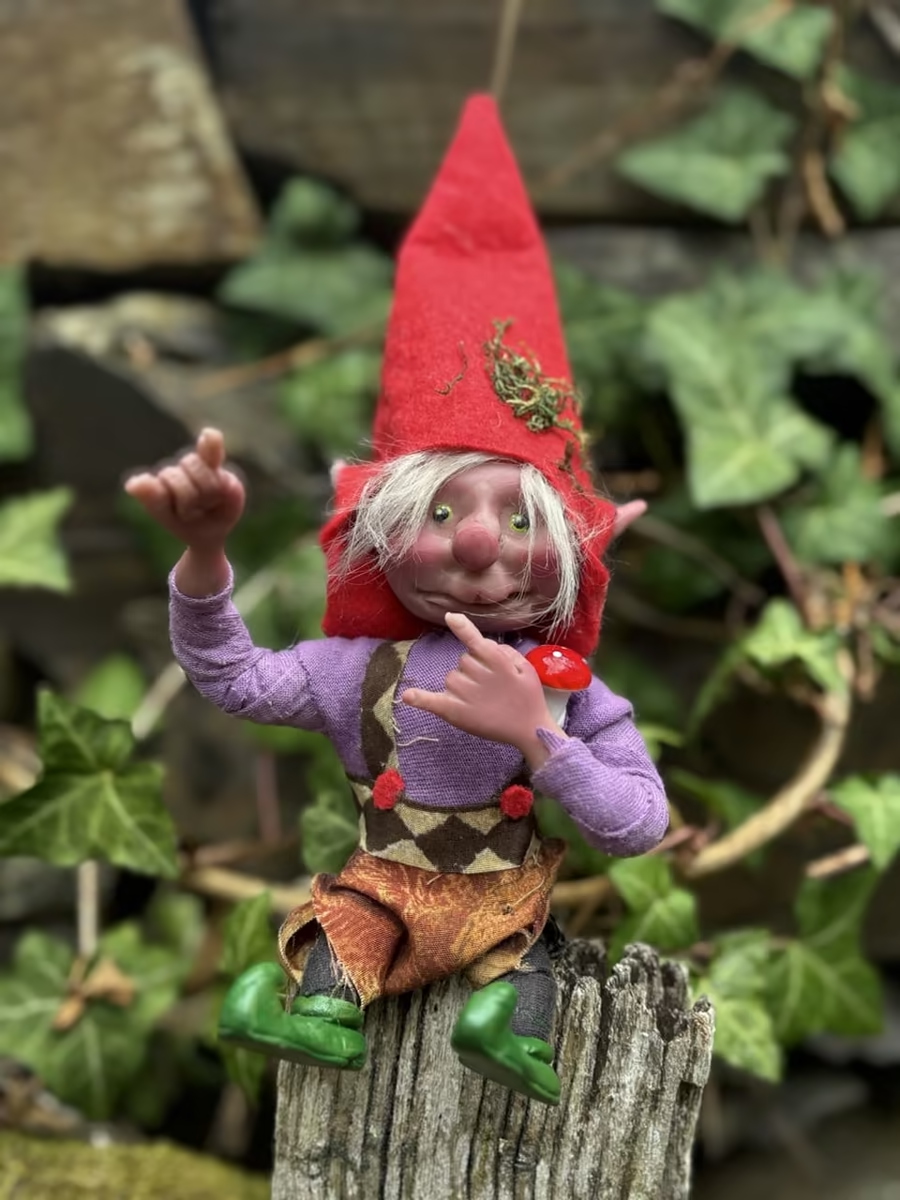
So today we’re telling you why Brownies and mushrooms always stick together. And why Magikitos wear them like a little badge of honour.
What are fairy rings, and why do they matter?
If you’ve ever walked through a forest and spotted a perfect circle of mushrooms popping up from the ground, you’ve found a fairy ring. In German they call them “Hexenringe”, witch rings. In French, “ronds de sorcières”. Different names, same vibe: that circle was not “normal”.
The real explanation is biology, and it’s kind of beautiful. A fungus grows underground in a circle, spreading out from a central point year after year. The mushrooms you see are just the “fruit” of that invisible organism. The mycelium underneath can be decades old, even centuries.
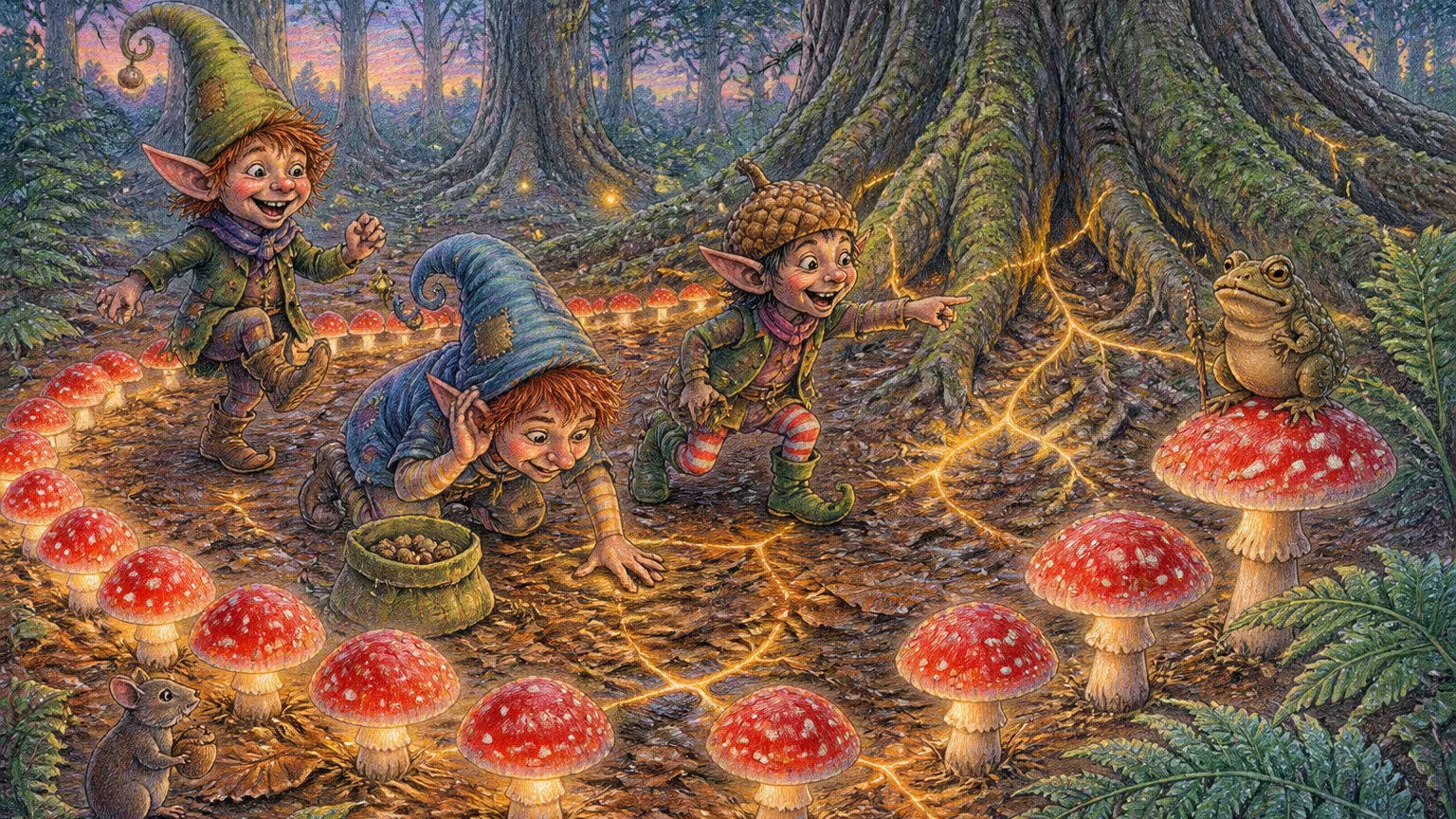
But folklore had its own answer. Fairy rings were where Brownies, Fairies, and forest spirits danced at night. And mushrooms grew wherever their feet had been.
In Scotland, stepping into a fairy ring was risky business. You could end up dancing for a hundred years and not even notice. In Germany, walking across a Hexenring meant bad luck. In Scandinavia, those circles were doors to other worlds. And in Asturias, they were the spots where the Trasgu and their friends threw their parties.
What nobody dared to do was mess with a fairy ring. No pulling mushrooms, no stomping the circle, no building on top of it. Doing that meant you’d insult the forest creatures. And trust me, that was a terrible idea in any century.
Amanita muscaria: the ultimate Brownie mushroom
When you picture a “magic mushroom”, you’re probably thinking of that red cap with white dots. You’ve seen it in storybooks, games, illustrations and, of course, in Brownie imagery. That’s Amanita muscaria. And its story is a ride.
Amanita muscaria is toxic. Usually not deadly, but it is psychoactive. And that’s where things get properly interesting.
In Siberia, shamans used it in rituals for thousands of years. Vikings may have used it before battle too, that’s the famous berserker theory, although people still argue about it. And in European folklore, Amanita muscaria was the mushroom of Fairies and Brownies. It grew where they lived, marked their territory, and worked like a little flag.
“Amanitas here, Brownies here. Don’t mess with it.”
The connection got even stronger in Victorian times, when British illustrators kept drawing Fairies and Brownies perched on Amanitas or using them like tiny umbrellas. Those images stuck in the popular imagination. And today, well over a century later, we still see red-with-white-dots and think, “forest magic lives here”.
But the idea didn’t start in the Victorian era. It’s much older than that. It comes from people who watched the woods closely and noticed that where certain mushrooms grew, the forest felt different. More alive. Greener. Like it was keeping a secret.
Toadstools: when the toads get involved
In English, a lot of mushrooms get called “toadstools”. Why? Because in British folklore, toads were companions of witches and Brownies, and mushrooms were basically their little seats.
Picture it: a misty forest, a toad sitting on a mushroom, a tiny Brownie hiding just behind it. That’s classic British folklore. Toads, like mushrooms, seem to appear out of nowhere. They love damp, shady places. And let’s be honest, they’ve got that face that makes you think, “Yep. There’s magic involved.”
This toad-mushroom-Brownie link shows up in medieval manuscripts, folk songs, and old home remedies. “If you find a toad next to mushrooms, don’t touch anything, someone lives there.” That was plain common sense in rural England back in the 1400s.
Mushrooms in Celtic lore: doorways between worlds
For the Celts, the world came in layers. The visible world, ours. The underworld, where the dead and spirits lived. And the in-between world, that liminal space where normal life and magic brush shoulders.
And what grows right in that in-between space? Mushrooms. Not fully above ground, not fully below. They’re the visible fruit of something invisible living underneath. They are, literally, a connection between two worlds.
The Celts saw them as doors. Messengers. Signs that something was happening in the world we can’t see. Where mushrooms grew, the veil between worlds was thinner. That’s why Brownies, Fairies, and spirits gathered there.
That Celtic idea spread across Western Europe and it’s still alive today in the oral traditions of Ireland, Scotland, Wales, Brittany, Galicia, and Asturias. Celtic lands, all of them. Lands of mushrooms and Brownies.
The forest’s underground internet
Now here comes the bit that’ll glue you to your chair. Because modern science has found something Brownies have always known.
Under the ground in basically any forest, there’s a massive fungal network called a mycorrhizal network. The mycelium, the fungus “roots”, connects with tree roots and creates an underground communication system scientists nicknamed the “Wood Wide Web”. Yep, the forest’s internet. (Moss does something similar, quietly holding things together.)
What does this network do? Stuff that’s honestly mind-blowing:
- Trees share nutrients with each other. A big, healthy tree can send sugars to a younger tree stuck in the shade that needs a boost. Through the fungi.
- They warn each other about danger. If one tree gets attacked by insects, it sends chemical signals through the fungal network so nearby trees can switch on their defences.
- Mother trees look after their kids. Older trees recognise their seedlings and send them more nutrients than they send to unrelated trees.
- One single fungus can connect hundreds of trees. The network is huge, complex, and alive.
So yeah: under your feet, in any forest, there’s a living communication network linking everything in the ecosystem. Trees “talk” to each other. Through fungi.
When old stories said Brownies lived beneath mushrooms because they could “run the forest” from there, they weren’t totally off. Mushrooms are, literally, the nodes of a network that keeps the whole forest alive.
If that’s not magic, let a Trasgu come down and see it.
Mushrooms and moonlight: the cycles that tie it all together
There’s one more detail that’s just gorgeous. Mushrooms grow in cycles. They show up after rain, pop overnight, don’t last long, then vanish again. Like the moon, waxing, glowing, and waning.
In lots of European traditions, Brownies follow lunar cycles too. More active under a full moon, quieter at new moon. And mushrooms, their little sidekicks, sprout in sync with the humidity and temperature the moon nudges around, through atmospheric tides.
Brownies, mushrooms, and the moon. A trio that keeps showing up in folklore. Three things that move in cycles, hide and reveal themselves, feel fleeting and eternal at the same time.
So why do Magikitos wear mushrooms?
By now you’ve got it, right? The mushrooms Magikitos wear aren’t just decoration or a random whim. They’re tradition, science, and identity. All rolled into one.
Magikitos wear mushrooms because they’re forest creatures. And in a forest, mushrooms are the quiet companions that connect everything. They’re the neighbours that warn you, the friends that share, and the guardians of the soil.
Every Magikito carrying a mushroom is carrying a tiny piece of that invisible network that keeps the woods alive. It’s a reminder that the most important connections are the ones you can’t see. That what’s happening under the surface matters just as much as what shines on top.
And okay, yes, they’re also very cute. We’re not going to pretend otherwise.
Wild facts for your next forest walk
Next time you’re out walking and you spot mushrooms, remember this:
- What you see above ground is only about 5% of the organism. The other 95% is underground, invisible, working away.
- Some fairy rings are over 700 years old. Older than most European cathedrals.
- A single gram of forest soil can hold up to 200 metres of mycelium. Two hundred metres in one gram. Now imagine the whole forest.
- Mycorrhizal networks don’t just connect trees of the same species. They link oaks with birches, pines with beeches. The whole forest is a community.
- Fungi existed before land plants. They’ve been on this planet for more than a billion years. Older than dinosaurs, older than flowers, older than us.
The Brownies, the Magikitos, knew all of this long before scientists put names to it. They lived among mushrooms because they understood where the forest’s real magic sits: not in what you can see, but in what’s connected underneath.
A lesson we could all use, don’t you think?