Right, so. We need to talk about something.
Every family has that one branch nobody quite mentions at Christmas dinner. The cousins who went off and did something wildly unexpected, and now everyone acts like they live in a parallel universe.
We have those. They're called the Latin American duendes. And they chose the jungle.
While we Brownies were perfecting the art of redistributing your house keys and establishing ourselves as guardians of the cosy living room, a whole other branch of the goblin family was developing something far more dramatic. They moved into the rainforest. They started calling children by name from riverbanks. They became something nobody's gran would leave a bowl of cream out for.
Same family tree. Very different career choices.
How did goblins end up in Latin America in the first place?
On boats. As most things in the sixteenth century did.
When Spanish colonisers arrived in the Americas, they brought their whole imaginative vocabulary with them, including the word "duende". As we've explored in the origin of the Brownie name, every European goblin tradition comes with an etymology that tells you exactly what it is: a house guardian, a threshold creature, a keeper of inside spaces.
But the word "duende" didn't arrive into a blank space. It landed slap in the middle of rich indigenous traditions that already had their own creatures to explain the scary things at the forest's edge, the children who wandered too far, the hunters who came back wrong. The Spanish word and those traditions collided, and what came out the other side was something genuinely new. A loose cannon of a creature, if you're being honest, with no particular interest in your sock drawer.
So who exactly is the Latin American duende?
Not the cosy living-room sort, put it that way.
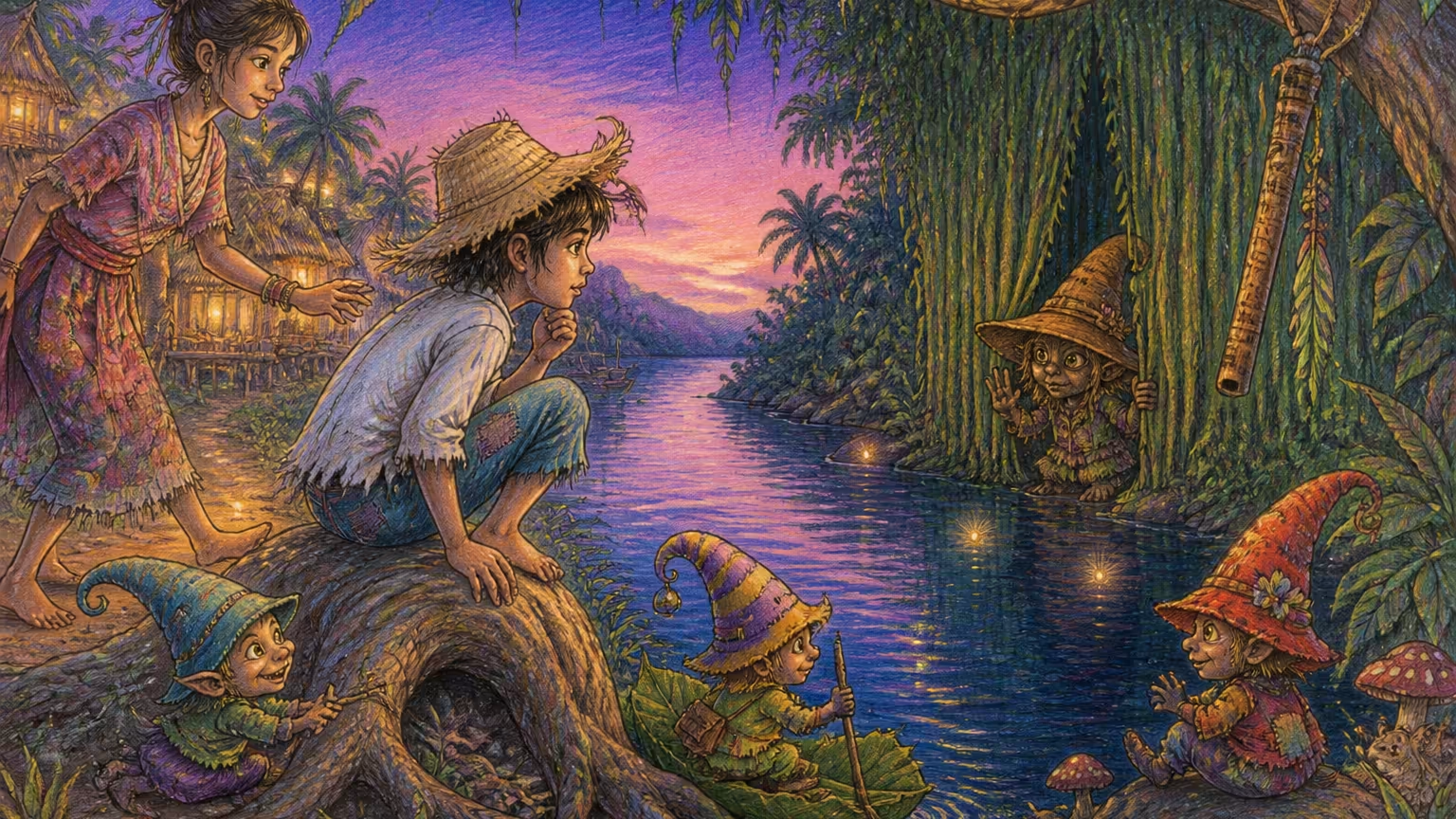
The Latin American duende lives near rivers, at the edge of forests, deep in the wild. Small, yes, but not the endearing small you might be imagining. Think small with an enormous hat and a face that suggests it's quietly nursing a grudge about something you haven't done yet.
Across Colombia, Peru, Ecuador, Venezuela: the duende appears near water. It calls children by their names from the riverbank. It lures anyone who wanders off from the group. Then it disappears with them into the forest. Not decorative folklore at all. This is a warning system handed down across generations: don't wander off alone at dusk.
There's also the musician version. All across Latin America, there are legends about the musician who gets lost in the wilderness and comes back playing like they've been touched by something no conservatory can teach. The duende as feral creative force. We understand that angle completely. The child-luring angle is where the family resemblance ends.
The core difference from us: the Latin American duende isn't a guardian of the inside. It's a guardian of the outside. The threshold between the known world and everything beyond the last house. We keep watch from within. They keep watch from without.
Why is the Latin American duende so different from European goblins?
Because the spaces are different, and so are the things that need protecting.
European Brownies grew up in a world where the real dangers lived indoors: harsh winters, famine, mysterious fevers. So naturally we became guardians of the hearth. The whole history of it is in our look at household Brownies across Europe.
Latin America was something else entirely. The forest was genuinely infinite. The rivers genuinely treacherous. Indigenous cultures had already developed spiritual beings for those outer spaces, beings that governed the boundary between the familiar and the terrifyingly unknown. When the Spanish word arrived, it found that mould and took that shape. Not a collision. A fusion. One that has, looking back, a rather elegant logic.
The chaneque: the goblin who was there before the word arrived
In Mexico, there's a creature that predates the Spanish arrival by centuries and yet slotted right into the duende category once the word arrived: the chaneque.
The chaneque comes from Nahuatl cosmology. A small being, guardian of wild animals, inhabitant of rivers and forests. When someone was badly frightened in the wild and fell mysteriously ill, the diagnosis was that the chaneque had stolen their susto, their fright. The soul had been separated from the body by the shock of it, and was now wandering lost until a curandero could bring it back.
Susto, in Mesoamerican traditional medicine, is a real illness. Diagnosed. Treated by specialists. The chaneque is its most common supernatural cause.
When Spanish colonisers arrived with their "duende", Nahuatl communities recognised the same figure wearing a different name. The two words started being used interchangeably, because folkloric logic is precise like that when it wants to be. Today the chaneque is the Mexican duende, and the Mexican duende is the chaneque. The etymology goes full circle in a way that fills us with a family pride that's genuinely difficult to explain.
Do we get on with them?
We don't see them often, if we're being straight. We live in your living rooms. They live in the Amazon rainforest. The commute would be a bit much.
But we share something that goes beyond etymology. We're both threshold creatures. Both of us live in the gap between what you see and what you sense but can't quite point to. Both of us make the everyday world slightly less predictable than you thought it was going to be.
Them from the forest edge. Us from the sock drawer.
Same family. Different assignments. Which is, when you think about it, not so different from how most human families work.