Why there are seashells on top of some mountains

Science bite

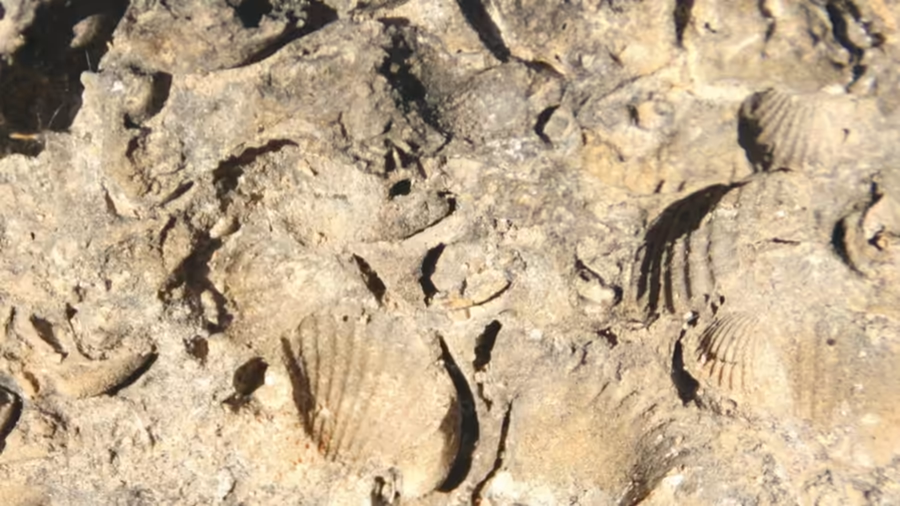
This morning, while we were hiking up the mountain, we spotted a tiny shell stuck in a rock, like finding a forgotten flip-flop in the middle of a meadow. And obviously we all looked at each other and went: “Wait, what is this doing up here, mate?”

The answer is as mind-blowing as it is real. Because where you’re huffing and puffing up the slope today, millions of years ago there were fish swimming around and little critters living their best life under the water.

So what exactly is a fossil?

A fossil is like a 3D snapshot nature took of a living thing from forever ago. Picture a shell sinking to the seafloor and getting covered by layer after layer of sand and mud. Over time, the original shell disappears, but it leaves a perfect mold behind. Then minerals from the ground fill that space until it turns into stone with the exact same shape. It’s like the sea packed a little cookie into a rock Tupperware for millions of years, just so you could stumble upon it today.
How did the ocean floor climb all the way up to the clouds?

To get it, think of Earth’s crust like a puzzle made of gigantic pieces that move with a patience that drives you mad. Sometimes two of those pieces crash into each other so hard that the ground has no choice but to crumple upward. It’s exactly what happens when you shove a rug against a wall: a bump forms and keeps rising into a little ridge. That “wrinkle” in the plates that make up Earth’s surface is what lifted ancient seabeds until they became mountain peaks thousands of meters high.

Is it easy to spot fossils in Spanish mountains?

In Spain we’re pretty lucky, we’ve got open-air geology museums all over the place. In the Pyrenees, the Baetic Systems, or the Cantabrian Mountains, it’s super common to be walking a trail and suddenly see sea snails or corals stamped right into the rock. It’s not that someone carried them up there to look cool, it’s the planet doing DIY on an epic scale. It’s proof that the landscape you see today hasn’t always looked like this, and that the Earth has way more memory than it seems.

Magikitos’ take: if today you feel out of place, remember the shell on the mountain. Maybe you’re not in the wrong spot. Maybe you’ve climbed far and high, but you still carry inside you all the strength of the sea from where you began.

Concheros: when clam scraps turned into a history archive

History

There are piles of shells that have nothing to do with a romantic beach stroll. They are the after-dinner leftovers of whole centuries. Along many coastlines, especially in the north of the Iberian Peninsula, you can find concheros. These are huge accumulations of shells and shellfish remains left behind by human communities for generations. Basically, it is like the sea has been keeping a historic shell bin that spills all the tea about how our ancestors lived together.

So what exactly is a conchero?

Picture an ancient dump, but packed with seriously good info. A conchero is not just a heap of empty shells. It is a deposit where clams, mussels, fish bones, fireplace ash, and stone tools all get mixed together. It is the real record of what people ate in prehistory, how they cooked it, and whether they threw big feasts or went through lean times. It is like reading a family diary through whatever they tossed out after dinner.

Why are archaeologists so obsessed with shells?

The cool thing about shells is that they are tough as rocks and they preserve beautifully for thousands of years. Thanks to them, scientists can figure out which species people collected, whether the sea was colder or warmer than it is now, and even if they were overharvesting small ones. On top of that, these heaps often hide traces of everyday life: fire spots for warmth and tools that show the sea was not only food. It was their calendar and their whole way of living.

In places like Cantabria, Asturias, or the Tagus Valley in Portugal, these concheros are proper libraries made of mud and mother-of-pearl. They show us those humans were absolute pros at making the most of whatever the sea gifted them with each moon. In the end, those mountains of leftovers prove that history was not only written by kings. It was also written by regular people sitting by the waves, shucking oysters and peeling limpets.

Magikito moral: what you call “leftovers” today is sometimes what tells the truest story of who you really are. Take care of the small and everyday stuff, because in the end life gets remembered for the same little shells day after day, not for one-off fireworks.

Sailor-Style Clams

Magical recipe

Today we’re cooking in imaginary Cantabrian coast mode, with a sauce so good your bread starts spelunking around the plate. Sailor-style clams are pure tradition, straight from a harbor bar and the classic “hush and dunk”, but brought into the forest with loads of spark.

Ingredients:

  • 800 g clams (fresh, alive, and ready to open up to the world)
  • 2-3 garlic cloves (so the sauce has attitude, without slapping you in the face)
  • 1 small onion or 1/2 a big one (whichever is giving you “use me now” vibes)
  • A good bunch of parsley (the green that turns into a wave)
  • 150 ml white wine (one you’d actually drink, not one that tastes like punishment)
  • 1 heaped tablespoon of flour (to bring the sauce together, not turn it into cement)
  • Extra virgin olive oil, salt, and pepper
  • Optional: a tiny bit of chili (if you want the tide a little wilder)

Method:

First, soak the clams in salted water for a bit so they let go of any sand. It’s like asking them to shake their shoes out before coming into the house. Then rinse them well.

In a large pan, pour in a generous glug of oil and gently cook the onion and garlic, very finely chopped, over medium heat until soft and smelling like “yep, real cooking happens here”. If you’re adding chili, now is the moment.

Add the flour and stir for a minute so it toasts just a touch. Pour in the white wine and keep stirring so you don’t get lumps. You’ll see the sauce come together, glossy and basically begging you to eat it.

Add the clams, cover, and turn the heat up a little. They’ll open in 2-4 minutes. As soon as they’re open, turn it off or down. If you overcook them they go chewy and then they complain inside your mouth.

Finish with lots of parsley, pepper, and a salt check. And now comes the solemn moment: send in the bread.

Forest tip: if a clam doesn’t open, it’s not shy, it’s suspicious. Don’t eat that one. And if the sauce turns out so good you feel like applauding, go on and clap. We don’t judge people who enjoy life around here.

How to hunt clams and coquina clams, the art of reading sand like it’s a WhatsApp chat

Curiosity

Some people look at the shoreline and see “sand”. And then there’s the shellfishing crew, who look at the exact same sand and go, “yep, there’s a dinner hiding under here that’ll hit different”.

Looking for clams and coquina clams (those tiny, delicate little beach clams) is like playing “Where’s Waldo?” but with little waves and fingers going numb.

What signs does a clam leave in the sand?

One of the classic clues is a tiny little hole, or two, or a mini “8” shape. Lots of clams have siphons (like little straws) to breathe and filter water, and that leaves marks. It’s like when you pull the straw out of a soda and you get that little circle in the foam. Same vibe, but ocean edition.

Why do more clams show up at low tide?

Because when the tide is out, areas get exposed where they’re buried just a few centimeters down. That’s when the ground basically opens up and you can search without fighting the waves. The tide is the sea’s supermarket schedule. If you show up when it’s closed, you just get water and frustration. So yeah, you know what they say, the early bird gets a little help from the sea!

And coquina clams are often right in that strip where the waves break softly. Some people use their hands or a small rake and go slow, like they’re combing the sand. You just need patience and a sharp eye. This isn’t about brute force, it’s about keeping your wise grandma sensor fully switched on.

Magikita conclusion: some days life hides like a clam. You don’t pull it out by yelling. You get it by reading the tiny signs, waiting for low tide, and putting your hands where you need to, with zero “ew” energy.

The Know-It-All Clam and the Hiking Shell

Joke of the day

In a clearing in the woods, we spot a seashell perched on a rock, staring at us like it took the cable car up.

We go, “Wait… what are you doing up here, bestie, you’re literally a beach creature?” And the shell goes, “I came to breathe some fresh air, down on the coast there’s way too much sand and way too many ‘well, actually’ dudes.” Then a clam shows up with full-on teacher face and drops, “That’s not fresh air, that’s plate tectonics, you clueless lot.” We’re like, “Okay, okay… and why do you talk so much?” And the clam goes, “Because if I’m not opening up, at least I’m explaining myself.”

Magikito moral: some creatures open up and some creatures just keep talking, but the important thing is not getting buried in the drama. Today, if you can’t handle it all, at least have a laugh and mop up the sauce with bread, no fear.

Your basket: 0,00 € (0 products)

Your Magic Cart

Your cart is empty. Adopt a Magikito!