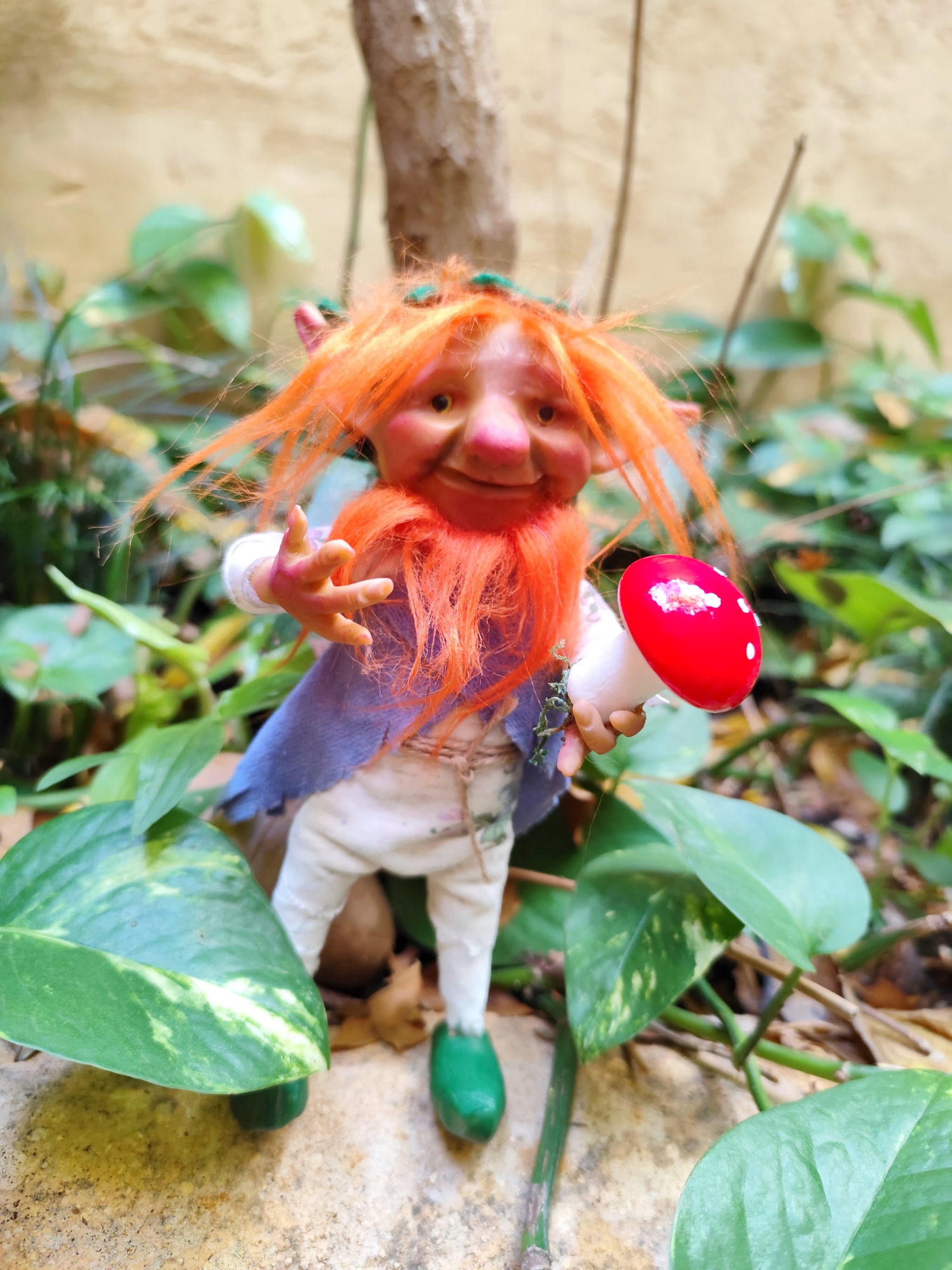
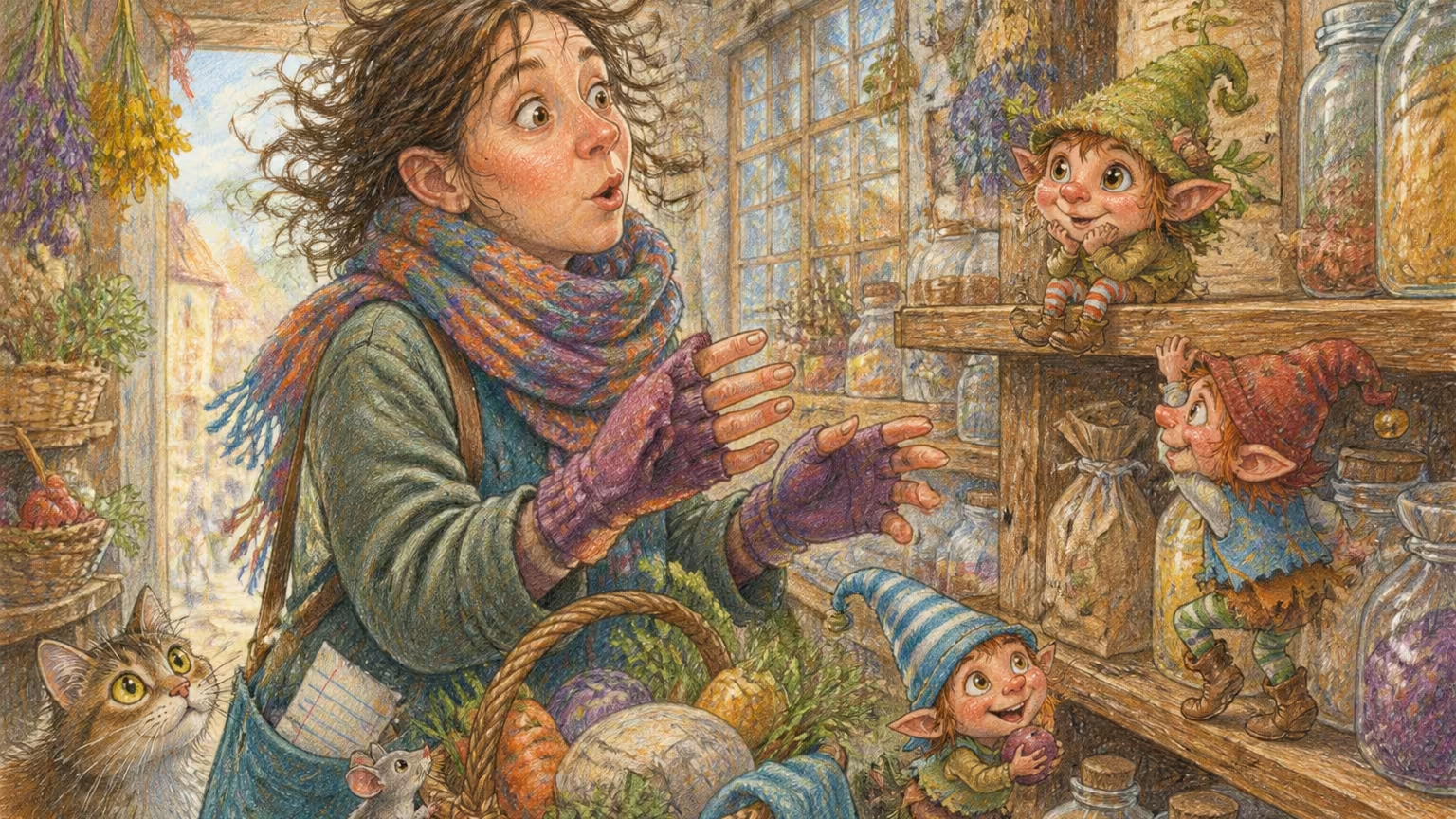
You’re in a shop, you spot a tiny creature with huge eyes and a round head, and your brain goes “oooh” before you can stop it. Your hands drift over on their own. Your voice jumps up a pitch without asking. And for a second, you forget the grocery list, the 5 p.m. meeting, and the fact that the world is complicated.
What just happened? Why can a fifteen-centimetre creature in a moss hat hijack your brain in half a second?
Turns out science has an answer. And it’s kind of amazing.
What is Kindchenschema, and why does it explain everything?
Back in 1943, a guy named Konrad Lorenz published a paper that changed how we understand cuteness forever. Lorenz was an ethologist (someone who studies animal behaviour), and he spent his days watching geese, ducks, and other birds. But what he found applies to all mammals. Us included.
Lorenz spotted a set of physical traits that trigger an automatic adult response: care and protection. He called it Kindchenschema (baby schema). Here’s the list:
- A large head compared to the body
- A wide, rounded forehead
- Big eyes set low on the face
- A small, flat nose
- Round, full cheeks
- A chubby body with short limbs
- Soft skin and a squishy texture
Recognise someone? Yep. That’s basically a human baby. And a puppy. And a kitten. And a baby panda. And a Magikito.
Lorenz showed that these traits flip on an automatic neural circuit. It’s not a choice. It’s not “just a preference.” It’s straight-up biology. Your brain sees Kindchenschema and switches to protect-mode. That’s it. No meeting. No vote.
Why did we evolve like this? The smartest survival trick ever
Human babies are, with all the love in the world, pretty useless. They can’t walk. They can’t feed themselves. They can’t defend themselves. They need constant care for years. And raising a human baby is exhausting, expensive, and all-consuming.
So how did evolution make sure adults didn’t just wander off and leave these helpless little beings behind? By making them irresistible. Literally. Human babies evolved to hit adult pleasure and care circuits automatically. Those big eyes, those round cheeks, that oversized head, it’s not random. It’s a survival hack refined over millions of years.
When you see a face with Kindchenschema traits, your brain releases oxytocin (bonding and care), dopamine (reward and pleasure), and it lowers cortisol (stress). All at once. In milliseconds.
That’s why you can’t help smiling at a puppy. You’re not “going soft.” Your brain has been perfecting the “protect the small” program for ages, and it runs it so fast you don’t even notice.
Kawaii culture: when Japan turned it into a whole vibe
If anyone truly understood Kindchenschema power and turned it into culture, it’s Japan. Kawaii culture (可愛い, “cute” or “adorable”) kicked off as a youth trend in the 1970s, and now it’s everywhere, from Hello Kitty to the signs in the Tokyo metro.
Hello Kitty is a wild case study. Sanrio created her in 1974 with Kindchenschema pushed to the max: huge head, spaced-out eyes, no mouth (so you can project your own feelings), tiny body. And it works. Hello Kitty brings in over 5 billion dollars a year. One of the most profitable brands on the planet. And she does nothing. Literally nothing. She’s just cute.
But kawaii goes way beyond products. In Japan, kawaii is an attitude. Police use adorable mascots in road-safety campaigns. City halls have kawaii characters as ambassadors. Japanese airline safety cards come with sweet little illustrations. The idea is that cute lowers anxiety, boosts attention, and makes people cooperate.
And science backs them up. A 2012 study from Hiroshima University found that looking at baby animals improves focus and performance on precision tasks. People who saw puppy photos before doing a dexterity task did 44% better than those who didn’t. Why? Because cuteness puts you into a careful, attentive state that spills over into whatever you do next.
In other words, looking at cute stuff makes you better at your job. Try that before your next meeting.
Cute aggression: when cuteness spills over
Ever seen something so cute you wanted to squeeze it? Like a puppy or a baby gives you this physical urge to squish, nibble (gently), or cuddle-crush? You’re not weird. It’s called cute aggression, and it’s a real, studied thing.
In 2015, Yale researcher Oriana Aragon showed that cute aggression is an emotional regulation trick. When cuteness hits too hard, your brain balances that intense positive feeling with a response that pulls the other way. Result: you want to squeeze the puppy. Not to hurt it (never to hurt it), but because your feelings need a little pressure valve.
It’s like crying from happiness. Or laughing when you’re nervous. Your brain uses opposite-sign emotions so it doesn’t overload. Cute aggression is your brain going: “This is too adorable, I need to do something with all this or I’m going to pop.”
Neuroimaging studies from the University of California (2018) confirmed that people who feel cute aggression show higher activity in the brain’s reward system and in areas linked to aggression. Both at the same time. It’s a perfectly healthy emotional short-circuit that shows just how strong Kindchenschema is.
If you’ve ever picked up a Magikito and felt an unexplainable need to press it to your face, yep. That’s cute aggression. Your brain juggling a level of cuteness it doesn’t know how to handle any other way.
Why are big eyes the perfect evolutionary trap?
Out of all Kindchenschema traits, big eyes hit the hardest. And for a very specific reason: babies have big eyes.
Human eyes don’t grow much after birth. They’re almost the same size in a newborn as in an adult. But the head does grow. A lot. So on a baby, the eyes take up a huge chunk of the face. And our brain tags that ratio as “baby = protect.”
Now look at Magikitos, they’ve got eyes that are seriously something. And that’s not random, and it’s not just “a design choice.” Those big, shiny, black eyes set in a round little face with a tiny nose switch on the exact same circuit as a newborn’s face. It’s a conversation with hundreds of thousands of years of evolution.
Eye-tracking studies show the first thing we look at on a face (human or not) is the eyes. And if those eyes are extra big, the emotional response ramps up. More oxytocin. More dopamine. More of that bonded feeling.
Anime artists know it. Disney designers know it. And Carmen, when she shapes a Magikito’s eyes just a bit bigger than they “should” be, knows it too. Even if she’s not thinking about Kindchenschema while she’s doing it. She’s just following what feels right. And it turns out what feels right is exactly what evolution wired in.
Beyond cute: why Magikitos go past “adorable”
But Magikitos aren’t only adorable. If they were, they’d be plushies. Or plastic figures pumped out by the thousand.
What makes Magikitos special is that they blend Kindchenschema (the biology of cuteness) with something mass production can’t copy: soul.
Each Magikito is handcrafted. One by one. No moulds. That means each one has a slightly different look, a slightly different smile, a personality of its own. It’s not generic cuteness. It’s specific cuteness. It’s that exact Magikito, with those exact eyes and that exact smile, looking at you and nobody else.
Hello Kitty is adorable, sure, but she’s identical to the millions of Hello Kittys out there. A Magikito is adorable and it’s the only one in the world. That one-of-one feeling is what turns cuteness into connection. You stop seeing “a cute little figure” and you start seeing “my Magikito.”
And that, friends, isn’t Kindchenschema anymore. That’s bond. It’s what happens when a baby stops being “a baby” and becomes “your baby.” Generic cuteness turns into specific love. Biology alone doesn’t cover that. That’s magic.
A little experiment to finish
Next time you see something that feels adorable (a puppy, a baby, a Magikito on a shelf), pay attention to what happens in your body. Don’t judge it. Just watch.
Notice how your face softens. How your shoulders drop. How your voice lifts half a step without you deciding. How your hands want to reach in. How your brain says “oooh” before your mouth can even form it.
That feeling isn’t silly. It’s one of the smartest systems evolution ever built. It’s your body telling you: “Protect this. Care for this. This matters.”
And then ask yourself, what kind of world would this be if we listened to that voice more often? If instead of feeling embarrassed by tenderness, we celebrated it. If instead of treating “cute” like an insult, we treated it like the highest compliment.
Magikitos have it figured out. They’re small, they’ve got huge eyes, they’re squishy, and they’re not embarrassed about it at all. Because they know something Konrad Lorenz proved eighty years ago: tenderness isn’t weakness. Tenderness is one of nature’s strongest forces. It’s what keeps the species alive. It’s what connects people to each other.
And if a fifteen-centimetre little creature in a moss hat can switch all that on just by looking at you from a shelf, then cuteness is, without a doubt, the most underrated superpower in the universe.