Some places hit different the second you arrive. The air feels heavier (the Japanese have a word for it: shinrin-yoku). The light behaves weirdly. Even the silence has texture. Taramundi is one of those places.
It’s not famous. It’s not on the front page of glossy travel guides. There’s no “must-see” monument everyone can point at. And that’s exactly why it’s so special. Taramundi doesn’t need you to discover it. It’s been here forever, doing its thing, not asking for permission or attention.
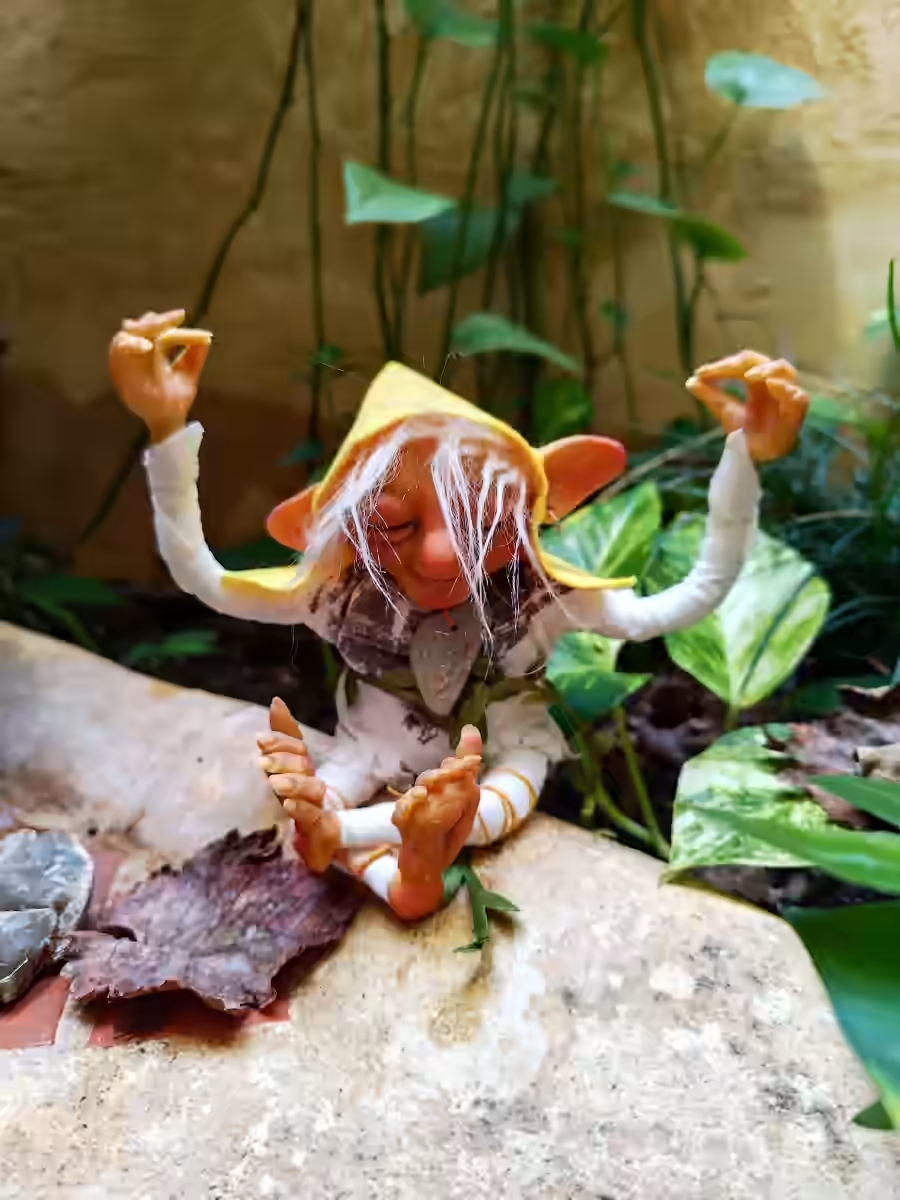
This is where Magikitos are born. And today we’ll tell you why it couldn’t be anywhere else.
What hits you first when you arrive?
The first thing you notice in Taramundi is the fog. Not city fog, the kind that smells like exhaust and puts you in a mood. Taramundi fog is something else. Thick. Slow. With a mind of its own. It slides between the trees like it’s got a plan. It settles on slate rooftops like a blanket. It leaves when it feels like it, not when the sun shows up.
Locals treat it like just another neighbour. “Fog today,” they’ll say as casually as “it’s Tuesday.” No complaints. No cursing it out. They live with it. And that tells you a lot about the people here: they’ve been side by side with nature for so long, the line between one and the other has basically vanished.
That fog is what gives Taramundi its magical vibe. When you walk a path between chestnut trees and the mist wraps around you, you get it. You get why places like this spark so many stories about magical creatures. Brownies, Fairies, all those little “did I just see that?” neighbours of the woods. People didn’t make the stories up. The landscape tells them for you.
Chestnut woods: green cathedrals
Taramundi’s chestnut trees are old. Really old. Some trunks are so wide you need three people to hug them. Their branches form green vaulted ceilings that filter the light and make that shadow-play photographers love. In person, it’s even better.
For centuries, the chestnut tree was the survival tree in northern Spain. Chestnuts fed whole families through winter. The wood did everything: houses, furniture, tools, barrels. Leaves became bedding for livestock. Nothing went to waste. Everything had a purpose.
Walking among these chestnuts is walking through living history. Each tree has watched generations be born, grow up, and move on. Some were already here when the Romans passed through Asturias. Others sprouted when medieval monks were building the area’s first monasteries. They’re wooden libraries, keeping the place’s memory tucked into their rings.
And between those chestnuts, if you pay attention, you’ll spot mushrooms. Moss. Ferns. All the raw material that later shows up in Magikitos. Nothing is invented here. It’s the real forest, carried into a creature made of cold porcelain or soft sheep wool. Every Magikito wears a tiny piece of this woods. Literally.
Knife craft: steel art since the 1600s
Taramundi is, more than anything, a village of knife makers. And this isn’t a tourist fact. It’s the backbone of its identity.
The tradition of handcrafted knife making in Taramundi is documented back to the 17th century, though it’s probably older. The ferreiros (local blacksmiths) forged pocketknives and blades by hand, one by one, using skills passed down from parent to child. Each knife had inlays of wood, bone, or horn, and each one had its own look.
A Taramundi pocketknife isn’t just a knife. It’s a little work of art. The handle gets decorated with geometric inlaid patterns in boxwood or heath, like the maker’s signature. Every knife maker had their own designs. Every knife was recognisable. Every piece told you who made it.
Every figure is different. Patience, attention to detail and the small variations of handwork are part of its character.
There’s a Museum of Knife Making in the village where you can see the whole process, from iron ore to a finished knife. And in some workshops you can still watch knife makers working with the same techniques from three hundred years ago. Not as a show for visitors, but because that’s simply how things are done properly.
Os Teixois: the cleverness of water
A few kilometres from the centre of Taramundi there’s a place that flips your idea of what “technology” even means. It’s called Os Teixois, an ethnographic site of water-powered machinery that’s been running since the 18th century.
Using only the force of a small river, the neighbours built a system that includes:
- A mazo (mazón): A giant wooden hammer powered by water, used to forge iron. No electricity. No engine. Just water and gravity.
- A flour mill: To grind grain. The same river that moved the hammer also turned the millstone.
- A sharpening wheel: To hone the village’s pocketknives and blades. Water made the grinding stone spin.
- A fulling mill: To work wool. Water drove wooden mallets that beat the cloth to thicken and toughen it.
All water. All wood, stone, and iron. All designed to work for centuries with nothing but common sense and care. And it works. Today, in the 21st century, Os Teixois is still up and running. The water still lifts the hammer. The stone still sharpens.
When you see Os Teixois, you understand something about Taramundi: the relationship with nature here isn’t romantic or decorative. It’s practical. The river isn’t just pretty, though it is. The river is power. The forest isn’t just scenery, though it is. The forest is material, food, shelter. Nature isn’t something you stare at from a distance. You use it, you respect it, you look after it, because everything depends on it.
Magikitos inherit that way of thinking. They’re not “nature-inspired” figures like someone slaps a forest photo as their wallpaper. They’re creatures made with nature: real moss, real twigs, real stones. That same direct, practical bond Taramundi has had with its surroundings for centuries.
The people: hands that know
Taramundi has fewer than 700 residents. In a world where cities grow and villages empty out, people still live here. People who chose to stay.
What sets Taramundi folks apart, and you feel it the moment you chat with them, is how they relate to hands-on work. Everyone here knows how to make something. Knives, cheese, bread, baskets, weaving. Not as a weekend hobby. As a way of life.
There’s a dignity to making things by hand that a lot of places have lost. The idea that doing something slowly, with care, matters. That a pocketknife crafted over three days is worth more than a hundred pumped out by a machine in an hour. Not because it costs more, but because it carries the intention of the person who made it.
Mazonos: water mills with stories
Scattered around the outskirts of Taramundi are dozens of mazonos, old water mills once used for everything: grinding grain, sawing wood, forging metal. Some have been restored and still work. Others are mossy, ivy-covered ruins that look like they walked out of a storybook.
Mazonos are solid proof that in Taramundi, craft isn’t some abstract concept. It’s infrastructure. The whole village was built around handmade work. Rivers weren’t scenery. They were the power source that kept the local economy moving.
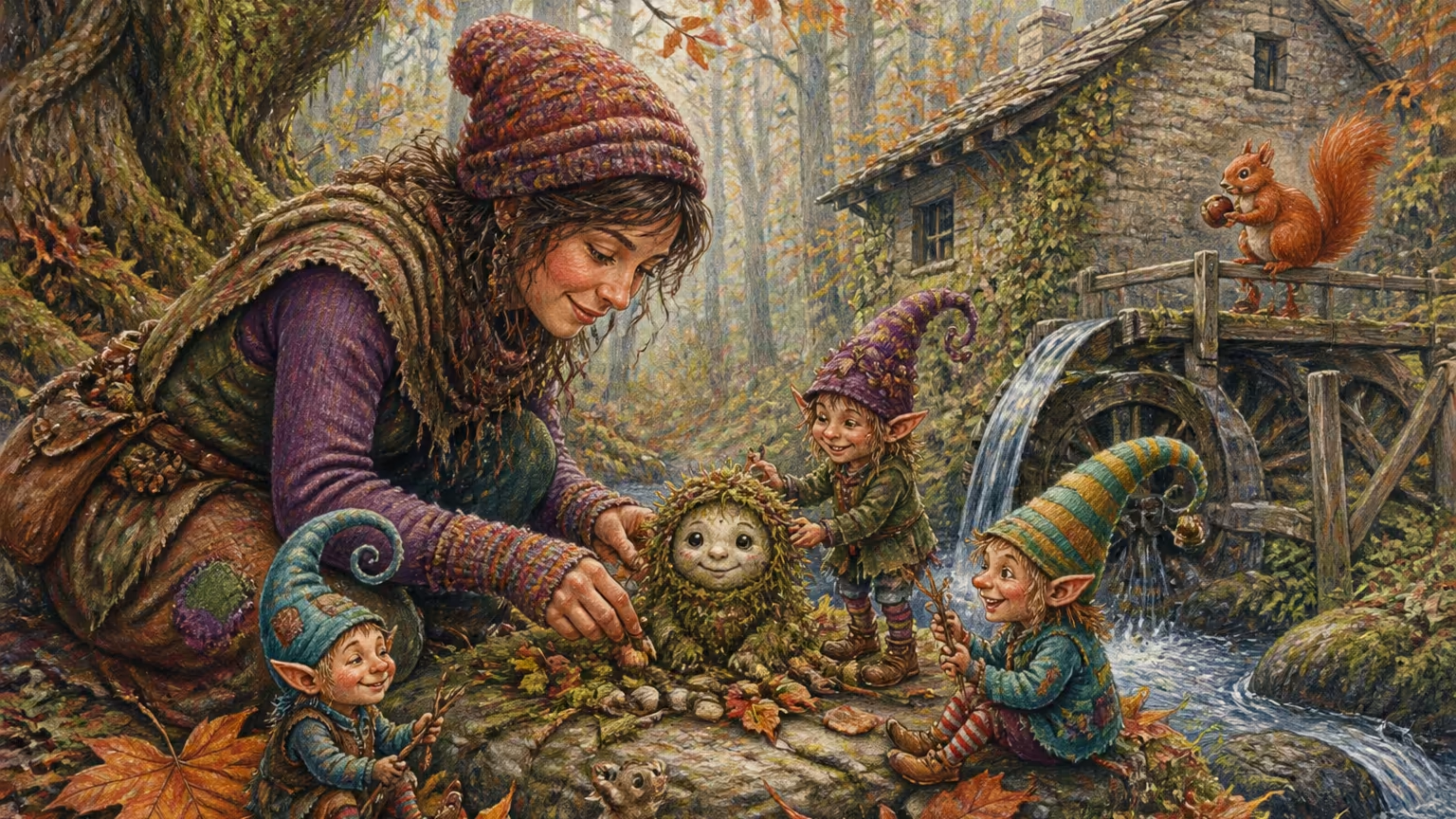
When you wander through Taramundi and stumble on a mazono half-hidden among trees, moss creeping over the stones, water sounding in the background, you get why this place inspires magical creatures. There’s nothing to invent. The place is already magic all by itself.
Autumn in Taramundi: when the magic doubles
If Taramundi is special all year, autumn turns it into something that’s hard to put into words.
The chestnuts go golden. The ground gets carpeted with fallen nuts. Mushrooms pop up everywhere (boletus, chanterelles, saffron milk caps). The fog thickens. The light turns amber. And the smell. Damp earth, decaying leaves, and chimney smoke, it’s the coziest smell on the planet.
In autumn, Taramundi celebrates the amaguesta, the roasted chestnut festival. Bonfires get lit, chestnuts get roasted, cider gets poured, and stories get told. It’s simple, and it’s been done the same way for generations. No fuss, no marketing. Just a village celebrating that the forest fed them for one more year.
Autumn is when Magikitos make the most sense. When you see one with its moss, its little mushroom, and that grin, and outside it’s raining, leaves are falling, and everything smells like the woods, the connection is instant. You don’t need an explanation. You feel it.
Why Taramundi and not any other forest?
Spain has loads of beautiful villages. Loads of corners with nature, craft, and tradition. So why is Taramundi the spiritual home of Magikitos?
Because Taramundi has the three things that define Magikitos, all in one place:
- Real craft. Not postcard craft. Knife making with centuries of history, living techniques, artisans working today the way their great-grandparents did.
- Living nature. Forests that aren’t a backdrop. They’re complete ecosystems with their mushrooms, their moss, their cycles. Nature you use, respect, and care for.
- Everyday magic. A place where fog has a personality, where mazonos still run on water like it’s the 1700s, and where people live with tradition without turning it into a show.
Magikitos are born in Taramundi because Taramundi is what Magikitos stand for: handcrafted, natural, and magical, all together, with no fuss.
A love letter, not a travel guide
We’re not trying to sell you a trip to Taramundi. Though if you go, you’ll love it.
What we’re really telling you is why, when you hold a Magikito in your hands, you’re not holding “just” a porcelain figure. You’re holding a little piece of Taramundi. Its woods. Its fog. Its handmade tradition. Its way of living with nature.
Every Magikito carries moss from the hills. Twigs from the forest. The patience of a village that’s spent centuries making things by hand, slowly, with care. And the magic of a corner of Asturias where time just moves differently.
Some people come to Taramundi for rural getaways. Some come hunting for handcrafted knives. Some simply get lost on the road and end up there by accident.
Everyone leaves thinking the same thing: “This place has something.”
That “something” is what we try to tuck inside every Magikito. We don’t know if we nail it every time. But we try. And Taramundi helps.
Because some places give you more than you ever asked for. And Taramundi is, without a doubt, one of them.