

Picture two neighbours on a shelf. On the left, a hand-modelled woodland fellow who looks as though he has eaten the last biscuit. On the right, a little souvenir from a shop that had dozens just like it. That one reminds you of a lovely afternoon and someone who now lives far away.
Now try deciding which has more “soul”. What a palaver. One is busy with the crumbs, and the other has nothing to prove. There are useful differences to explore without making either of them audition for a place in your home.
Can a handmade figurine also be decorative?
Of course. “Handmade” describes how something is made, while “decorative” describes a use. A handmade figure can decorate a shelf, and a mass-produced one can mean the world to someone. Those are different questions.
What changes during production
Someone modelling each figure shapes its face, posture and details as they work. They can repeat a design, consult sketches and use tools. Working by hand does not mean forgetting everything you have learnt whenever you start another piece.
Other methods use a mould to reproduce a shape. People may still be involved in designing, preparing, painting and finishing the pieces. Understanding the actual process tells you more than imagining an entirely empty factory.
Our article on hand-modelled figures explores that work more closely. There is plenty to appreciate in what someone does without awarding medals based on the name of their technique.
| The term | What it tells you |
|---|---|
| Handmade | A process involving work by hand. The individual steps explain how. |
| Produced in a series | A design reproduced in more than one example. |
| Decorative | A use for the object, compatible with either approach above. |
| Cold porcelain, resin, wood... | Materials, rather than automatic measures of quality or affection. |
Look closely at the work
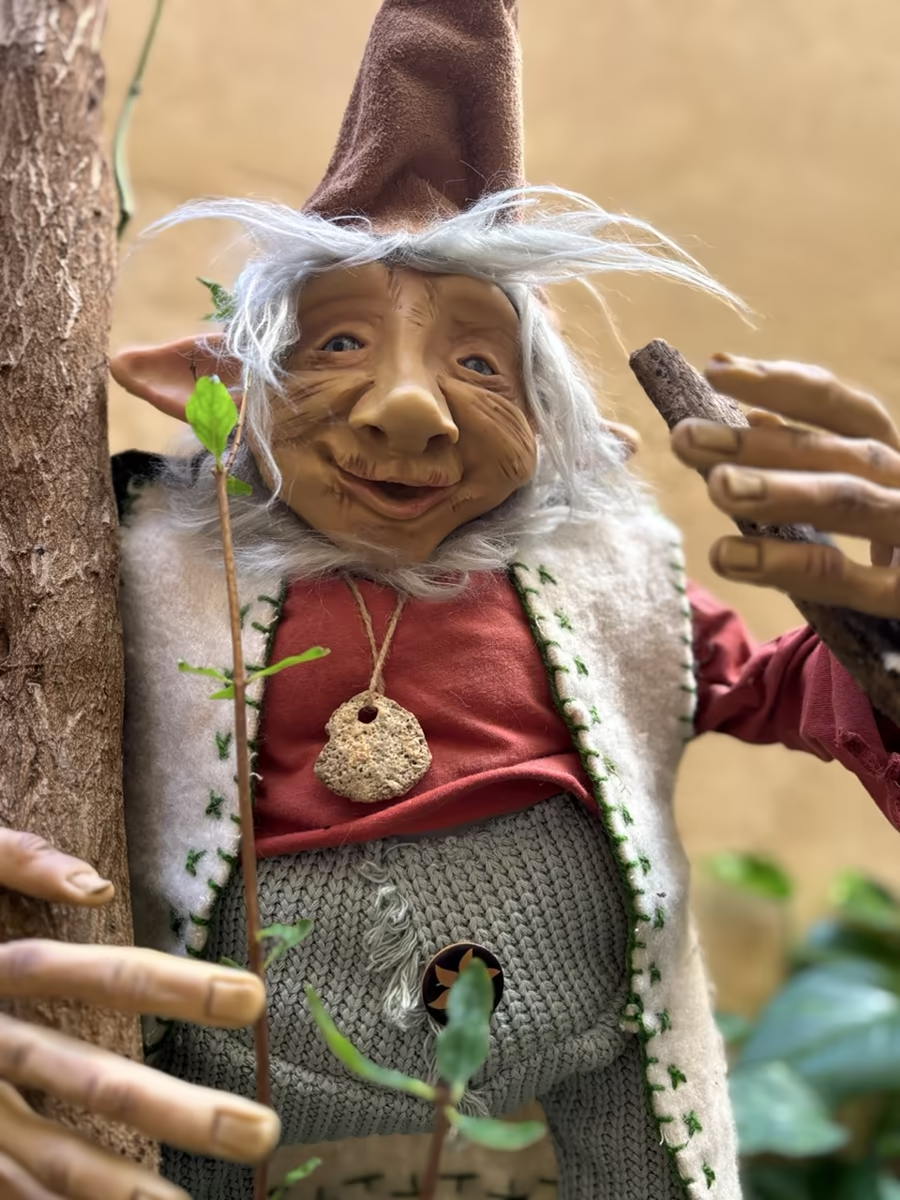
Look at the expression, the joins, the paintwork and the clothes. You might enjoy an uneven texture or a beautifully smooth finish. Small differences can add character, but an imperfection is not automatically a virtue. A loose join is still a loose join.
This Magikito has unruly hair, green stitching on his waistcoat and a smile that is hard to ignore. You can enjoy those details without needing another figure to lose the comparison. A shelf can accommodate different tastes, even if one resident insists on hoarding the biscuits.
The price covers more than materials
A price may include design, materials, making time, tools, business costs, packaging and distribution. A commission might involve trials or agreed changes too. Plenty of work can happen beyond the moment captured in a photograph.
That can help explain a quote, but “handmade” does not make every price reasonable. Compare what is included and ask about the details that matter to you. You may value fine finishing enormously and care little about having a one-off. Your budget matters too, without an apology attached.
Durability depends on the actual piece
The words “resin” or “plastic” do not establish that a figure will withstand knocks, water or years of sunshine. Look at the particular material, shape, thin sections, joins and care instructions. A slender finger does not become indestructible because the body looks sturdy.
For the cold porcelain figures shown here, keeping them dry and treating them as delicate objects is the sensible approach. Our care guide covers positioning and cleaning. Knowing a piece is fragile helps you care for it. It does not make it more valuable.
Can a decorative figure be used as a toy?
Do not assume so because it looks sturdy or friendly. For play, choose a toy intended for the child's age and abilities. The CPSC advises following age and safety guidance and keeping small parts away from children under three.
A display figure may have fragile details or parts that come loose. That distinction matters much more than whether it was made in a small workshop or a large production run.
Handmade does not automatically mean greener
Comparing environmental impacts requires looking at materials, production, transport, use and eventual disposal or recovery. This is the life-cycle approach explained by UNEP.
Without information about the actual pieces, we cannot declare one the winner because fewer were made. We can consider keeping and caring for what we already have, or passing it on to someone who will enjoy it. A new woodland resident needn't evict the souvenir.
You bring the meaning too
A little ornament might remind you of your gran, a friend or a rainy afternoon when you laughed yourselves silly. That connection does not disappear because another thousand were made. Nor does it arrive automatically with a unique piece.
With the Magikitos, we play with stories and Magical Sparks. The cold porcelain figures represent the inhabitants of that fictional world. We share them here for enjoyment and do not sell them. We love the craft, and we love the different reasons people become fond of an object.
For practical questions when choosing a figure, try our guide to reading listings and asking about the work. If you are chuffed to bits with both neighbours from the opening scene, let them share the shelf. They can sort out the crumbs between them.