We hit the trail in absolutely brutal cold and pulled on gloves… but they were so chunky we looked like two loaves of bread going for a walk.
And the little glove goes, “Perfect, now you can’t touch your phone.” We go, “Awesome, and how are we supposed to unlock the screen?” And it, all icy and blunt, says: “You don’t. Today you unlock real life.”
We laughed because it’s true, sometimes the best ‘airplane mode’ is a clumsy glove. Today, if your patience melts, let it be for something worth touching.
Ice floats just to be contrary
Science bite
Did you know...?
Most things in the world, when they get really cold, go all shy and shrink. They squeeze in so much that they end up super heavy for the tiny space they take up. That is why, if you toss them into a river or a bucket of water, down they go until they kiss the bottom. But water is a rebel with a mission: when it freezes, instead of getting smaller and dropping down, it decides to stretch out, float, and stay up top waving hello from the surface.
To crack this mystery, we first need to talk about density.
What is density?
Picture a wooden crate like the ones we use to carry bottles of sidra. If you fill it to the brim with river stones, that crate is very “dense” because there is a lot of stuff packed into that space, and you will need a miracle to lift it. But if you empty it and fill it again with suuuper fluffy sheep’s wool, most of the space is actually air, and the crate will weigh almost nothing even though it is the same size. That is density: how squished together or spread out the “little things” are inside a space.
Now think of water molecules like Lego pieces. When water runs down the waterfalls of Taramundi, those pieces are loose and messy, wobbling around from side to side. Normally, when things cool down, they snuggle closer to take up less space and get denser. But water likes its personal space. When it freezes and turns into ice, the Lego pieces hold hands while leaving huge gaps between them, like they are building an igloo with loads of windows.
With so much “empty space” in its shape, ice becomes less dense, meaning lighter, than liquid water. That is why it floats, just like a log floats in a pond because it has little air channels inside.
Out in the forest we have it clear: sometimes what looks like it “doesn’t fit” or takes up too much space is exactly what protects life. If you feel like the weird little critter today, remember that ice, by being the different one, becomes a blanket so the fish do not freeze under the river.
Why does snow “crunch” differently depending on the cold?
Curiosity
Have you noticed snow can sound like a cookie… or like sad cotton too?
On snowy days, when the whole forest turns white, we love listening to what our footsteps have to say. Sometimes the snow sounds like a party, other times it’s a bit “squish squish”. It’s not magic, it’s just temperature remixing your boots’ soundtrack without warning.
Why does snow crunch?
To get it, imagine snowflakes as super thin tiny glass cookies. When it’s crazy cold (way below zero), those little cookies are stiff and hard. When you step on them, they all snap at once. That “crack” you hear is thousands of icy micro-structures popping into pieces under your weight. It’s like crushing extra-crunchy cereal in a bowl.
But when the sun warms things up a bit and we’re close to zero degrees, the snow gets lazy. A thin film of water shows up on top, like the cookies got dunked in milk and turned soft-ish. Instead of breaking with a sharp sound, the flakes stick together and squish without complaining, soaking up the noise instead of letting it out. That’s why your steps sound duller and more muted, like you’re stepping on a pile of damp cotton.
It’s brilliant because, without even looking at a thermometer, your ears and your boots already know if the ground is in crunchy mode or in soft mode. It’s like an ankle-height weather report.
Magikito conclusion: if your day is crunching today, maybe you’re in rigid mode and you need a little calm. If your day goes “squish”, maybe you need less toughness and to let yourself flow a bit more. In the end, both sounds still point you back home.
The Day Ice Guzzled a Whole River
History
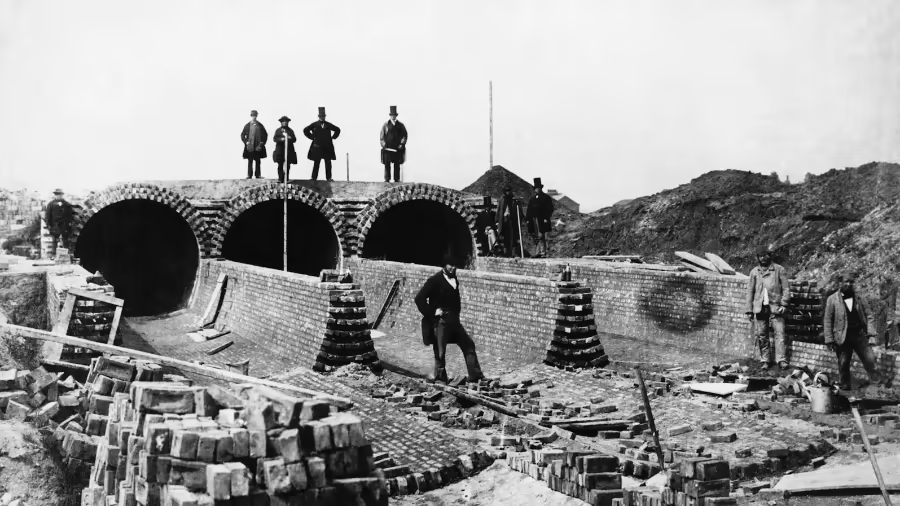
The Great Stink: London, 1858. Heat that melted everyone’s patience
Picture it: summer in London, the kind of heat that glues you to your chair, and the Thames running lower than an empty canteen. The catch is, back then the river was basically the city’s official trash chute. When the sun really started going for it, the whole thing turned into a nasty stew simmering on low. The stench was so feral that people sprinted across the bridges with a handkerchief pressed to their nose.
What was London’s Great Stink?
Things got so bad that even politicians, who usually sit comfy in their offices, started dropping like flies. In Parliament, which is right by the river, they had to soak the curtains in chlorine just to avoid fainting mid-debate. The press, with a proper smirk, called it “The Great Stink”. The wild part is that, even though people still believed diseases traveled through bad smells (those “miasmas”), the disgust was so real it forced them to stop moaning and start building.
Thanks to that unbearable pong, engineer Joseph Bazalgette designed a massive sewer system that would still blow your mind today. Sometimes history doesn’t move forward because of grand speeches, it moves because something reeks so bad there’s no choice but to fix it.
We like to think small: if something “smells off” in your routine, don’t just pinch your nose. Maybe it’s time to redesign the little pipe where what no longer serves you gets carried away, so your life can smell like fresh grass again.
Pumpkin cuddle-blanket cream with healing ginger
Magical recipe
Today we’re going in with the good spoon. This cream is like tucking your stomach under a wool blanket and whispering, “Chill, we’ve got the cold handled.”
Ingredients:
600 g of a seriously good-looking pumpkin
1 medium potato
Half an onion, the kind with a little bite
A small knob of fresh ginger, grated with style
700 ml root-veg broth or salted water
A couple tablespoons of the fancy olive oil
Salt and pepper to wake it up
A splash of cream or some seeds if you’re feeling elegant
Prep:
Drop the onion into the oil for a few minutes until it goes soft, a bit dopey, and translucent. You’ll know it’s ready.
Toss the pumpkin and potato into the pot, give it a good stir, and add the ginger. This is where the magic starts, the kind that kicks the cold right out of your bones.
Cover everything with the broth and let it simmer gently until it’s all nice and tender. Then go wild with the blender until it’s silky smooth, no rebellious lumps crashing the party.
Serve with a little cream or some seeds on top for crunch, so you can feel like today is a great day to be alive.
Forest tip: if winter is coming in hot, you just keep that spoon moving. First we warm the body, and then, if needed, we’ll let the brain have a think.
Melting at the right time is brave too
Reflection
“Stiffness looks like strength, until it stops you from changing shape.”
Today we watched an ice sheet standing all serious in the shade… and at the very first sunbeam, it let go of a tiny thread of water without apologizing.
And it got us thinking, how classy it is to yield when it’s time. Not as a defeat, but as a graceful adaptation.
We freeze up too sometimes, in a fixed idea, in an automatic reply, in that “I have to handle it” said through clenched teeth. And of course, nothing flows like that. Not joy, not rest, not those silly but surprisingly useful solutions.
Melting a little can be as simple as changing the plan, asking for a hand, eating a proper potaje stew, or saying “today I’m feeling more fragile” without turning it into a whole drama. Soft isn’t weak. Soft is what moves.
Where in your day could you loosen up by one degree, just one, so the water can run inside you again?