The Easily-Offended Folder

Joke of the day

This morning we found the “My Documents” folder crying behind a corner.

We ask: “What’s up, mate—running out of space for more files?”. And it goes: “More files? You’re using me like a junk closet! You’ve got 300 screenshots of a recipe you’re never going to cook, 14 PDFs of books you’re not going to read, and that blurry photo of a receipt from 2021.” We go: “It just feels wrong to delete stuff…”. And it says: “Well it feels wrong for me to live with this much digital trash in my stomach—I’m starting to feel like a drawer full of tangled cables with anxiety.”

Magikito moral: if even your documents folder is overwhelmed, maybe it’s not a lack of space… maybe we’ve genuinely gone a bit too far. Delete one tiny thing today, even if it’s just out of respect for your own chaos.

The Clingy Archive

Science bite

We snuck into a cave and found an old USB stick that said “SUPER IMPORTANT”. We opened it and… 1,490 photos of the exact same cat. That’s when our curiosity sparkled: why is it so hard to delete digital stuff if we don’t even look at it again?

We call it “Digital Diogenes”, because it looks a lot like hoarding… with one brand-new ingredient: digital clutter doesn’t take up space in your living room.

What’s “Diogenes” about keeping digital files?

Picture a wardrobe. If you shove in ten identical coats, you’ll feel the chaos pretty fast. On your phone, though, you can stash ten near-identical photos and… nothing happens. Because we don’t see the bulge, the brain goes: “Yep, toss it all in.” The problem is that later—when you actually need to find something—you get lost in a jungle of copies and suddenly even breathing feels like effort.

Why does deleting hurt more than keeping?

Because our heads come with a built-in little program called loss aversion. It’s like when someone asks: “Would you rather win €5 or avoid losing €5?” A lot of people prefer avoiding the loss. Deleting feels like losing something “forever”, even if it’s just the same lock-screen screenshot… again.

What does “zero cost” have to do with it?

Saving digital bits and bobs these days is ridiculously cheap and fast. One tap and done. Deleting, on the other hand, forces you to decide. And deciding is tiring. That’s decision fatigue—like staring into a drawer full of lidless food containers and freezing. Plus, humans get a bit dreamy about the future… “I might need it one day.” That day almost never comes, and when it does, they don’t even remember what they had.

How can I delete things without fear?

With silly-but-useful rules: “If I’ve got 7 similar photos, I’ll keep the one that actually makes me feel something,” or “If I don’t even know what it is, into the bin.” Turn deleting into a tiny routine—because deep down, deleting can feel really good.

Magikitos’ take: you’re not saving files, you’re saving the laziness of not deleting them. So today, get your sparkle together and feed the recycle bin—she deserves a snack every now and then too.

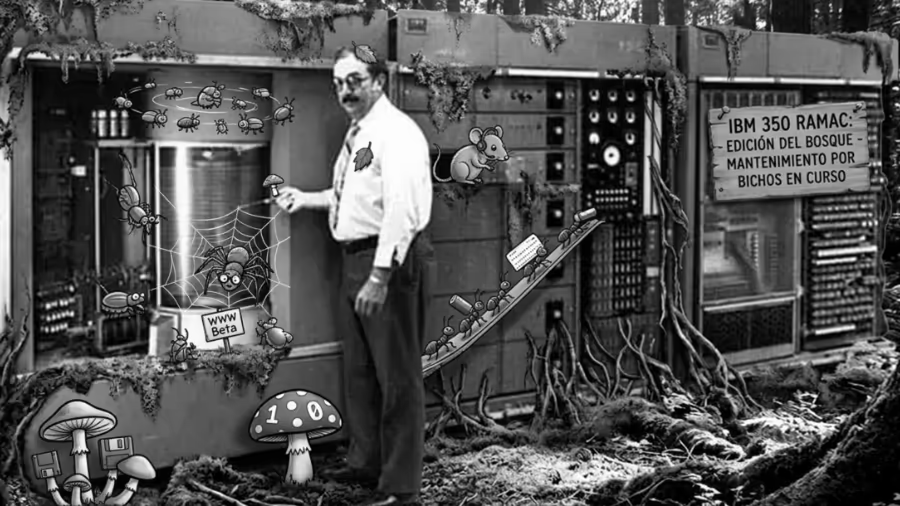
The wardrobe disk

History

In Taramundi we’ve got a super-ancient oak that thinks it’s the father of “cloud storage”. Well, today we told it there was once a hard drive that was, quite literally, a wardrobe.

In 1956, IBM presented the IBM 350, part of the RAMAC system. It was one of the first commercial hard drives. And when we say “hard drive”, we don’t mean a tiny little chip the size of a fingernail—we mean a massive contraption with a bunch of platters spinning inside, like an industrial washing machine with a library complex.

What was the first hard drive in history like?

Picture a metal tower on wheels—loud, heavy—storing data the way you’d store index cards in a gigantic office. Its capacity was around 5 megabytes. Yes. Five.

What are 5 megabytes, in plain language?

It’s like having a little tupper that only holds five olives… and you trying to squeeze a paella in there. With 5 MB today you can’t even fit a handful of decent phone photos, let alone a video. But back then it was a wildly useful leap: being able to access data “randomly” on disk without rewinding tapes was the kind of jump that changes how work gets organized.

The funny part is that we come from there: from having to choose what you kept because not everything would fit. Now almost everything fits… and precisely because of that, choosing is harder.

Magikito moral: before, the machine set the limit. Now you do. It’s dizzying, yes—but it’s also freedom: you get to decide what deserves to stay on your “drive” and what can go off to graze in the fields of forgetfulness.

No-Duplicates Salad

Magical recipe

Today we cook the way you clean your camera roll: no guilt, with a bit of judgment, and a tiny “wow… I forgot this was even here.” This salad is your fridge’s delete duplicates mode, but crispy and seriously tasty.

Ingredients:

  • A big handful of leafy greens (that opened bag giving you puppy eyes like “use me now”).
  • 1 tomato or a couple of slightly wrinkly cherry tomatoes—still holding their dignity.
  • 1/2 cucumber or a few slices that survived the week.
  • Any leftover roasted or cooked veggies (pepper, zucchini, carrot… whatever’s been living its best life in there).
  • A small handful of cooked legumes (chickpeas, lentils) or a bit of chicken, tuna, feta… whatever gives you protein and peace.
  • Yesterday’s bread, diced (to make deluxe “crunchy-copies”).
  • Extra-virgin olive oil, salt, and pepper.
  • For the dressing: 1 teaspoon mustard, juice of 1/2 lemon or a splash of vinegar, and 1 teaspoon honey (optional, but it makes the forest smile).

Preparation:

In a pan with a little drizzle of oil, toast the bread cubes until golden. It’s like picking “the best photo” and then putting it in a frame.

In a big bowl, add the greens and start tossing in what you’ve got: tomato, cucumber, those veggies left orphaned in a container, and your chosen protein. Don’t chase perfection—chase harmony: let every ingredient have a role.

Mix the dressing separately, like responsible adults: mustard, lemon or vinegar, oil, salt, pepper, and honey if you’re in the mood. Whisk with a fork and taste it. If it winks at you, it’s ready.

Dress the salad, scatter the crunchy-copies on top, and dig in.

Forest tip: if deleting 500 photos feels like too much today, start with the fridge. Your body learns fast: fewer repeats, more delicious.

Copies in Your Head

Reflection

“Saving isn’t always caring for what we have: sometimes it’s just not daring to let it go.”

In the forest, when a squirrel stores 40 nuts, it has a plan. But when you store 40 identical photos, most times there’s no plan—there’s a “just in case” that’s made itself a little home in your chest.

The digital world tempts us with a gentle lie: “If you save it, you won’t lose it.” And then comes the muddy truth: you lose it anyway, just in a different way. You lose it as noise, as endless searching, as that feeling of “I’ve got a thousand things” and at the same time “I can’t find anything.”

And careful—we’re not talking only about files. We’re talking about phrases you repeat to yourself, fears you’ve cloned, expectations kept in backup. Things you don’t look at, but they still weigh you down.

What mental or digital duplicate could you delete today—even a tiny one—just to see how that new empty space feels on the inside?

Your basket: 0,00 € (0 products)

Your Magic Cart

Your cart is empty. Adopt a Magikito!