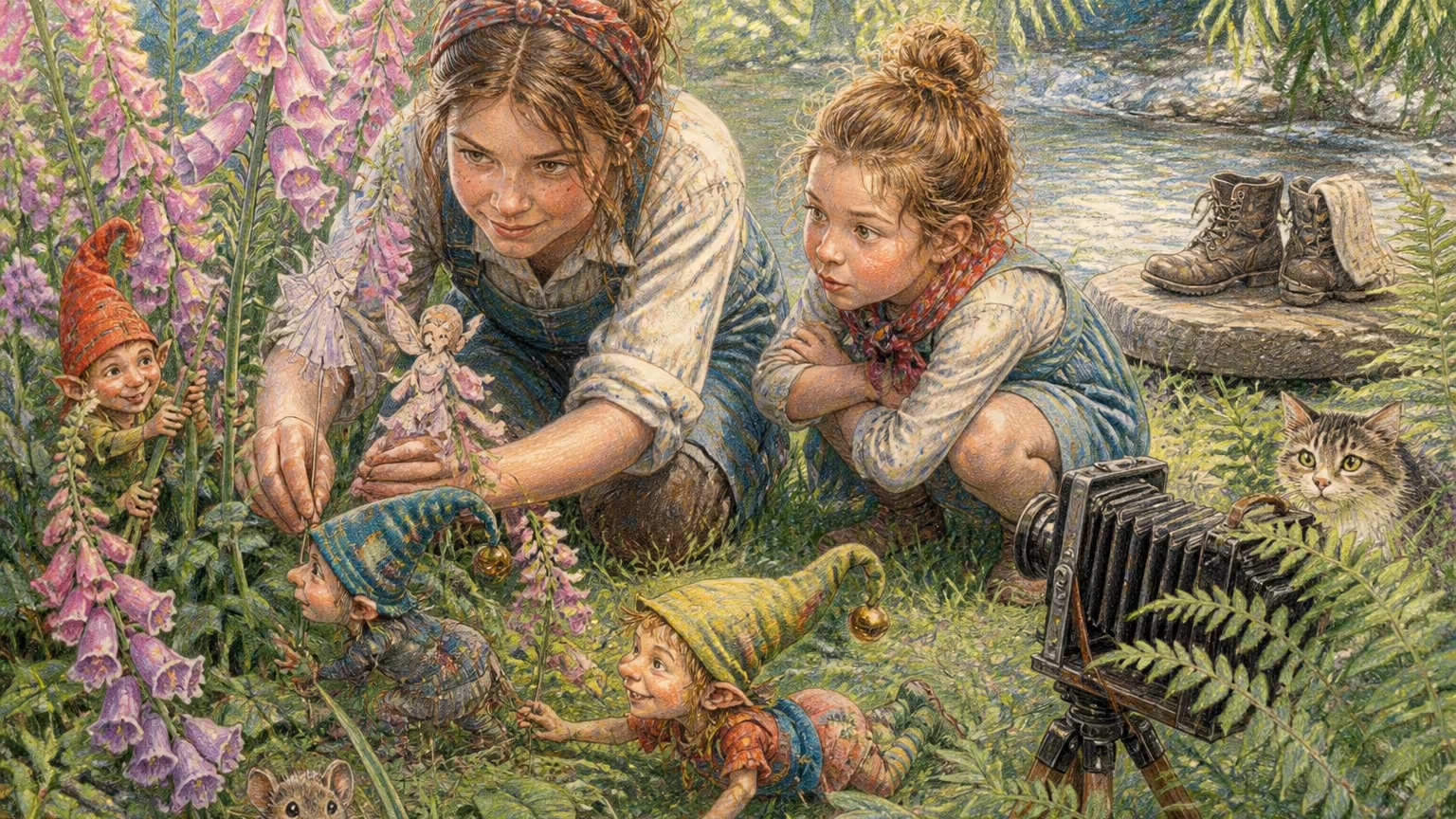
In the summer of 1917, in a small Yorkshire village called Cottingley, two cousins took five photographs of fairies in their back garden. The eldest was sixteen, the youngest was nine. The fairies were paper cutouts on hat pins. The photographs were sharp, well composed, and absolutely convincing. Sir Arthur Conan Doyle (yes, the creator of Sherlock Holmes) saw them, declared them genuine, and published a book defending the case. For sixty-six years, the world argued about whether the Cottingley fairies were real.
Then in 1983, when one cousin was in her seventies and the other nearly eighty, they admitted the truth on national television. Four of the five photographs were faked. The fifth, they couldn’t quite agree on. The story is one of the strangest in British folkloric history, and it has all the elements of a great fairy tale: two children, a Yorkshire beck, a famous author, a hoax that lasted three generations, and a small remaining mystery at the end.
We Magikitos have been telling this story in the workshop in Taramundi for years, partly because it’s irresistible, and partly because it shows something true about belief and fairies in early twentieth-century Britain. Today’s the full version. If you’ve got the wider folkloric context already, you might want to look at our piece on brownies, hobs, pixies and boggarts for the larger family of creatures that the Cottingley fairies briefly joined.
What are the Cottingley fairies, exactly?
The Cottingley fairies are a series of five photographs taken in 1917 and 1920 by two young cousins, Elsie Wright and Frances Griffiths, in the garden of a house in Cottingley, near Bingley in West Yorkshire. The photographs appear to show small fairy creatures, dancing or posing among the foxgloves and ferns of an Edwardian English garden. They were taken with a borrowed Midg quarter-plate camera, developed by Elsie’s father, and circulated privately for several years before reaching a wider audience. In 1920 they were published in The Strand Magazine, in an article written by Sir Arthur Conan Doyle, and they became one of the most famous photographic curiosities of the twentieth century.
Five photographs, two girls, one Yorkshire beck, and an entire generation’s debate about whether the small folk really lived in English gardens. That’s the Cottingley case in one sentence.
When and where were the photographs taken?
The first three photographs were taken in July and September 1917, in the back garden of Elsie Wright’s family home in Cottingley. The garden ran down to a small stream called the Cottingley Beck, the place where the cousins spent most of their summer afternoons. The remaining two photographs were taken in August 1920, in the same garden and beside the same beck. The location matters because Cottingley is in the West Riding of Yorkshire, in an area with a long folkloric tradition of belief in the small folk, and because the Cottingley Beck itself was an old place, exactly the kind of stream where, according to local lore, fairies might still be found.
If you visit Cottingley today, the garden no longer exists in its original form (the house has been altered), but the beck still runs roughly where it always did, and the larger landscape of small Yorkshire villages around Bingley still feels exactly like the kind of place where the story could happen. The location is part of why it convinced people in 1917 and 1920. It looked exactly right.
Who took the Cottingley fairy photographs?
Two young cousins, Elsie Wright (born 1901) and Frances Griffiths (born 1907). Elsie was sixteen when the first photographs were taken, and Frances was nine. Frances had come from South Africa to live with Elsie’s family during the First World War, while Frances’s father was serving in France. The two girls spent long summer afternoons together at the Cottingley Beck, and the photographs were taken with Elsie’s father’s borrowed Midg camera. Elsie was an artistically talented teenager who had worked briefly in a photographer’s studio in Bradford, which gave her the technical knowledge to compose and develop the images. Frances, much younger, played the role of the model in most of the photographs.
The relationship between the two cousins is one of the most interesting parts of the case. They protected each other’s story for over sixty years, never breaking ranks even when sceptical journalists, photo experts, and folklorists pressed them repeatedly. Their loyalty to each other, more than the photographs themselves, is what gave the hoax its strange longevity.
How did Conan Doyle become involved?
Through Edward Gardner, a leading member of the Theosophical Society in London, who came across the photographs in 1919 and brought them to Doyle’s attention. Conan Doyle was at the time deeply interested in spiritualism and supernatural phenomena, having lost his son Kingsley to the war in 1918, and he was writing an article on fairies for The Strand Magazine when he first saw the prints. The photographs seemed to him to confirm the existence of the small folk, and he commissioned new photographs (the two from 1920) before publishing a major article in the December 1920 issue of The Strand. He later expanded the article into a book, The Coming of the Fairies (1922), which defended the photographs as genuine and discussed the wider question of fairy existence in modern Britain.
Were the Cottingley fairy photographs real?
No, four of the five photographs were faked, as the cousins finally admitted in 1983 when they were both in their late seventies. The fairies in those four photographs were paper cutouts, drawn by Elsie based on illustrations from Princess Mary’s Gift Book (1914), then carefully cut out and supported on long hat pins driven into the soil among the plants. The cousins photographed the cutouts from a careful angle to make them look three-dimensional, and the resulting prints, developed by Elsie’s father in his small home darkroom, were good enough to fool everyone who saw them for over six decades. The fifth photograph, known as The Fairy Bower, remained ambiguous, with Frances insisting until her death in 1986 that it had been genuine while Elsie maintained that it was also a hoax.
The detail about the hat pins is important because it explains how a low-tech fake could pass for a real photograph for so long. Photography in 1917 was not yet in the position to easily detect this kind of physical staging. The fairies looked solid because they were solid (just made of paper, not flesh), and the lighting was natural because the photographs really were taken outdoors. The forgery was at the right level of physical detail to defeat the analytical tools of its era.
How were the photographs created?
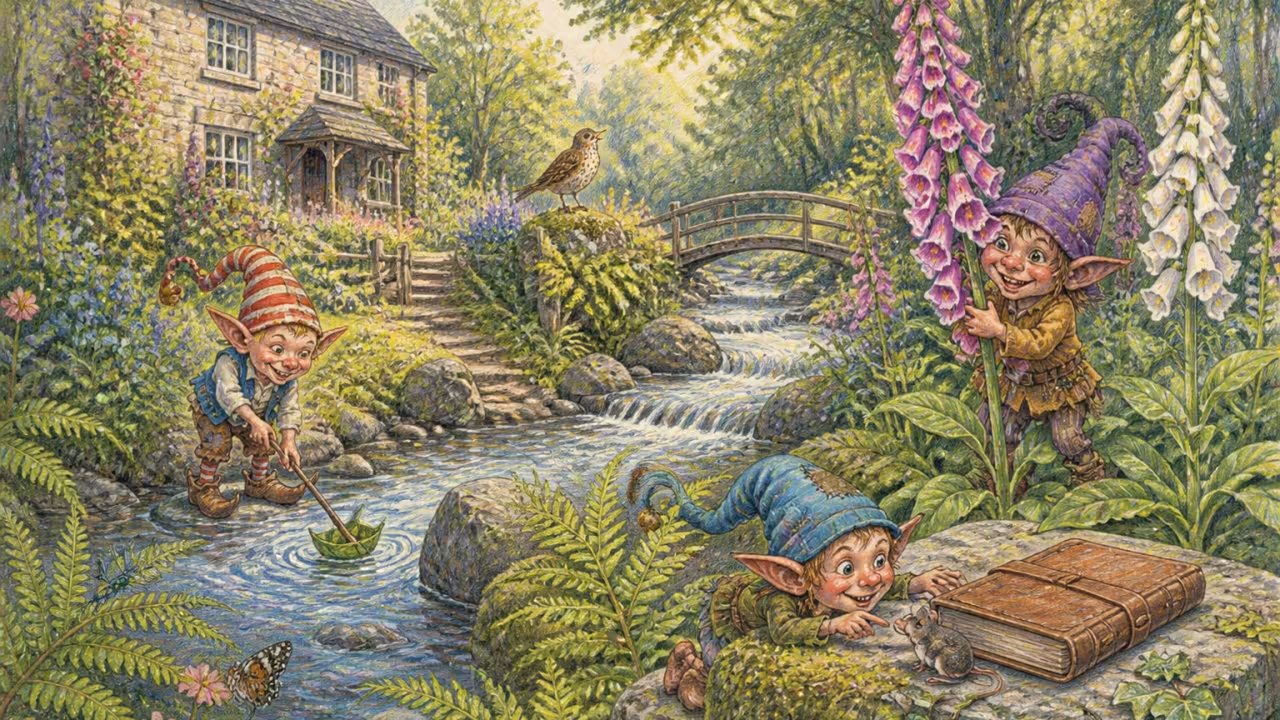
With paper, hat pins, and surprisingly careful craft. Elsie Wright traced illustrations from Princess Mary’s Gift Book onto stiff paper, drew her own fairy designs based on them, and cut them out using small scissors. The cutouts were then mounted on long sewing pins or hat pins, which Elsie pushed into the soil among the foxglove plants and ferns at the edge of the beck. The cousins then arranged themselves in the scene (Frances was usually the model in the foreground), and Elsie or her father took the photograph with the borrowed Midg camera. The plates were developed in the family darkroom, and the resulting images looked like genuine photographs of fairies dancing or posing in the garden. The technique was crude but effective, and it required no special photographic skills beyond what Elsie had picked up at her brief studio job.
What surprised everyone after the 1983 confession was how simple the trick had been. People in 1920 imagined elaborate technical fakery, double exposures, or composite negatives. The actual method was paper cutouts on hat pins, photographed in daylight by a teenager and a child. The simplicity was the secret. Nobody was looking for paper cutouts because nobody could believe two young girls would have bothered to make them.
When was the hoax confessed?
In 1981 and 1983, in separate interviews given by Elsie and Frances when they were elderly women. The first partial confession came in 1981, when Elsie acknowledged to the writer Joe Cooper that the photographs had not been genuine. The full confession was published in 1983 in the magazine The Unexplained, with both cousins admitting that four of the five photographs had been faked using paper cutouts. Frances, however, insisted to the end that the fifth photograph (The Fairy Bower) was real. Elsie disagreed but never pressed her cousin on it. Both cousins died in the 1980s (Elsie in 1988, Frances in 1986), taking the small remaining mystery of the fifth photograph with them.
The 1983 confession received international media coverage, and the Cottingley fairies became a textbook case of how a simple hoax can persist for decades when the social and emotional incentives are right. It also raised an interesting question that historians still discuss: did the cousins themselves come to half-believe the story over time? Frances, in particular, seemed to maintain that something genuine had happened in the garden at Cottingley, even if the photographs had been staged.
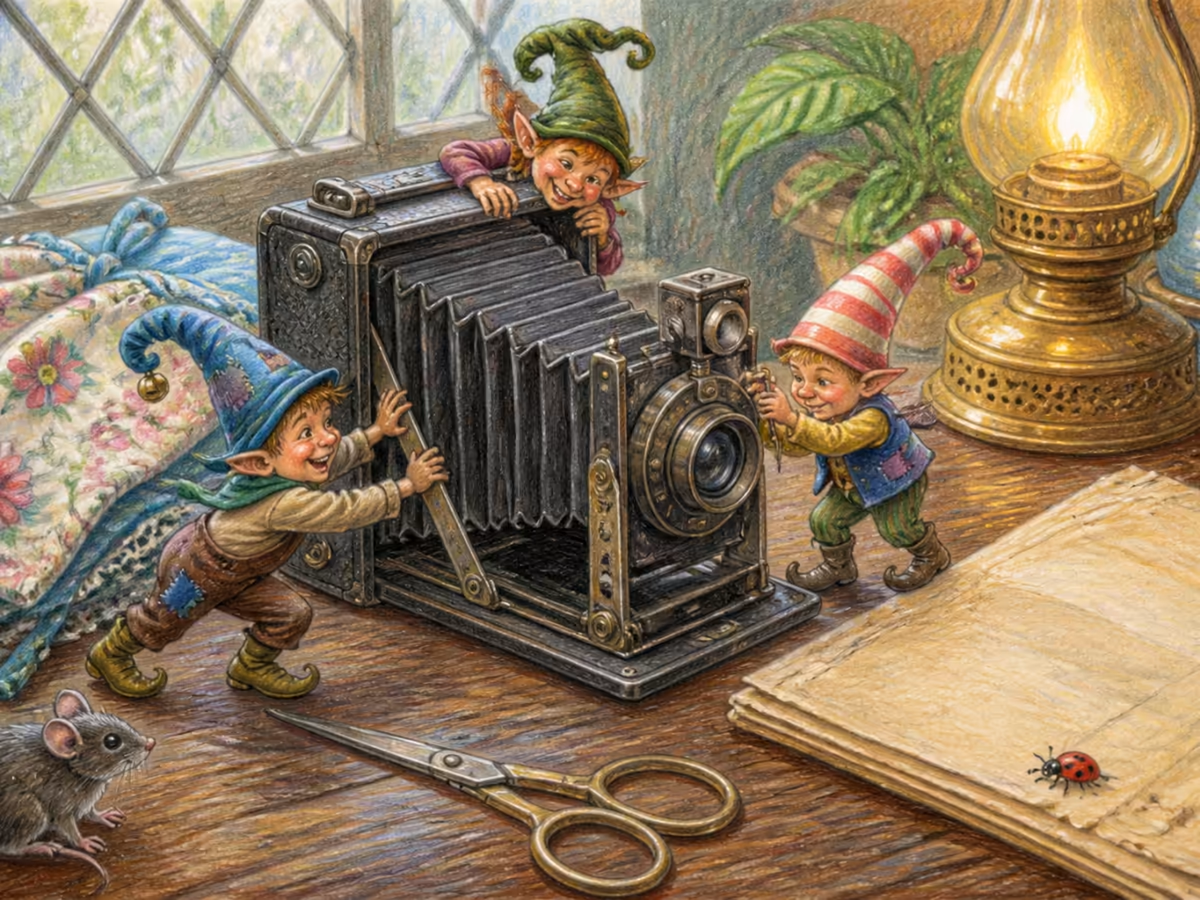
The Midg quarter-plate camera used at Cottingley had a single focal length, a shutter speed of about 1/25th of a second, and produced glass plates that resolved details at the level of large leaves and small flower petals. It could not, in 1917, distinguish between three-dimensional objects and well-lit paper cutouts at the distances the cousins used. That technical limitation is one of the unsung characters of the whole story.
Modern image analysis of the original prints eventually identified suspicious flatness in the fairy figures, but the analysis required equipment that didn’t exist in 1920. The cousins had, in effect, fooled a technology gap.
Why do the Cottingley fairies still matter today?
Because they’re a case study in how the human mind handles uncertain evidence, especially when the witnesses are children, the photographs are clear, and the underlying belief is socially attractive. The Cottingley fairies weren’t believed because the evidence was strong (it wasn’t, on careful inspection), they were believed because the post-war public, traumatised by the First World War and the influenza pandemic, deeply wanted small magical creatures to exist in English gardens. Conan Doyle himself had recently lost his son. The fairies offered comfort that the world still had wonder in it, even after the worst war Europe had ever seen. That emotional incentive is what sustained the hoax for sixty-six years.
The Cottingley case is now studied in folklore departments, photographic history courses, and the psychology of belief. It’s also, simply, a wonderful story. Two cousins, one beck, sixty-six years of secret. We Magikitos read it the way we read all great folklore: with affection for the cousins, with respect for the wonder it sustained, and with the small understanding that the line between real magic and the human need for magic is often thinner than it looks.
In our own way, we honour that wonder by shaping and sharing handmade fairies with proper character and folkloric weight, the opposite of paper cutouts on hat pins. Our treasures hold the smaller pieces that round out a thoughtful fairy collection, never industrial, always slow.
The Cottingley fairies were paper cutouts. The wonder they unleashed across post-war Britain was completely real. Both things can be true at once.
The Magikitos, from the workshop in Taramundi
Are there other famous fairy photographs from this era?
Yes, though none reached the level of fame the Cottingley case achieved. The early twentieth century saw a flurry of supposed fairy photographs in Britain and continental Europe, especially in the period 1917 to 1925, when spiritualism was at its peak. Most of the others were quickly debunked or dismissed as obvious manipulations, but a small handful enjoyed brief moments of attention. Several amateur photographers across Britain and the continent claimed their own fairy pictures in those years. Each was investigated, found unconvincing for one reason or another, and quietly forgotten. Cottingley was the only one that fully captured the public imagination, partly because of the involvement of Conan Doyle, partly because of the children at the centre of it, and partly because the photographs themselves really were unusually good.
Where can you see the original Cottingley photographs today?
At the National Science and Media Museum in Bradford, West Yorkshire, where the original glass plate negatives and prints are held in the permanent collection. The museum (formerly the National Media Museum) has held the materials since the 1990s, and parts of the collection are periodically displayed in exhibitions on photography, folklore, or the history of belief. The museum is also located not far from Cottingley itself, which makes it a logical pilgrimage for anyone interested in the case. A separate collection of letters, drawings, and the Princess Mary’s Gift Book source material is held at the Brotherton Library at the University of Leeds, accessible to researchers by appointment. A few of Frances’s late-life letters and her own personal annotations are held privately by descendants.
If you can’t travel to Yorkshire, the photographs themselves are now in the public domain and widely reproduced online and in books. We Magikitos recommend the earliest prints rather than later reprints, because the subtle textures of the early prints carry information that modern reproductions tend to smooth over. The slightly suspicious flatness of the fairy figures, the small shadows that don’t quite match the surrounding plants, the strange stillness of the figures against the moving foxglove leaves: all of these tells are visible in the original prints, invisible in the later reprints. Reading the photographs carefully is itself a small lesson in how to look at any photograph at all.