
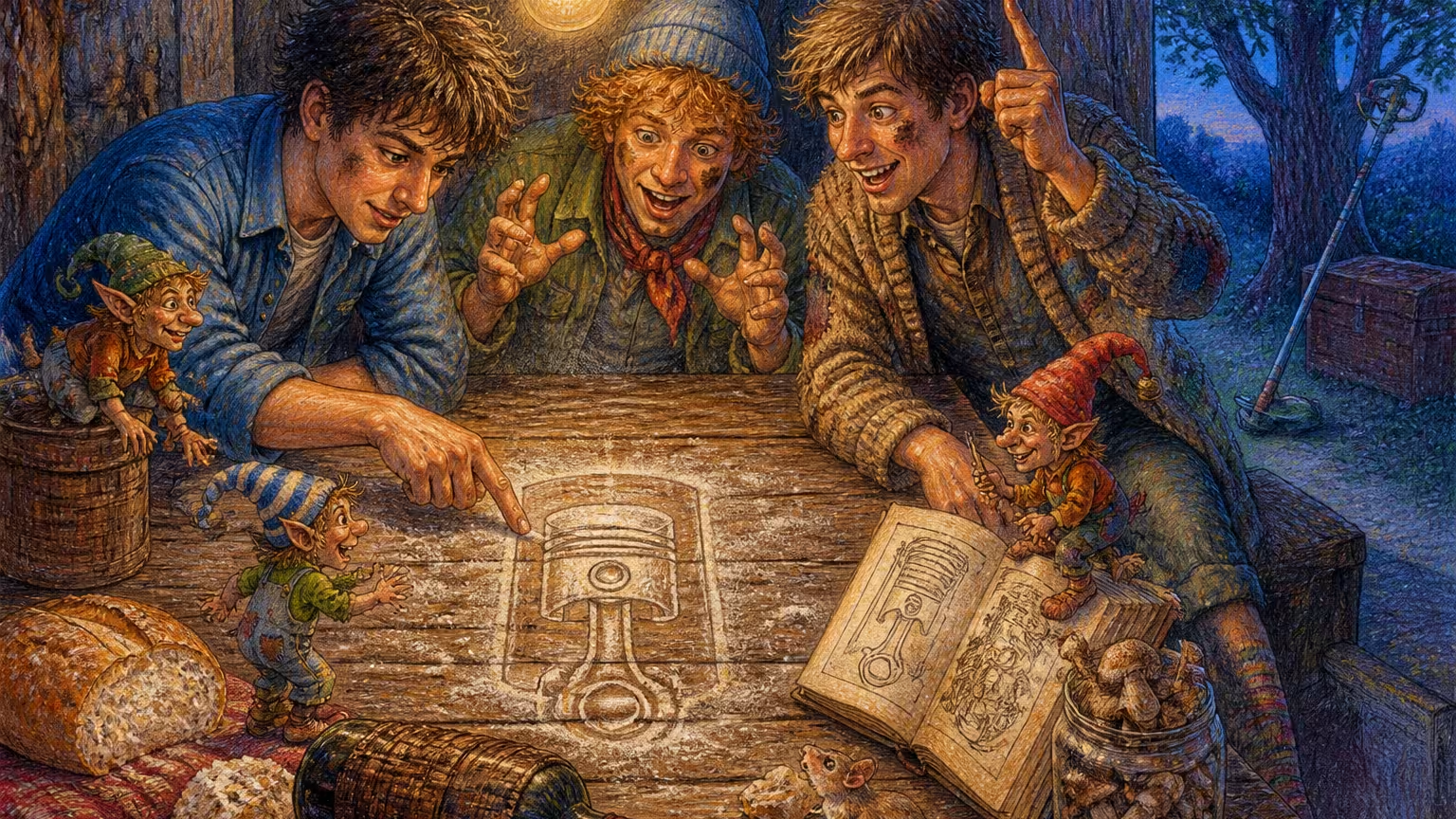
We went looking for mushrooms and found a brushcutter. It was behind a chestnut tree, its cutting head tangled in grass, looking as though it had fallen out with every owner it had ever had. One of us called it a dragon on a stick. Another asked where the soup went. Our engineering department was off to a flying start.
We left it switched off and looked for the identification plate and manual. An abandoned machine needs checking, not an optimistic yank on the starter cord. It had already started something else, though: a question. How the hell does a liquid make a lump of metal go round?
By evening we Brownies were at a table with bread, a flask of wine and an engine drawing among the crumbs. The brushcutter stayed well out of it. We had that glorious after-dinner confidence that lets you explain the universe while failing to find your glasses. But this time we wanted to understand. We'd fallen down a rabbit hole, and there was a piston at the bottom.
How does a petrol engine turn fuel into movement?
A petrol engine converts some of the fuel's chemical energy into movement. Petrol mixes with air, and a spark ignites the mixture inside a cylinder. Combustion raises the temperature and pressure of the gases, which push a piston. A connecting rod transfers that push to a crankshaft, making it turn. Burnt gases leave, a fresh charge comes in, and the cycle repeats.
That's the whole journey: chemical energy, hot gases, a push, rotation. The spark starts the reaction. Most of the energy comes from fuel reacting with oxygen in the air. The spark plug can wear the conductor's hat, but the petrol pays the orchestra.
One word needs sorting out. People talk about little explosions, but a conventional petrol engine needs fast, controlled combustion: a flame travelling through the mixture. Uncontrolled detonation is a different matter and can damage an engine. We can tell a decent party from the kitchen blowing up, too.
Five parts, and suddenly the thing makes sense
The cylinder is the space the piston moves through. The cylinder head closes it at the top. The piston travels up and down, with rings that help seal in the gases. If the pressure cheerfully escaped round its sides, we'd lose much of the useful push.
Below it sit the connecting rod, a jointed link, and the crankshaft, whose crank pin is offset from the main axis. That offset is the clever bit. The rod pushes on the crank pin and produces rotation, much as pushing a bicycle pedal turns its crank. Push right at the main axle's centre and you lose that leverage.
That was when the penny dropped. The piston goes back and forth, but it pushes a point that goes round. No hidden motor under the motor. Just a beautifully arranged bit of geometry. We moved a spoon round a cork to demonstrate, then spent ten minutes looking for the cork.
The petrol needs preparation as well. A carburettor meters fuel and disperses it into incoming air. Other engines use injectors. What burns is vaporised fuel mixed with oxygen, so a random slosh of liquid won't do. The engine must fill a space, squeeze the charge, burn it at the right moment and get the leftovers out. Repeatedly. Without the components applying for separate citizenship.
Getting it started and keeping it turning
Before the first combustion, something has to move the mechanism. On many brushcutters, pulling the starter cord turns the crankshaft. A car generally uses an electric starter motor. Once it's running, combustion supplies the energy to keep going.
The flywheel is a rotating mass. It stores some energy from each power stroke and gives it back between them, helping the engine turn while it compresses the next charge. It doesn't create energy. It spreads it out over time. We'd like something similar for our enthusiasm for washing up.
The spark has a proper supply system, too. Ignition equipment produces high voltage at the plug. Many small machines use magnets on the flywheel and a coil, without needing a battery. In a typical carburetted engine, opening the throttle lets more air and mixture in. More fuel can then burn and produce more force. How fast the engine turns also depends on the load it's driving.
Four strokes to get the whole job done
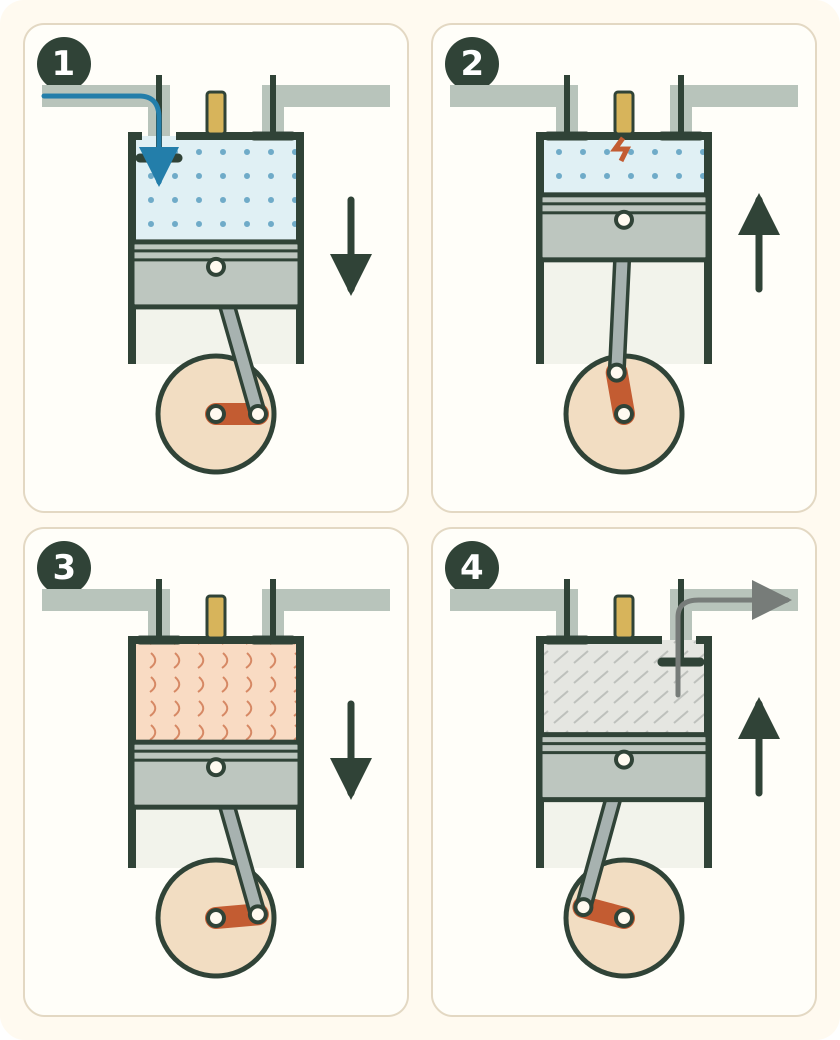
A stroke is one trip of the piston from top to bottom or bottom to top. It doesn't mean a second, a cylinder or a gear. Let's begin with a simple four-stroke petrol engine using a carburettor or port injection. Valves act as doors, and a camshaft coordinates their opening.
- Intake: the piston moves down. The inlet valve opens. As the cylinder's available space grows, a pressure difference allows the air-fuel mixture to enter. The exhaust valve stays closed.
- Compression: the piston moves up. Both valves are closed. The trapped charge occupies a smaller volume, raising its pressure and temperature. The spark comes near the end, usually a little before the piston reaches the top, because combustion takes time.
- Power: the piston moves down. Hot gases push on it. Both valves remain closed through the main part of this stroke. This is the useful push that delivers work to the crankshaft.
- Exhaust: the piston moves up. The outlet valve opens, and the piston pushes burnt gases out, making room for the next intake.
Four piston strokes take two crankshaft revolutions. Each cylinder has one power stroke every two revolutions. With several cylinders, their pushes can be staggered. Our diagram simplifies the timing: real valves can open early, close late and briefly overlap.
One of us raised a glass. “Three strokes getting ready and one doing the pushing?” Exactly. Even mechanical work needs somebody to lay the table. The Briggs & Stratton explanation follows those four strokes through.
Our brushcutter takes the two-stroke shortcut
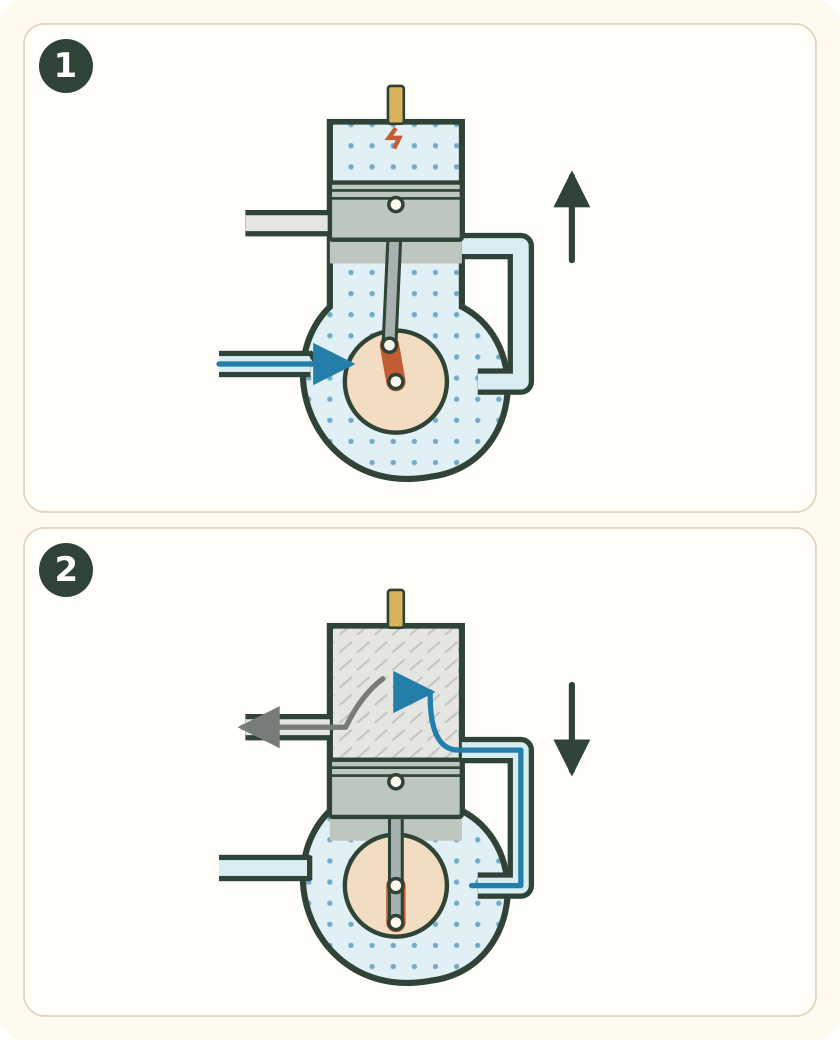
The manual identified our find as a conventional two-stroke. Plenty of brushcutters use this arrangement, although four-stroke models exist too. Intake, compression, combustion and exhaust still have to happen. They overlap to fit into one crankshaft revolution: one trip up and one trip down. There's a power stroke every revolution, which doesn't automatically mean twice the power.
The trick happens on both sides of the piston. On the way up, it compresses the charge already trapped above it. Meanwhile, the space in the crankcase below it grows, drawing in fresh mixture. The spark comes near the top of the travel.
On the way down, combustion pushes the piston while its underside compresses the fresh charge in the crankcase. Further down, it uncovers the exhaust port first, then the transfer passages. Burnt gases begin to leave. Fresh charge moves from the crankcase into the cylinder and helps sweep them out. The piston itself covers and uncovers these openings. Our drawing shows a simple version with a reed valve admitting mixture to the crankcase.
The crankcase is acting as a pump. The same piston is working on both sides. We'd needed most of an afternoon to grasp it, while the little beast can repeat the process thousands of times a minute. We were chuffed to bits just to keep up on paper.
Oil, grass and all that racket
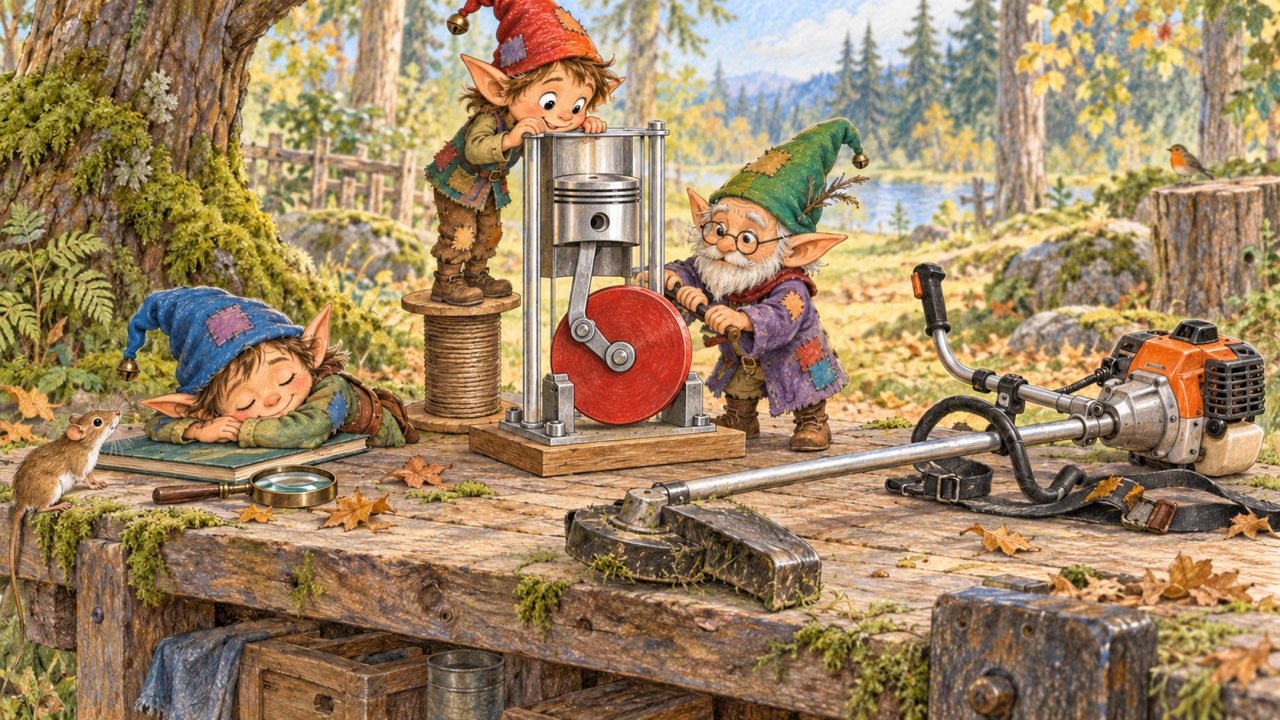
In this two-stroke, suitable oil travels with the fuel, lubricates internal parts and is eventually burnt. The manual specifies the mixture ratio. A conventional four-stroke usually keeps its oil separate, but some four-stroke designs also use oil mixed with fuel, as this STIHL system demonstrates. Counting strokes alone won't tell you what belongs in the tank.
Rotation reaches the cutting head through a transmission. Many brushcutters use a centrifugal clutch that couples the engine to a drive shaft as engine speed rises. That shaft carries rotation down the tube and, depending on the design, gears transfer it to the cutting head. The grass gets the final result of the whole chain.
There's heat to deal with as well. Some energy leaves in the exhaust, and some is dissipated through cooling and friction. On many small engines, fins and moving air help carry heat away. Not everything poured into the tank becomes useful work. Noise isn't a measure of efficiency, whatever your mate with the loud car says.
What's the difference between petrol and diesel engines?
The main difference is how combustion starts. In a conventional petrol engine, a spark plug ignites an air-fuel mixture. A diesel compresses air without fuel until it becomes very hot, then injects diesel fuel, which ignites in that hot air without a spark plug. Both can use a four-stroke cycle. Fuel type and number of strokes describe different things.
Compression heats the air because the piston does work on it. The diesel uses that heat to start combustion when fuel is injected. Glow plugs fitted to many diesels help particularly during cold starting and warm-up. They aren't spark plugs firing every cycle. See the US Department of Energy explanation and Bosch's glow-system documentation.
| What we're comparing | Conventional petrol | Conventional diesel |
|---|---|---|
| Starting combustion | A spark plug | Fuel injected into air heated strongly by compression |
| Preparing the charge | Air and fuel mix before ignition | Air is compressed first, then fuel is injected |
| Fuel delivery | Carburettor or injection, including direct injection | Injection into compressed air |
| Cycle | Two-stroke or four-stroke designs | Two-stroke and four-stroke diesels both exist |
Another easy trap: an injector doesn't make an engine a diesel. Petrol engines with direct injection still use spark plugs. Petrol and diesel fuel aren't interchangeable either. Their properties differ, as do the systems built to burn them.
Petrol's octane rating measures resistance to unwanted autoignition, not bottled horsepower. Higher octane doesn't guarantee more power in any old engine. The EIA explains the number. Diesel engines often use fuel efficiently thanks to their design and operating conditions, but meaningful consumption comparisons need specific engines and jobs.
A toast to finally getting it
We looked at the drawing again. Air and fuel. Compression. A spark, or sufficiently hot air in a diesel. Gases pushing, a rod transmitting force, a crankshaft turning. Two revolutions per four-stroke cycle. One for our two-stroke. We could follow the journey without hiding behind a grand-sounding word.
The wine went round again, and someone declared that an engine was fire taught to go in circles. We liked that. Then we looked at the rings, valves and passages. That fire had quite a team keeping it organised.
It reminded us of watching the northern lights: knowing how something works adds another layer of wonder. And we'd lost ourselves in making something again, this time among sketches, questions and crumbs. The brushcutter still hadn't fired up. We had.