We were sewing a jacket in Taramundi and the pocket started complaining in full union-rep voice.
“Hey, you always stuff me with sad coins and guilty receipts. I deserve something pretty too!”
We felt so bad we slipped in a candy and a note that said “sorry for the drama”. Since then, every time we reach in, the pocket gives us little reconciliation tickles. You should check yours too, there might be a receipt from 2019 in there asking for retirement.
Your phone knows where you are... even without GPS
Science bite
Did you know your phone can tell where you are even when GPS gives up?
When you go into a tunnel or a building, GPS basically goes “blind”. But your phone doesn’t quit. It switches on its pocket sensors and starts hunting for clues. It uses the accelerometer, the gyroscope and the magnetometer.
What are the accelerometer, gyroscope and magnetometer?
Picture them as your phone’s three extra senses. The accelerometer measures little pushes and changes in speed (so it knows if you’re moving fast or you just took a step), the gyroscope measures turns (so it knows if you rounded a corner), and the magnetometer is basically a tiny compass that detects where Earth’s North is. Add up those details and your phone can estimate your path without needing to “look at the sky”.
And if that still isn’t enough, it goes for triangulation. What’s triangulation? Imagine you’re in a dark square and you can hear three different music spots. Just by how loud each one sounds, you can guess if you’re closer to source A, B, or C. Your phone does the same with nearby Wi-Fi signals and cell towers. It compares their strength and boom, it drops you on the map.
The funniest part is that your position is actually figured out from a bunch of tiny clues stacked together. A turn here, a step there, one signal gets stronger, another gets weaker. Just like us when we come back through the woods at night, your body remembers the way by the little details.
Magikitos see it as a life mini-moral: if today you feel like you’ve lost your direction, don’t wait for a giant sign in the sky. Look for a teeny clue right under your feet. That’s science too.
The handbag was invented for one very specific reason
Curiosity
Why did the handbag show up if pockets already existed?
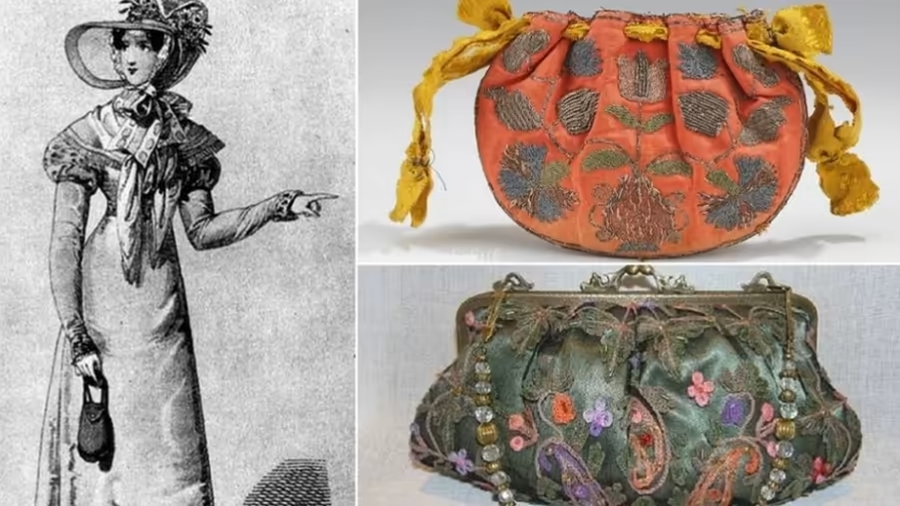
There was a time when clothes lost their pockets in a pretty… strategic way. At the end of the 18th century, dresses changed shape and got more fitted. That made the inner pockets disappear, because there was simply nowhere left to hide them.
What are inner pockets?
Picture this: back then, pockets weren’t sewn into the garment like they are now. They were more like two separate little pouches tied around the waist with a ribbon, under the skirt. They were huge and you could stash basically anything, but once dresses got slimmer, those pouches made awkward bulges and looked terrible.
To fix the space problem, the reticule became the big hit (also spelled retículo).
Pretty wild how this whole story began, right?
What is a reticule?
It was the great-great-great-grandparent of the handbag: a small, elegant little pouch worn hanging from the wrist. Since clothes no longer had their own storage built in, people started carrying their things on the outside.
The fun part is the handbag wasn’t born just to show off, it was pure textile architecture. If the structure of your outfit won’t let you carry anything, you invent an external accessory. And once that habit stepped onto the stage, it never left. Today we carry half our life in there: keys, gum, and even parallel universes.
We Magikitos see it as a big lesson: sometimes it’s not that you need something new, it’s that you’re trying to make up for what’s missing in the foundation. And wow, that explains a lot of human choices.
“Hot-pocket” empanadillas
Magical recipe
Today you want something you can eat with one hand while the other is doing the “wait, where did I leave my keys?”.
These empanadillas are exactly that: edible pockets and zero drama.
Mix tuna, tomato, onion and hard-boiled egg. Taste and tweak. Your tongue makes the rules here, not the recipe.
Spoon a little onto each wrapper, fold and seal with a fork, like you’re locking up a secret.
Oven: 200 ºC, 10-12 minutes, brush with egg first. Frying: hot oil, flip-flip until golden.
When you bite in and it comes out warm, it feels like the universe just gifted you an extra pocket, only crunchy. And that kind of luxury is very Saturday.
The day a message got stitched into a hem
History
A secret traveling stitch by stitch: Mary, Queen of Scots
In 1587, Mary Stuart (Mary, Queen of Scots) was executed in England after years of captivity. Politics and tragedy aside, her story left one detail we can’t stop obsessing over in the woods: sewing as a secret language.
During her imprisonment, Mary embroidered and sewed a lot. Textile pieces linked to her (and her circle) have survived, full of symbols, emblems, and coded messages. It wasn’t just “little crafts to pass the time”. It was a way to communicate, resist, and leave a trace when paper could be confiscated and words were watched.
Picture it: a letter is risky, but an embroidered motif looks harmless. A hem can be a hiding place. A stitch can be a sentence wearing a coat.
We’re keeping this thought: there are days when you can’t shout what you think, but you can sew it into what you do. What tiny message are you “embroidering” into your actions today?