We were wandering through the woods, eyes on the ground, and suddenly a mushroom popped up with its little cap looking flawless.
It goes: “Can you snap me a pic from down low? That way I look taller and, like… more mycelium-y”.
We told it: “Sure, but don’t try to sell us a self-love course afterwards”.
Moral: careful, some mushrooms are full-on posing too, so don’t believe everything you see.
Mycelium: the forest’s underground highway
Science bite
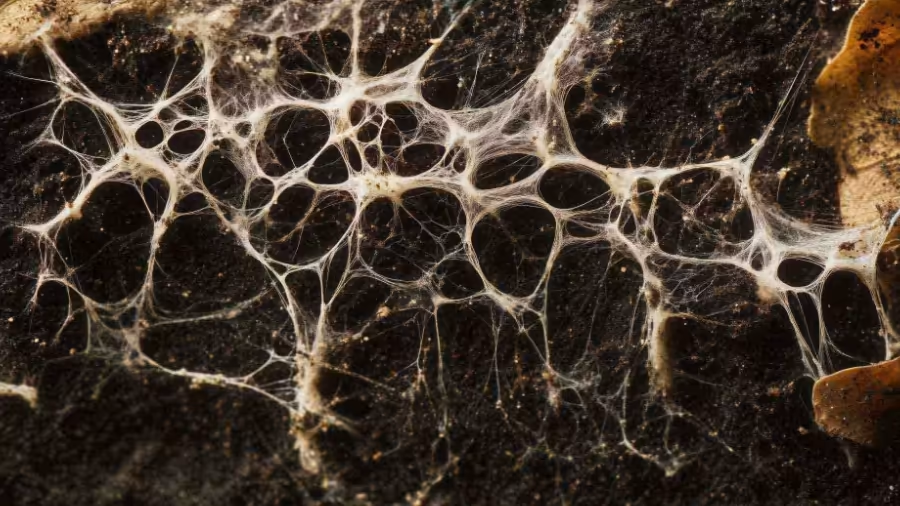
When you spot a mushroom peeking out from the moss, you’re really only seeing the tip of the iceberg. The real heavy stuff is under the ground, where there’s an endless network of super thin white threads called mycelium. It’s like the forest has its own internet, made of natural cables that link all the trees together, forming what scientists jokingly call the "Wood Wide Web".
So what exactly is mycelium?
Picture mycelium as the mushroom’s real "body", a tangle of fibers that look like spiderwebs but are tougher than you’d guess. It’s like millions of microscopic roots stretching out for miles. These threads are legit scouts, cruising through the soil looking for water and minerals. But mycelium has a tiny problem, it can’t cook up its own food because it lives in the dark. That’s where the trees step in to sign a pact.
What happens when mycelium hugs a root?
When a mycelium thread meets a tree root, they hug so hard they basically become one. That friendship deal is what we call mycorrhiza. The tree is a pro chef that uses the sun to make delicious sugars, but it can’t reach every corner of the soil. The fungus, born and raised as a treasure hunter, brings back water, phosphorus, and nitrogen from places the root would never reach on its own. It’s a "snacks for supplies" trade that keeps the forest alive.
How does the trees’ group chat work?
The wild part is that this wiring also sends info packets in real time. If a tree on one side of the forest gets attacked by aphids, it releases a chemical alarm signal through the fungus threads. Nearby trees get the message and start making bitter compounds in their leaves so the bugs won’t munch on them.
They’ve even seen "grandpa and grandma" trees using this network to send extra nutrients to younger trees stuck in the shade that can’t cook very well. It’s a mutual support system, and mycelium takes a small commission for being the messenger.
In the end, without this thread-connection and that deal of helping each other out, the forest wouldn’t last a single round against a drought or a pest invasion. It’s a massive team where nobody gets left behind if the network is healthy.
Magikitos translation: on the outside you look like an independent human who can handle everything solo. But underneath, what really saves your life is your people-network. Don’t be a lonely fungus, take care of your connections and keep the wiring fresh, because it’s what keeps you standing when the world gets tough.
The fungi that make zombies
Curiosity
You’ve probably heard scary stories, but nothing beats what goes down under the forest leaves when an ant bumps into the wrong fungus. This isn’t a zombie movie, it’s nature playing 4D chess just to survive. There’s a fungus called Ophiocordyceps that can “hack” an insect’s brain and turn it into a remote-controlled puppet.
How does this natural hack work?
It all starts with an invisible spore landing on the little critter. The fungus grows inside, and instead of killing it right away, it takes over its muscles. It forces the ant to ditch her buddies, climb up a plant, and clamp down on a leaf with all its strength, in the exact spot with the perfect humidity and temperature for the fungus. Once the insect is locked in place, the fungus finishes the job and sprouts a stalk out of the insect’s head to fire new spores from up high.
Why do something so wild?
It’s not that the fungus is the neighborhood villain, it just found the most efficient way to spread its “seeds”. By making the insect climb to a high, breezy spot, the spores can travel much farther on the wind and infect more bugs. It’s pure chemical engineering written into the fungus’s DNA. The insect stops being a living creature and becomes a biological launch tower that helps the fungus conquer new territory.
The craziest part is how precise it is. The fungus knows exactly which muscles to lock so the insect’s jaw won’t let go, not even after it’s dead. It’s a macabre choreography that’s been running for millions of years in the quiet of the forest.
Magikitos interpretation: if today you feel like an idea or an impulse is dragging you, without you meaning to, to a place that isn’t good for you, pause for a second and check who’s actually flying this thing. Make sure your inner mycelium is always yours, and that nobody is using you as a launch tower for their own plans.
Brutal mushroom remix: forest “shawarma” with yogurt and lemon
Magical recipe
Alright, today we’re going in with a proper heavy-hitter: a mushroom remix that tastes like street food, hot grill, and rainy forest all at once.
It’s like making a kebab, but the mycelium crew gives you a standing ovation.
Ingredients:
A bunch of mixed mushrooms (button, portobello, shiitake, oyster... whichever ones wink at your ôjo)
A creamy plain yogurt
One lemon
A couple garlic cloves
Smoked paprika, cumin, and black pepper (bold, but with love)
A cheeky glug of olive oil
Salt
Pita bread or tortillas
A handful of greens and sliced onion
Method:
Slice the mushrooms and toss them with oil, chopped garlic, salt, cumin, and paprika. Let them hang out while you pull your “this is about to get serious” face.
Hit them hard in a hot pan until they brown and get a little crispy on the edges. Let them drop their water, let it evaporate, then let the toasty part happen. That’s where the magic lives.
Mix the yogurt with squeezed lemon, pepper, and a pinch of salt. That sauce is the “toll” for the underground highway.
Fill the bread with mushrooms, sauce, and greens. Big bite, tiny thoughts.
If the sauce drips, it’s not clumsiness, it’s the mycelium saying “you’re connected”.
You’re not a lone mushroom
Reflection
"Strength isn’t always obvious, sometimes it’s in what holds you up from underneath."
Mushrooms teach us a seriously powerful lesson, they show up right when it’s time and disappear without making a big scene.
But under the surface the mycelium has been hustling for ages, connecting, sharing, hunting for water, cutting deals with the roots of trees... holding the whole neighborhood up.
In human life it’s the same. Some days you demand yourself to “produce” like you’re a display mushroom. And you forget what really matters, the network.
Sleeping, eating properly, talking to someone you trust, asking for help, getting grounded, taking a silly little walk, etc.
Which part of your mycelium are you going to look after today so tomorrow you can “come up to the surface” without breaking?